
Root & butt rots South East Queensland
Brown Root Rot in Trees: Symptoms and Treatment
Brown root rot is a fungal disease that rots a tree's roots and root collar, and it is killing significant trees across Brisbane, including heritage Moreton Bay figs. This guide shows you what brown root rot does, how to identify brown root rot and how to treat brown root rot.
- What it is
- A fungus that rots the roots and root collar
- Scientific name
- Pyrrhoderma noxium
- Trees affected
- More than 250 species, including figs, poinciana, jacaranda, Chinese elm, hoop pine and eucalypts
- Peak season
- Year-round; fruiting bodies appear after prolonged rain
- How it spreads
- Root-to-root contact, infected stumps and roots, and airborne spores
- Key sign
- A gritty brown crust, or stocking, with a white margin on the trunk base and roots
- Think your tree has brown root rot?
- We'll check the base and roots and tell you what's needed. Book a check →
What is brown root rot?
Brown root rot is a fungal disease, caused by Pyrrhoderma noxium, formerly Phellinus noxius, that rots a tree’s roots and root collar, cutting off its water supply and weakening its anchorage. It is killing significant trees across Brisbane, including heritage Moreton Bay figs in parks and along streets, and it can infect more than 250 plant species.
- GroupBracket fungiWood-decay fungi in the Hymenochaetaceae
- GenusPyrrhodermaFormerly placed in Phellinus
- SpeciesPyrrhoderma noxiumBrown root rot, attacking over 250 species
How brown root rot kills a tree
Brown root rot decays the roots and the root collar, so it attacks a tree in two ways at once. As the roots rot, the tree loses its water and nutrient supply and its crown declines; at the same time the root plate that anchors the tree is being weakened, so an infected tree can fall over while its crown still looks reasonable. Unlike most decay fungi, it attacks healthy trees as well as stressed ones.
Brown root rot compared with other root rots
Brown root rot differs from other root and butt rots in its gritty, cemented stocking and its stringy white rot crossed with dark lines. Telling them apart matters, because brown root rot spreads to neighbouring trees and needs strict disposal.
| Root rot | What you see at the base | What the wood looks like |
|---|---|---|
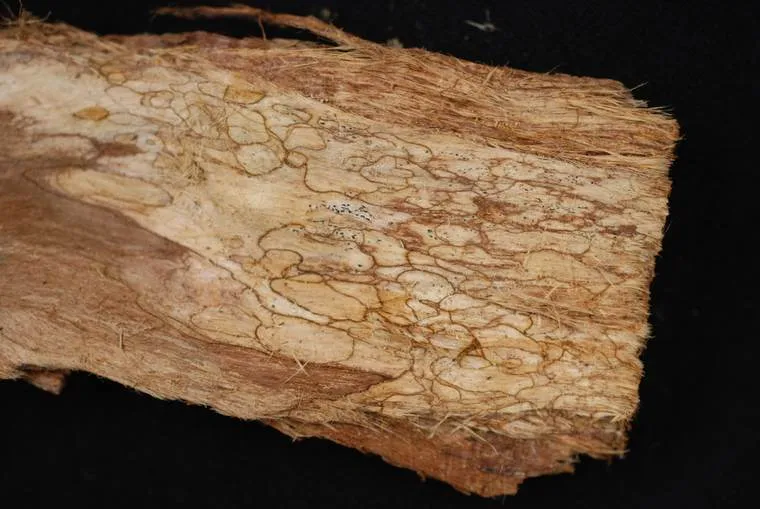
| Brown root rot (Pyrrhoderma noxium) | A gritty brown crust, or stocking, with a white advancing margin | Soft, stringy white rot crossed by a network of dark brown lines |
| Ganoderma butt rot | Shelf-like brackets with a white pore surface, and rusty-brown spore dust | Pale, spongy white rot |
| Phytophthora root rot | No fungal growth; decaying fine roots, sometimes a weeping collar | Dark lesions under the bark at the collar |
| Soil or mulch crusted on the bark | Loose crust that washes or rubs off | Sound wood beneath |
Sources: Business Queensland, Brown root rot; Panchalingam et al. (2025), Microbiology Australia 46.
How to identify brown root rot
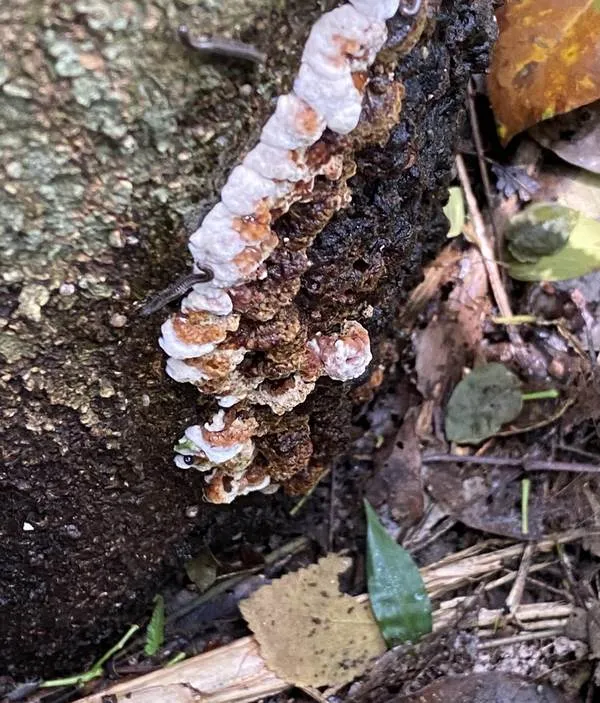
The main sign of brown root rot is a gritty brown crust, called a stocking, on the trunk base and roots, with a white to cream margin where it is actively growing. Not every infected tree develops a stocking, and it is often hidden under soil or mulch, so the base usually needs exposing to find it.
Signs and symptoms of brown root rot
In the crown
- Yellowing leaves
Leaves turn pale yellow, then whitish, as the roots fail. - Thinning crown
The canopy thins and branches die back over months or years. - Wilting and sudden death
Young trees may wilt and die quickly.
At the base and roots
- The stocking
A hard, gritty crust of fungus cemented with soil and stones, white at the margin and cinnamon-brown to black behind it. - Decayed wood
Brown at first, then soft, stringy and pale, crossed by a network of dark brown lines. - Fruiting bodies
Hard, flat, grey-brown crusts or shelves with a pale edge, mostly after prolonged rain.
How to diagnose brown root rot
To diagnose brown root rot, the soil and mulch are cleared from the root collar so the base can be inspected for the stocking, which feels hard and gritty and does not rub off like soil. A sample of decayed wood from the margin of the infection can then be sent to a plant pathology laboratory to confirm it, which matters because removal and disposal decisions follow from the diagnosis.
What trees does brown root rot affect?
Brown root rot affects more than 250 plant species, so almost any tree can be infected, and in Brisbane it is killing many of the city’s most significant street and park trees. Because the host list crosses so many plant families, the type of tree cannot be used to rule it out.
| Tree | Where it has been recorded |
|---|---|
| Moreton Bay fig (Ficus macrophylla) | Heritage park and street trees across Brisbane, the greatest concern |
| Poinciana (Delonix regia) | Brisbane; declined within three months in Taiwanese records |
| Jacaranda (Jacaranda mimosifolia) | Brisbane |
| Chinese elm (Ulmus parvifolia) | Brisbane |
| Moreton Bay ash (Corymbia tessellaris) | Brisbane |
| Hoop pine and kauri (Araucaria cunninghamii, Agathis robusta) | Brisbane |
| Palms, avocado, spotted gums and eucalypts | Listed hosts in Queensland |
Sources: Panchalingam et al. (2025), Microbiology Australia 46; Business Queensland, Brown root rot.
In Brisbane it has been recorded in Shorncliffe, Taringa, New Farm, Eagle Farm, West End, the city centre and areas near the Brisbane River. Across Queensland it occurs from the east coast to northern New South Wales, and is more common in moist areas and near gullies and waterways.
Suspect brown root rot in your tree? We can inspect the base and roots and tell you what's needed.
Book a checkAre trees with brown root rot dangerous?
Trees with brown root rot can be dangerous, because the fungus decays the roots and root collar that hold the tree up. An infected tree can fall over at the base, particularly in a storm on saturated ground, while its crown still looks reasonable.
That makes a confirmed infection a structural matter as well as a health one. A large infected tree over a house, road or play area needs a tree risk assessment, and often a root investigation to see how much of the root plate has been lost.
When brown root rot is most active in South East Queensland
Brown root rot is active year-round in South East Queensland, because the decay continues inside the roots regardless of season. The fungus grows best at temperatures close to 30°C, which is why it is a problem in subtropical and tropical regions, and its fruiting bodies appear mainly after prolonged rain.
How brown root rot spreads
Brown root rot spreads mainly through root contact, passing from an infected tree to the roots of its neighbours. It also spreads from infected stumps and root fragments left in the ground, which can stay infectious for many years, and occasionally by airborne spores entering wounds.
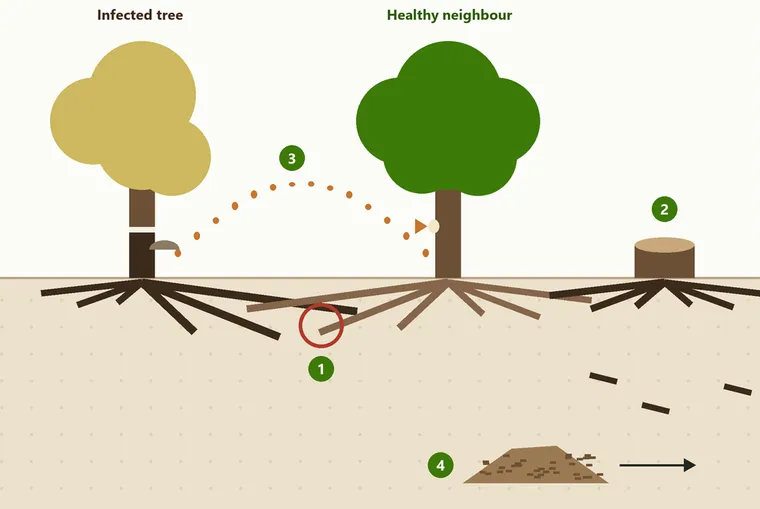
- Root contact – the main route: infected roots touch a neighbouring tree’s roots.
- Stumps and roots – stay infectious for years if left in the ground.
- Airborne spores – occasionally, from fruiting bodies into fresh wounds.
- Moved mulch and soil – chips and soil from an infected site carry it to new gardens.
Moving infected material spreads it further: chipped wood, mulch and soil from an infected site can carry the fungus to new gardens. Root contact explains why it moves outward from one tree, and why avenues of street trees often lose trees one after another.
How to treat brown root rot
Brown root rot is treated by removing the infected tree with its stump and major roots, and disposing of the material safely, within an integrated pest management (IPM) approach. No treatment cures an infected tree, so the aim is to stop the disease spreading to neighbouring trees and new plantings.
Removing the tree, stump and roots
Most effective
What it is
Removing the infected tree together with its stump and as many of its roots as possible.
How it works
The fungus lives in the wood, and infected stumps and root fragments remain a source of infection for years. Grinding the stump below ground level is not enough on its own: excavating the major roots is what removes most of the fungus from the site.
Effectiveness
The most effective measure, and the one Queensland Government guidance leads with. It protects neighbouring trees as well as replanting on the site.
Safe disposal of infected material
Essential
What it is
Keeping infected wood, roots and chips out of mulch and green waste, unless properly composted.
How it works
Queensland Government guidance is that infected material is composted for at least 16 weeks, turned regularly, so the piles reach 75°C, with anything over 18 mm sieved out before use. Chipping an infected tree into mulch spreads the fungus to every garden the mulch reaches.
Effectiveness
Essential on every brown root rot job. Never accept mulch from an infected tree, and tell your green waste receiver what the material is.
Protecting neighbouring trees
Supporting
What it is
Keeping nearby trees healthy and avoiding moving the fungus to them.
How it works
Root-to-root contact is the main way the disease moves between trees. Mulching, watering and avoiding root damage keep neighbours vigorous, and cleaning boots, tools and machinery stops soil and wood being carried from the infected tree.
Effectiveness
Reduces stress on the trees most at risk, but cannot stop roots already in contact with the infection.
Root barriers
Limited
What it is
A physical barrier in the ground between an infected tree and healthy ones.
How it works
Because the disease spreads through root contact, a deep, continuous barrier can break the path between infected and healthy roots.
Effectiveness
Listed by the Queensland Government as a possible measure, but noted as possibly ineffective. Depth and continuity are everything, and a partial barrier achieves little.
Biological control
Experimental
What it is
Applying beneficial microorganisms, Trichoderma fungi and actinomycete bacteria, that suppress the fungus.
How it works
In research with Brisbane City Council, a combined Trichoderma and actinomycete treatment suppressed brown root rot in glasshouse and field trials, and the fungus was not recovered from treated roots. Each agent alone only held it back.
Effectiveness
Genuinely promising for protecting soil and slowing the disease, but still at the research stage, and not a cure for an infected mature tree.
Fungicides and injection
Not effective
What it is
Spraying, drenching or injecting an infected tree with a fungicide.
How it works
The fungus is established in the roots and root collar, inside the wood, which is exactly where injected or applied products reach worst.
Effectiveness
There is no established treatment that cures an infected tree. Cutting off the crust does not help either, as the fungus is in the wood beneath it.
How to prevent brown root rot
Preventing brown root rot relies on keeping infected wood and soil away from healthy trees, and keeping trees healthy enough to resist infection. Most new outbreaks start from infected material being moved, or from roots left behind.
- Never use mulch from an unknown or diseased tree, unless it has been properly composted.
- Remove stumps and major roots when an infected tree comes down.
- Clean boots, tools and machinery after working around an infected tree.
- Avoid root and trunk damage, compaction and planting too deep, all of which make urban trees more vulnerable.
Is brown root rot killing your fig tree?
Brown root rot is one of the most serious threats to fig trees in Brisbane, and the Moreton Bay fig is the species of greatest concern. A fig with brown root rot may decline slowly over many years, so a thinning crown on a large fig should not be dismissed as age or drought.
- Check the base – look for a gritty brown crust with a pale margin on the trunk base or roots, under any soil or mulch.
- Watch the crown – pale, yellowing leaves and thinning on a fig that was once dense.
- Look at the neighbours – nearby trees declining in sequence point to a disease spreading through the roots.
Because a large fig over a house or street is a structural risk once its roots are infected, have it assessed early through a tree health assessment.
Brown root rot: common questions
Can a tree recover from brown root rot?
Rarely. There is no established treatment that cures an infected tree, and the disease is usually fatal once it is established in the roots and collar. How long a tree takes to decline varies enormously: in Taiwan, infected poincianas declined within three months, while a fig took twenty years.
Is brown root rot contagious to other trees?
Yes. It spreads mainly through root contact, so it moves outward from an infected tree to its neighbours, and avenue plantings often lose trees one after another. It also spreads from infected stumps and roots left in the ground, and occasionally by airborne spores entering wounds.
Can I use mulch from a tree with brown root rot?
No. Chipping an infected tree into mulch spreads the fungus wherever the mulch goes. Queensland Government guidance is that infected material is composted for at least 16 weeks, turned regularly, so the piles reach 75°C, before any use.
How long does brown root rot stay in the ground?
For years, in the wood rather than the soil. Research found it can survive in dead plant material for ten years, with a 50% survival rate, and Queensland Government guidance notes that infected root fragments can remain a source of infection for decades. Removing the stump and major roots is what clears a site.
Is Phellinus noxius the same as brown root rot?
Yes. Phellinus noxius is the older name for the fungus that causes brown root rot, and it is still the name used in most Queensland material. Its current scientific name is Pyrrhoderma noxium.
What should I do if a council tree has brown root rot?
Contact your local council, which the Queensland Government advises for brown root rot found on council land. Do not take wood, chips or soil from the tree.
References
General information, not a diagnosis. Many tree problems look alike, and only an inspection, and sometimes a laboratory test, can confirm what is wrong. Any treatment product must be registered for the use and applied strictly to its label.