
Leaf diseases South East Queensland
Frangipani Rust: Symptoms, Causes and Treatment
Frangipani rust is a fungal disease that covers the undersides of frangipani leaves in orange spores and strips the tree early, and South East Queensland's humid summers suit it perfectly. This guide shows you what frangipani rust does, how to identify frangipani rust and how to treat frangipani rust.
- What it is
- A rust fungus that attacks frangipani leaves
- Scientific name
- Coleosporium plumeriae
- Trees affected
- Frangipanis only (Plumeria), especially white and white-and-yellow varieties
- Peak season
- Summer and autumn, in warm, humid weather, until the leaves fall
- How it spreads
- Wind-blown spores, infected leaf litter and cuttings
- Key sign
- Orange powdery spots under the leaves, with yellow-brown patches above
- Think your frangipani has rust?
- We'll check it and tell you what will help. Book a check →
What is frangipani rust?
Frangipani rust is a fungal disease, caused by Coleosporium plumeriae, that infects frangipani leaves, covering their undersides in orange spores and making them drop early. It attacks only frangipanis, and has spread from the Caribbean to most places they are grown, reaching Australia by the mid-1990s.
- GroupRust fungiFungi that live only on living plants
- GenusColeosporiumRusts of many plant groups
- SpeciesColeosporium plumeriaeFrangipani rust, attacking only Plumeria
How frangipani rust damages a tree
Frangipani rust feeds on the leaves without infecting the stems or flowers, so it weakens the tree rather than killing it. Heavily infected leaves curl, dry and fall, and in a bad season a tree can lose almost all its leaves well before winter. With fewer leaves the tree makes less energy, so it grows more slowly and flowers less the following season.
How to identify frangipani rust
The main sign of frangipani rust is orange powdery spots on the undersides of the leaves, with matching yellow to brown patches on top. The powder rubs off on your fingers, and it is the easiest way to tell rust from the normal yellowing of leaves before winter.
Signs and symptoms of frangipani rust
Top of the leaf
- Yellow flecks
Small pale yellow spots, the first sign, directly above developing pustules. - Brown patches
The spots join up and turn into sunken, angular, grey-brown dead areas. - Curling and leaf drop
Heavily infected leaves dry, curl and fall early.
Underside of the leaf
- Orange pustules
Raised, powdery, yellow-orange spots, often in thousands on one leaf. - Orange powder
Spores that rub off on a finger or tissue. - Darker spots late in the season
Older infections can turn brown as the pustules age.
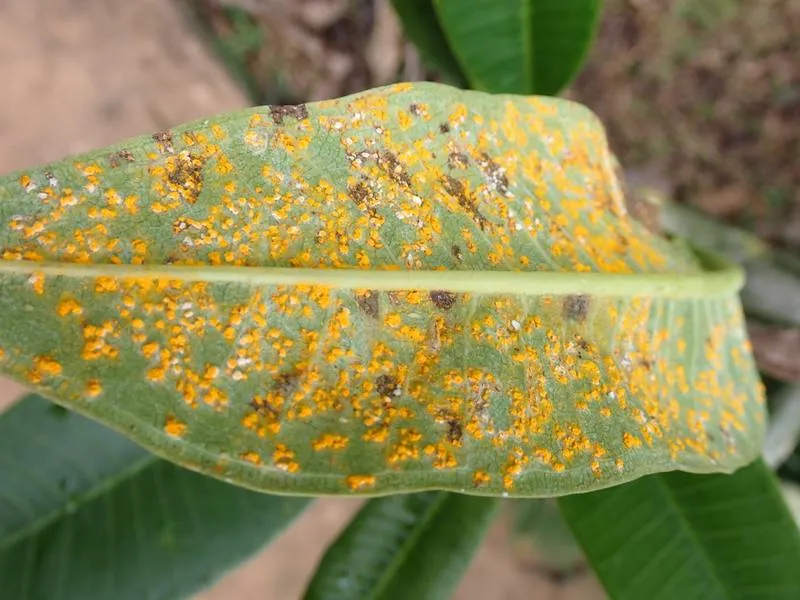
How to diagnose frangipani rust
To diagnose frangipani rust, turn the leaf over and look for raised orange pustules, then wipe one with a tissue: rust leaves an orange powder. The plant must be a frangipani, as other plants have their own rusts, and leaves that yellow evenly without any powder are usually just the normal leaf drop before winter.
Which frangipanis does rust affect?
Frangipani rust affects only frangipanis (Plumeria), including at least eight species and forms, but varieties range from highly susceptible to highly resistant. In South East Queensland gardens, the common white-and-yellow frangipani is among the worst affected.
| Frangipani | How badly it is affected | Notes |
|---|---|---|
| White and white-and-yellow varieties | Severe | Commonly reported as the most susceptible, often stripped by autumn |
| Many pink and red varieties | Lower | Generally reported as more tolerant, though it varies by cultivar |
| Evergreen frangipani (Plumeria obtusa) | Varies | A recorded host; reports of its tolerance conflict |
| Young plants and cuttings | Most at risk | Have few leaves to lose, so early leaf loss sets them back most |
Sources: Scheck (2020), California Department of Food and Agriculture; Jackson and McKenzie, Pacific Pests, Pathogens and Weeds.
Suspect rust on your frangipani? We can check whether it's rust or something more serious.
Book a checkWhen frangipani rust is most active in South East Queensland
In South East Queensland, frangipani rust is most active through the warm, humid summer and autumn, and it is usually most noticeable from late summer until the leaves fall. The spores need a wet leaf surface to infect, so wet weeks, heavy dew and shady positions all make it worse.
The disease winds down when the tree drops its leaves in winter, but the fungus survives on fallen and lingering infected leaves, ready to infect the new growth when the weather warms.
How frangipani rust spreads
Frangipani rust spreads on the wind. Each pustule releases large numbers of spores, which blow onto nearby leaves and trees and infect wherever they land on a wet surface. Over longer distances it travels in infected cuttings and plants, which is how it spread around the world through the trade in frangipanis.
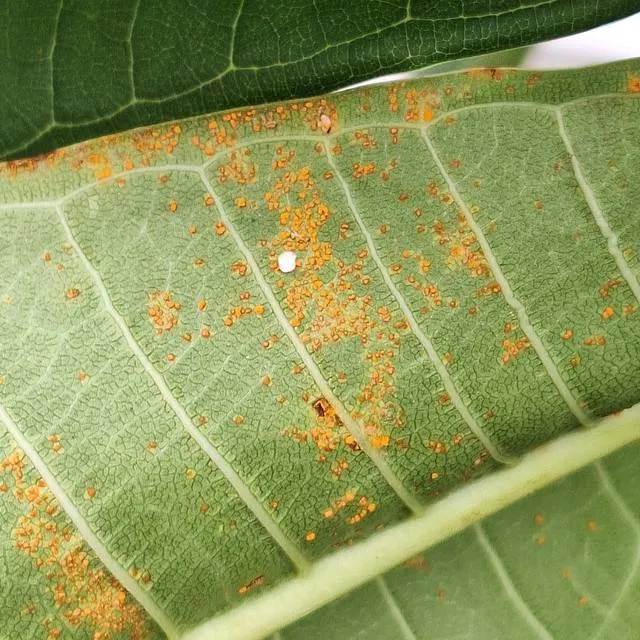
How to treat frangipani rust
Frangipani rust is treated by clearing infected leaves, opening up the canopy and keeping the foliage dry, within an integrated pest management (IPM) approach. It cannot be eradicated, because the spores travel on the wind, so the aim is to keep it at a level the tree can live with.
Clearing infected and fallen leaves
Most effective
What it is
A cultural control: picking off badly infected leaves and clearing fallen ones from under the tree, then bagging them for the bin.
How it works
The rust survives on infected leaves and leaf litter, and each pustule releases thousands of spores to start the next cycle. Removing that material takes away most of the spores that would reinfect the new leaves in spring.
Effectiveness
The most effective measure in a home garden, particularly in autumn as the leaves fall and before new growth in spring. Infected leaves should go in the bin, not the compost.
Pruning for airflow and sun
Effective
What it is
A cultural control: opening up the canopy, and keeping frangipanis out of dense shade.
How it works
Rust spores need a wet leaf surface to germinate, and the disease is worst in shady, humid positions. Thinning crowded branches, and not crowding the tree with other plants, lets the leaves dry quickly after rain and dew.
Effectiveness
Reduces how severe the rust becomes each season, though it will not stop infection in a wet summer.
Watering at the base
Supporting
What it is
A cultural control: keeping irrigation off the leaves.
How it works
Overhead sprinklers wet the foliage and give spores the moisture they need. Watering at the base, in the morning, keeps the leaves dry for longer.
Effectiveness
A simple support to the measures above. It cannot control rainfall or humidity in a South East Queensland wet season.
Choosing tolerant varieties
Long term
What it is
A cultural control: planting frangipani varieties that hold their leaves better against rust.
How it works
Frangipani varieties range from highly susceptible to highly resistant. Growers commonly report the white-flowered and white-and-yellow types as the worst affected, and many pink and red types as more tolerant.
Effectiveness
The long-term answer where rust strips a tree every year. Tolerance varies between individual cultivars, so it is worth asking a specialist grower about a particular variety.
Fungicide
Limited
What it is
A chemical control: a fungicide applied to protect the leaves.
How it works
Protectant fungicides cover the leaf surface before spores arrive, so they have to be applied before infection and repeated as the season goes on. Any product must be registered or permitted for that use and applied strictly to its label.
Effectiveness
Practical in nurseries and on small plants. On a large garden frangipani it is rarely worthwhile, because the canopy cannot be covered properly and spores keep arriving on the wind.
How to prevent frangipani rust
Preventing frangipani rust relies on giving the tree sun and airflow, keeping its leaves dry, and not giving the spores a place to survive. A tree in an open, sunny position with clean ground beneath it is far less affected than one in shade.
- Plant in full sun, with space around the tree for air to move.
- Take cuttings only from healthy trees, and check new plants for orange powder under the leaves.
- Clear fallen leaves in autumn and winter, and bin them rather than composting them.
- Choose tolerant varieties where rust is a recurring problem.
Is rust killing your frangipani?
Rust is rarely what kills a frangipani: it strips the leaves early and weakens the tree, but the tree usually recovers with its next flush. If a frangipani is genuinely declining, look for other causes, particularly soft, blackened or shrivelled branches, which point to stem rot, often after a wet winter or waterlogged soil.
- Leaves only – orange powder and early leaf drop, with firm, healthy branches, is rust, and the tree will reshoot.
- Branches affected – soft, wrinkled, black or weeping branch tips are not rust, and need attention.
- Whole tree declining – thinning and dieback year after year suggests a root or drainage problem.
Where branches are rotting or the tree is declining over several seasons, a tree health assessment can find the cause.
Frangipani rust: common questions
Will frangipani rust kill my tree?
Rarely. Rust fungi need a living host, and frangipani rust does not infect the stems or flowers. It strips the leaves early, which weakens the tree and reduces flowering, and young plants can be set back, but an established frangipani usually recovers with the next flush of leaves.
How do I get rid of frangipani rust?
It cannot be removed from an area, because the spores travel on the wind, but it can be reduced. Clear and bin fallen and badly infected leaves, open up the canopy so the leaves dry quickly, water at the base, and choose tolerant varieties where a tree is stripped every year.
Should I cut off leaves with frangipani rust?
Removing the worst-affected leaves, and clearing fallen ones, reduces the spores that start the next cycle. Bag them for the bin rather than composting them. There is no need to strip every spotted leaf, as the tree drops its leaves in winter anyway.
Is frangipani rust the same as myrtle rust?
No. Frangipani rust, Coleosporium plumeriae, attacks only frangipanis, and myrtle rust attacks only the Myrtaceae, such as lilly pillies and eucalypts. They look similar but are different fungi and cannot spread to each other's hosts.
Why are my frangipani leaves turning yellow with orange spots?
Yellow patches on top of the leaf with orange powder underneath is almost always frangipani rust. Yellowing without the orange powder has other causes, including the normal leaf drop before winter, cold, and waterlogged soil.
Can I spray frangipani rust?
A fungicide can protect the leaves, but only if applied before infection and repeated through the season, and any product must be registered or permitted for that use and applied to its label. On a large garden tree it is rarely worthwhile; clearing infected leaves and improving airflow do more.
References
- Jackson, G., & McKenzie, E. Frangipani rust (Fact sheet 243). Pacific Pests, Pathogens and Weeds. Source
- Kakishima, M., et al. (2017). Geographic expansion of a rust fungus on Plumeria in Pacific and Asian countries. New Zealand Journal of Botany, 55. Source
- Scheck, H. (2020). California Pest Rating Proposal for Coleosporium plumeriae. California Department of Food and Agriculture. Source
General information, not a diagnosis. Many tree problems look alike, and only an inspection, and sometimes a laboratory test, can confirm what is wrong. Any treatment product must be registered for the use and applied strictly to its label.