
Insects South East Queensland
Leaf Beetles on Trees: Identification and Treatment
Leaf beetles are beetles whose adults and larvae chew the leaves of trees, and in South East Queensland they include eucalyptus leaf beetles, Christmas beetles and the swarming beetles that strip new growth after rain. This guide shows you what leaf beetles do, how to identify leaf beetles on trees and how to treat leaf beetles.
- What it is
- Beetles whose adults and larvae chew the leaves of trees
- Scientific name
- Many beetles, including Paropsis, Paropsisterna and Anoplognathus
- Trees affected
- Eucalypts, especially young trees, figs, lemon-scented gum and fruit trees
- Peak season
- Summer and autumn; Christmas beetles in summer, swarming beetles after rain
- How it spreads
- Flying adults, often in swarms, from soil and pasture where the larvae develop
- Key sign
- Leaves with scalloped or ragged edges, often with beetles or yellow-green larvae on new growth
- Beetles eating your tree?
- We'll tell you what they are and if the tree needs help. Book a check →
What are leaf beetles?
Leaf beetles are beetles whose adults, and often larvae, chew the leaves of trees. In South East Queensland the main ones are the eucalyptus leaf beetles and tortoise beetles, Christmas beetles, and the red-shouldered and swarming leaf beetles that strip new growth after rain, and they do most harm to young trees.
- KingdomAnimaliaAnimals
- OrderColeopteraThe beetles
- FamiliesChrysomelidae and ScarabaeidaeLeaf beetles, and the scarabs that include Christmas beetles
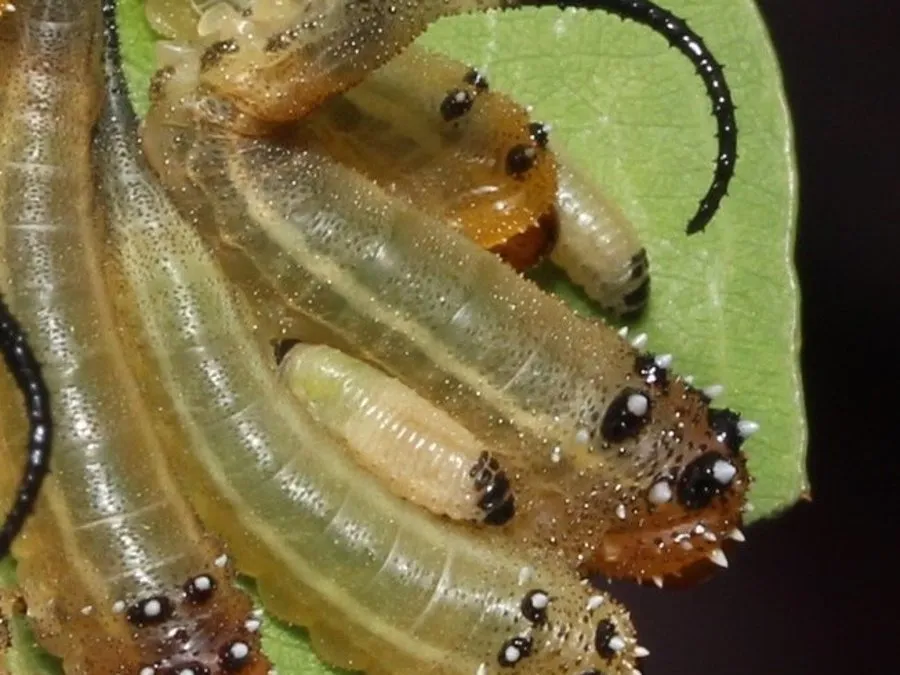
How leaf beetles damage a tree
Leaf beetles damage a tree by eating its leaves, especially the soft new growth. Clusters of larvae can consume whole leaves in the crowns of young trees, and repeated defoliation stunts growth and can stop the main stem outgrowing the side shoots, giving a bushy “broom top”. Established trees usually recover; trees under about three years old are most at risk.
Types of leaf beetles on trees
The leaf beetles on South East Queensland trees range from small, dome-shaped beetles that feed in clusters on gums to large Christmas beetles and swarming beetles that arrive after rain. Each leaves its own feeding pattern, which helps tell them apart.
| Beetle | What it looks like | Main trees | Damage |
|---|---|---|---|
| Eucalyptus tortoise and leaf beetles (Paropsis, Paropsisterna) | Dome-shaped, under 10 mm, speckled or orange, like ladybirds with longer antennae; yellow-green larvae | Rose gum, blackbutt, forest red gum, spotted gum and other eucalypts | Larvae strip new growth; adults leave scalloped leaf edges |
| Flea beetles (Chaetocnema) | Tiny, 1.5 to 3 mm, shiny black, jumping | Eucalypts, wattles, shrubs | Leaves etched as if blasted by a shotgun, mostly in winter |
| Christmas beetles (Anoplognathus) | Large, 15 to 30 mm, shiny yellow-brown to red-brown | Spotted gum, rose gum, forest red gum and other eucalypts | Swarms tear jagged, ripped edges in leaves |
| Red-shouldered leaf beetle (Monolepta australis) | About 6 mm, yellow with red patches on the shoulders | Eucalypts, macadamia, avocado, mango, lychee, ornamentals | Swarms skeletonise new flushes within hours |
| Swarming leaf beetles (Rhyparida) | Small, 3 to 5 mm, shiny brown or black | Cadaghi, lemon-scented gum, fruit trees | New shoots look burnt |
| Fig leaf beetle (Poneridia semipullata) | Slender, tan beetle with long antennae | Figs, pittosporum | Larvae skeletonise older leaves |
Sources: Business Queensland, Leaf beetles, Christmas beetle, Red-shouldered leaf beetle and Swarming leaf beetles; Herbison-Evans and Crossley, Poneridia semipullata.
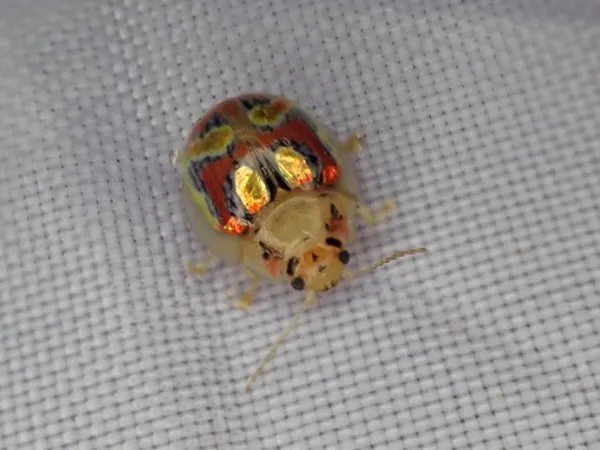
Eucalyptus leaf beetle
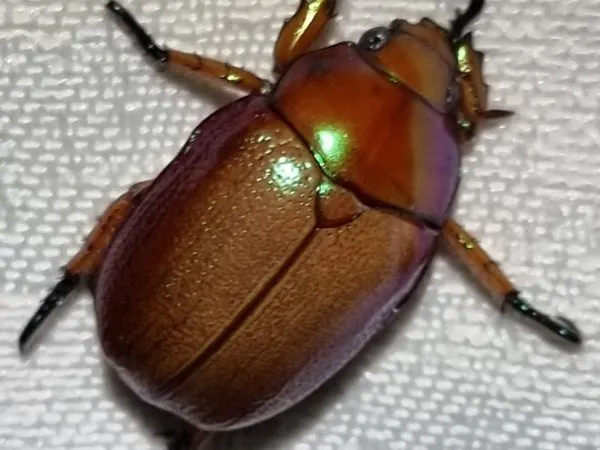
Christmas beetle
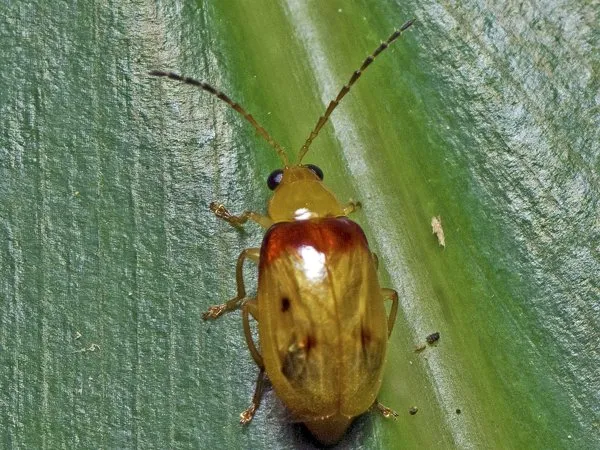
Red-shouldered leaf beetle
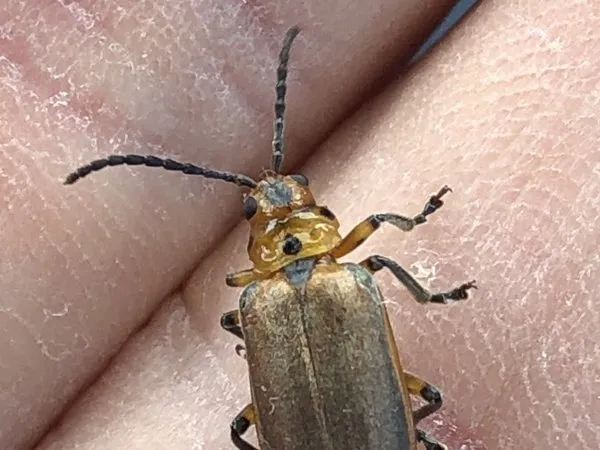
Fig leaf beetle
How to identify leaf beetles on trees
The main sign of leaf beetles is leaves with scalloped, ragged or skeletonised edges, often with beetles or clusters of larvae on the new growth. The feeding pattern points to the beetle: scalloped edges for leaf beetles, jagged tears for Christmas beetles, and burnt-looking shoots for swarming beetles.
Signs and symptoms of leaf beetles
Early signs
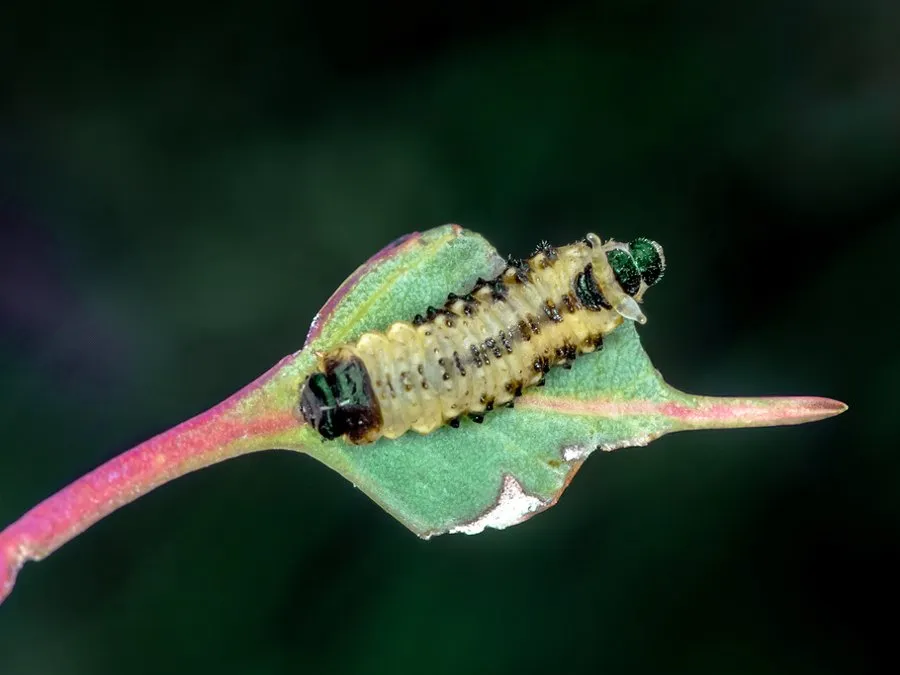
- Scalloped leaf edges
Curved bites out of the edges of mature leaves. - Clusters of larvae
Yellow-green larvae feeding together on new shoots. - Summer swarms
Christmas beetles feeding together in the crown in summer.
Heavy damage
- Stripped new growth
Young shoots eaten back, or looking burnt after a swarm. - Broom-top crowns
Bushy, many-stemmed tops on repeatedly defoliated young trees. - Bare young trees
Whole young eucalypts stripped after a summer swarm.
How to diagnose leaf beetles
To diagnose leaf beetles, look at the bite pattern and then for the insects: scalloped edges and yellow-green larvae on new growth point to eucalyptus leaf beetles, jagged tears in mature leaves to Christmas beetles, and shotgun-like etching to flea beetles. Eucalyptus weevils are the main look-alike: their slug-like larvae trail a thread of droppings and leave long, window-like tracks in new leaves. Do not mistake a ladybird for a leaf beetle: ladybirds have short antennae and eat pests.
What trees do leaf beetles attack?
Leaf beetles mostly attack eucalypts in South East Queensland, especially young trees, and some species also attack figs, fruit trees and ornamentals. Rose gum, blackbutt, forest red gum and spotted gum are among their main hosts.
- Young eucalypts – eucalyptus leaf beetles and Christmas beetles, most damaging on trees under about three years old.
- Lemon-scented gum and cadaghi – swarming leaf beetles and red-shouldered leaf beetles.
- Figs – the fig leaf beetle.
- Fruit trees – red-shouldered and swarming leaf beetles on macadamia, avocado, mango and lychee.
- Paperbarks – Oxyops weevils on broad-leaved paperbarks.
Suspect beetles are eating your tree? We can tell you what they are and if the tree needs help.
Book a checkWhen leaf beetles are most active in South East Queensland
In South East Queensland, leaf beetles are most active in summer and autumn. Eucalyptus leaf beetles usually defoliate trees twice a year, in late December to early January and in late March to May, and in South East Queensland up to four generations a year can cause three or more peaks.
Christmas beetles emerge from the soil in summer, often after rain. Red-shouldered leaf beetles emerge after good rains following a dry spell, and swarming leaf beetles after the first storms of spring and summer. Flea beetle damage is most evident in winter.
Sources: Business Queensland, Leaf beetles, Christmas beetle, Red-shouldered leaf beetle and Swarming leaf beetles.
How leaf beetles spread
Leaf beetles spread as flying adults, which move between trees and, for Christmas beetles and swarming beetles, arrive in swarms. Many of them spend their larval life in the soil: Christmas beetle, red-shouldered and swarming beetle larvae feed on grass roots in pasture and lawn, so trees next to pasture are hit hardest.
- Swarms after rain – rain triggers adults to emerge from the soil together.
- Pasture next door – larvae develop in grassland, then the adults fly to nearby trees.
- Generations on the tree – eucalyptus leaf beetles lay eggs on leaves and stems, and their larvae drop to pupate in the soil below.
How to treat leaf beetles
Leaf beetles are treated by letting natural predators work, removing beetles and larvae by hand on small trees, and helping young trees through, within an integrated pest management (IPM) approach. On established trees, treatment is rarely needed.
Natural predators
Most effective
What it is
A biological control: the insects, spiders and birds that eat leaf beetles.
How it works
Shield bugs, ladybirds, wasps, spiders and tachinid flies attack eucalyptus leaf beetles, and possums, currawongs, magpies and predatory wasps eat Christmas beetles. Broad-spectrum sprays kill these predators along with the beetles.
Effectiveness
Keeps beetle numbers in check on most established trees without any help.
Hand removal on small trees
Effective
What it is
A physical control: collecting beetles and larvae, scraping off eggs and hosing larvae off the leaves.
How it works
For ornamentals and small numbers of young trees, Business Queensland suggests collecting adults and larvae into soapy water, scraping eggs off the shoots and hosing larvae off the foliage.
Effectiveness
Very effective on young trees and small ornamentals within reach, which are the trees leaf beetles hurt most.
Choosing less susceptible trees
Supporting
What it is
A cultural control: planting eucalypts that beetles attack less, especially next to pasture.
How it works
Business Queensland notes that western white gum (E. argophloia) and Gympie messmate (E. cloeziana) are less commonly affected by Christmas beetles. Cadaghi and lemon-scented gum attract swarming and red-shouldered beetles, which matters when planting near fruit trees.
Effectiveness
Useful when planting new trees in high-risk spots, such as rural blocks next to grassland.
Helping young trees through
Supporting
What it is
A cultural control: watering, mulching and checking young trees during the beetle season.
How it works
Young trees under about three years old suffer most. Checking them through summer and autumn catches clusters early, and watering and mulching helps them regrow after feeding.
Effectiveness
Gets young trees past the stage when beetles do lasting damage to their form.
Insecticides
Last resort
What it is
A chemical control: an insecticide registered for the beetle on that tree.
How it works
For red-shouldered and swarming leaf beetles in orchards, Business Queensland limits spraying to when beetles are active and damage is evident, with care for bees at flowering. Any product must be registered for the use and applied to its label.
Effectiveness
Rarely worthwhile on garden and street trees, and it kills the predators that control leaf beetles.
How to prevent leaf beetle damage
Preventing leaf beetle damage relies on protecting young trees through their first few years and keeping natural predators working. Established trees rarely need protecting at all.
- Check young trees through summer and autumn for clusters of larvae and eggs.
- Remove clusters early by hand, into soapy water.
- Avoid broad-spectrum sprays, which kill ladybirds, wasps and other predators.
- Choose less susceptible eucalypts for new plantings next to pasture.
- Water and mulch young trees so they recover quickly from feeding.
Leaf beetles: common questions
What is eating holes in my gum tree leaves?
Gum leaves with scalloped or ragged edges are usually being eaten by leaf beetles, Christmas beetles or eucalyptus weevils, and leaves grazed to the veins by caterpillars or sawfly larvae. Look on the new growth for clusters of yellow-green larvae, or in summer for swarms of Christmas beetles in the crown.
What are the beetles that look like ladybirds on my gum tree?
Dome-shaped, speckled or patterned beetles on gum leaves are usually eucalyptus tortoise beetles or eucalyptus leaf beetles. Business Queensland notes they look like ladybirds but have longer antennae, and that telling them apart matters, because ladybirds are beneficial insects that eat pests.
Why are the edges of my gum leaves scalloped?
Scalloped, curved bites out of the edges of mature gum leaves are the typical feeding pattern of adult leaf beetles and eucalyptus weevils. Christmas beetles leave more jagged, ripped edges. On an established tree this is usually cosmetic.
Do Christmas beetles damage trees?
They can, mainly young trees. Christmas beetles emerge from the soil in summer, often after rain, and swarms can strip young eucalypts quickly, especially near pasture where their larvae develop. Young trees up to about three years old are most at risk, and native predators such as possums, magpies and currawongs help keep them in check.
What are the yellow beetles swarming on my tree after rain?
Small yellow beetles with red patches on the shoulders, swarming on new growth after rain, are red-shouldered leaf beetles. Business Queensland notes they emerge after good rains following a dry spell, and that swarms can do serious damage to new growth within two to three hours before moving on.
What is skeletonising my fig leaves?
Fig leaves stripped to a skeleton of veins, usually the older leaves, are often the work of the fig leaf beetle, whose larvae graze the leaf surfaces while the adults chew the edges. Damage can be extensive on small, shrubby figs.
Should I spray for leaf beetles?
Usually not on an established tree. Leaf beetles mostly damage young trees, and natural predators such as ladybirds, shield bugs, wasps, spiders and birds keep them in check. On small trees, Business Queensland suggests collecting the beetles and larvae into soapy water, scraping off eggs and hosing larvae off instead.
References
- Business Queensland. Leaf beetles. Source
- Business Queensland. Christmas beetle. Source
- Business Queensland. Eucalyptus weevils. Source
- Business Queensland. Red-shouldered leaf beetle (Monolepta australis). Source
- Business Queensland. Swarming leaf beetles (Rhyparida). Source
- Herbison-Evans, D., & Crossley, S. Poneridia semipullata (fig leaf beetle), Australian Caterpillars and their Butterflies and Moths. Source
General information, not a diagnosis. Many tree problems look alike, and only an inspection, and sometimes a laboratory test, can confirm what is wrong. Any treatment product must be registered for the use and applied strictly to its label.