
Other South East Queensland
Mistletoe in Trees: Identification and Control
Mistletoe is a native plant that grows on the branches of trees, drawing water and nutrients from its host, and around 36 species grow in South East Queensland, mostly on eucalypts, wattles and sheoaks. This guide shows you what mistletoe does to a tree, how to identify mistletoe and how to control mistletoe in trees.
- What it is
- A native plant that grows on tree branches and takes water and nutrients from them
- Scientific name
- Loranthaceae, mainly Amyema and Dendrophthoe
- Trees affected
- Eucalypts, wattles, sheoaks, bottlebrushes and many other trees
- Peak season
- Year-round; most noticeable when it flowers
- How it spreads
- Seeds carried by birds, especially the mistletoebird, and left stuck to branches
- Key sign
- Clumps of leaves that differ from the tree's own, often drooping, with red or orange tubular flowers
- Worried about mistletoe in your tree?
- We'll tell you if it's a problem and what to do. Book a check →
What is mistletoe?
Mistletoe is a native plant that grows on the branches of trees and shrubs, attached by a modified root called a haustorium that taps into the tree’s water supply. Australia has 89 species of mistletoe, around 36 of them in South East Queensland, and most belong to the Loranthaceae, the family of showy, flowering mistletoes.
- KingdomPlantaePlants
- OrderSantalalesThe sandalwood order, home of the mistletoes
- FamilyLoranthaceaeMost Australian mistletoes
Sources: Australian National Botanic Gardens, Taxonomy; Land for Wildlife South East Queensland.
How mistletoe affects a tree
Mistletoe affects a tree by taking water and dissolved nutrients from its branches. Most mistletoes have green leaves and make their own sugars, so they are partial parasites. The haustorium often restricts the flow along the branch beyond it, so that part of the branch can die, leaving the mistletoe at the tip. A heavy load of mistletoe adds to the strain on a tree that is already stressed.
Source: Australian National Botanic Gardens, What is a mistletoe?
Types of mistletoe in South East Queensland
The mistletoes in South East Queensland range from generalists that grow on almost any tree to specialists that grow on only one, and many closely mimic the leaves of their usual host. Common mistletoes in the region include the long-flowered mistletoe, box mistletoe and variable mistletoe.
| Mistletoe | What it looks like | Main hosts |
|---|---|---|
| Long-flowered or yellow-flowered mistletoe (Dendrophthoe vitellina) | Broad leaves; long, tubular orange-red and yellow flowers | A generalist, recorded on about 100 host species |
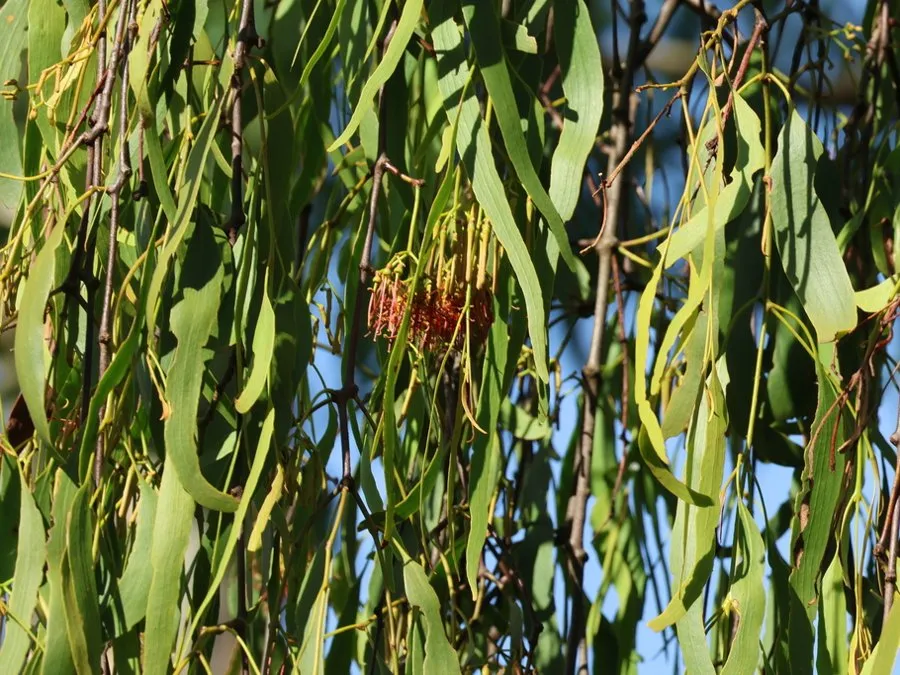
| Box mistletoe (Amyema miquelii) | Long, drooping leaves like a eucalypt’s; red flowers in clusters | Mainly eucalypts and wattles |
| Variable mistletoe (Amyema congener) | Leaves vary in shape; red to orange flowers | Wattles, sheoaks, bottlebrushes, other mistletoes and exotic trees |
| Coast mistletoe (Muellerina celastroides) | Thick, oval, leathery leaves | Hosts not well recorded; its genus grows mainly on eucalypts and wattles |
| Mangrove mistletoe (Amyema mackayensis) | Round, fleshy leaves that blend with the mangrove | Grey mangrove only |
Sources: Land for Wildlife South East Queensland; Australian Native Plants Society, Amyema miquelii; Australian National Botanic Gardens, Cryptic mimicry of their hosts.
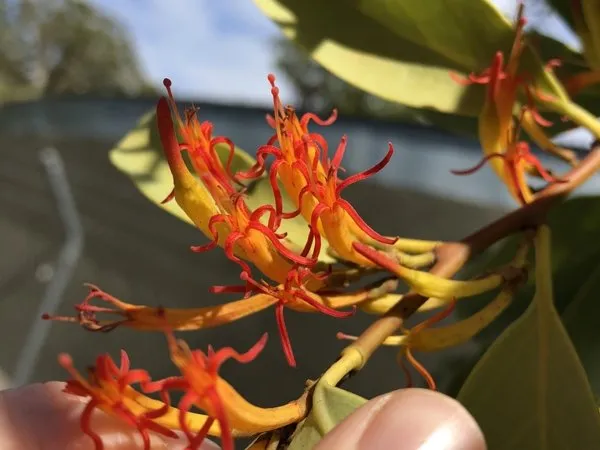
Long-flowered mistletoe
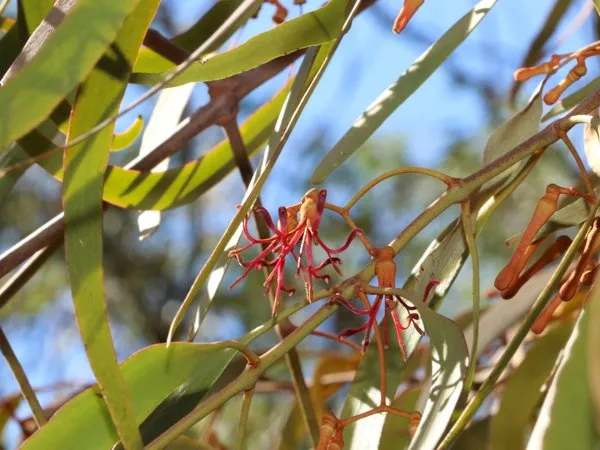
Box mistletoe
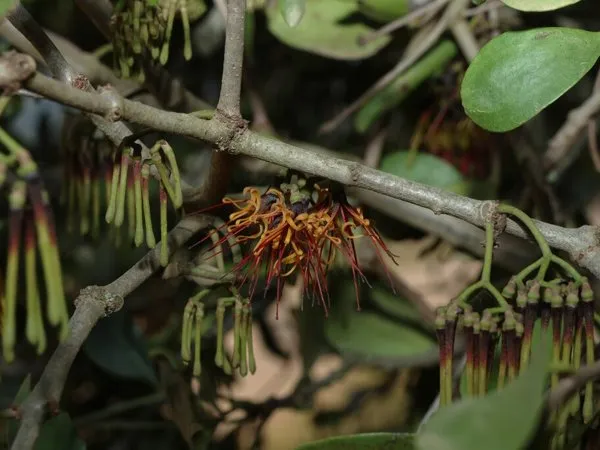
Variable mistletoe
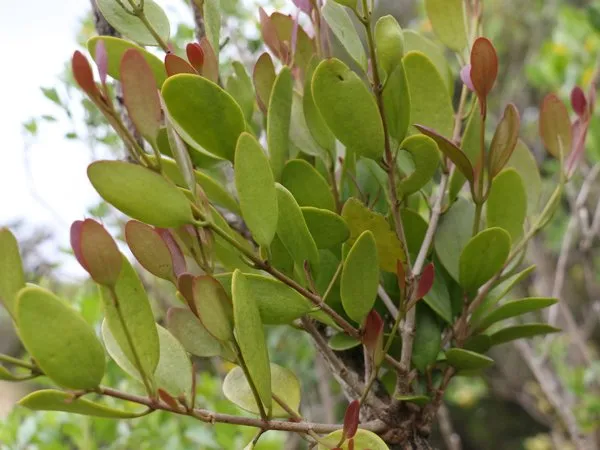
Coast mistletoe
How to identify mistletoe
The main sign of mistletoe is a clump of leaves hanging from a branch that looks slightly different from the rest of the tree, usually more drooping, a different green, or a different leaf shape. Because many Australian mistletoes mimic their host, the easiest way to confirm one is to find where it joins the branch.
Signs and symptoms of mistletoe
Early signs
- Odd clumps of leaves
A bunch of foliage that hangs differently from the tree’s own. - Tubular flowers
Red, orange or yellow tube-shaped flowers among the leaves. - Mistletoebirds
Small black and red birds feeding in the same spot.
Heavy infestation
- Many clumps
Mistletoe through much of the crown. - Dead branch tips
The branch dying beyond where the mistletoe attaches. - Thinning canopy
Less of the tree’s own foliage, often on a stressed or isolated tree.
How to diagnose mistletoe
To diagnose mistletoe, follow the clump back to the branch: a mistletoe grows from a single point, often with a swelling where its haustorium has grown into the wood. The tree’s own regrowth grows from buds along the branch instead, and ferns and orchids sit on the bark without growing into it. Flowers and small sticky berries confirm it.
What trees does mistletoe grow on?
Mistletoe grows on a wide range of trees in South East Queensland, most often eucalypts, wattles, sheoaks, melaleucas and bottlebrushes, and some species grow on exotic garden trees too. Generalists such as the long-flowered mistletoe have been recorded on about 100 host species, while others grow on just one.
- Eucalypts – box mistletoe and many others, often mimicking the gum’s long leaves.
- Wattles – box mistletoe and variable mistletoe.
- Sheoaks and casuarinas – variable mistletoe and needle-leaved mistletoes that mimic the sheoak.
- Melaleucas and bottlebrushes – variable mistletoe and others.
- Mangroves – mangrove mistletoe on grey mangroves.
Suspect mistletoe is harming your tree? We can tell you whether it's the mistletoe or something else.
Book a checkIs mistletoe killing your tree?
Mistletoe rarely kills a healthy tree; heavy mistletoe is usually a sign the tree is already stressed. Land for Wildlife South East Queensland calls the belief that mistletoe kills trees a myth: the two usually live together, and if the tree dies, the mistletoe dies with it.
- Stress comes first – drought, overgrazing, insect attack and habitat fragmentation all lead to heavy infestations.
- Isolated trees are worst – lone paddock trees, with compacted soil, wind exposure and little cover, carry the most mistletoe.
- Branches can die – the part of a branch beyond a mistletoe can die, and a heavy load adds to a declining tree’s strain.
If a tree is thinning or dying back with mistletoe through it, the useful question is what stressed the tree. A tree health assessment looks for the cause, and a tree risk assessment checks whether dead branches are a danger.
When mistletoe is most active in South East Queensland
Mistletoe grows year-round in South East Queensland, and it is most noticeable when it flowers, as its red, orange and yellow tubular flowers stand out against the tree. Flowering and fruiting times vary between species.
How mistletoe spreads
Mistletoe spreads by birds, which eat its berries and leave the sticky seeds on branches. The seed is coated in a glucose-rich, sticky layer called viscin; birds such as the mistletoebird swallow the seed whole and later deposit it, and the seed sticks to the branch where it lands, germinates and grows its haustorium into the wood.
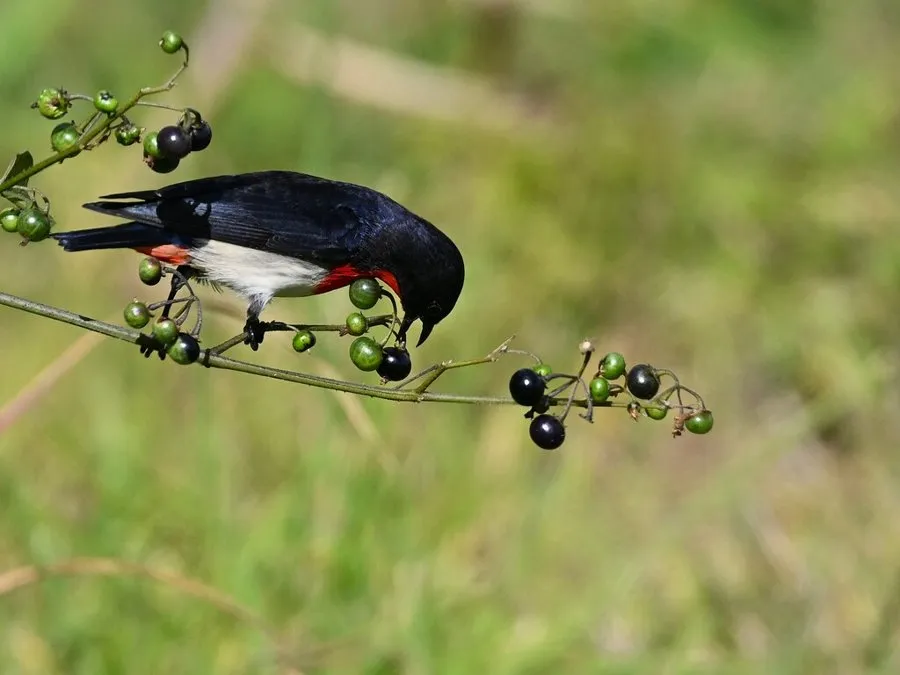
- Mistletoebirds – the best-known spreader, specialised for eating mistletoe fruit.
- Honeyeaters – several honeyeaters also eat the fruit and spread the seed.
- No soil stage – mistletoe never touches the ground, so it cannot spread through soil, mulch or roots.
Source: Australian National Botanic Gardens, Dispersal and germination.
How to control mistletoe
Mistletoe is controlled by improving the health of the tree and pruning out the worst-affected branches, within an integrated approach that keeps some mistletoe for wildlife. On a healthy tree with a few clumps, it usually needs no control at all.
Improving tree health
Most effective
What it is
A cultural control: fixing the drought stress, compaction, root damage or isolation behind a heavy infestation.
How it works
Heavy mistletoe follows stress. Watering through drought, mulching the root zone, protecting it from compaction and grazing, and planting around isolated trees all help the tree carry its mistletoe without decline.
Effectiveness
The only lasting answer, because it deals with why the mistletoe built up. Removing mistletoe from a tree that stays stressed only buys time.
Pruning out infested branches
Effective
What it is
A physical control: cutting branches back to below where the mistletoe attaches.
How it works
The haustorium grows into the branch, so breaking off the leafy clump can leave it in the wood. Cutting the branch below the attachment removes the mistletoe completely, and removes branch ends it may already have killed. Pruning a protected tree may need council approval.
Effectiveness
Reliable for clumps on smaller branches. Mistletoe on the trunk or main limbs cannot be pruned out without heavy cuts, which do the tree more harm than the mistletoe.
Leaving mistletoe for wildlife
Supporting
What it is
Keeping some or all mistletoe where the tree is healthy.
How it works
Mistletoe is a keystone resource: its nectar, fruit and leaves feed honeyeaters, mistletoebirds, possums and the caterpillars of jezebel butterflies, and it is often the only flower or fruit available in dry times. In an Australian experiment, removing mistletoe from woodlands cut bird species numbers by about 21% within three years.
Effectiveness
The right choice on a healthy tree. Where some removal is needed, taking out the worst clumps rather than all of them keeps most of the benefit.
Herbicide trunk injection
Last resort
What it is
A chemical control: a herbicide injected into the lower trunk, which the tree carries to the mistletoe.
How it works
A trial on eucalypts found that, together with good host health, some mistletoes could be partly controlled this way, but smaller trees were significantly more likely to die after injection than larger ones. Any product must be registered for the use and applied to its label.
Effectiveness
Partial at best, and a real risk to the tree. Rarely appropriate for a garden or street tree.
How to prevent heavy mistletoe
Preventing heavy mistletoe relies on keeping trees healthy and not isolated, because mistletoe builds up on trees under stress. A few clumps on a healthy tree are normal and do no harm.
- Water trees through drought, especially young and isolated trees.
- Protect the root zone from compaction, grazing and soil disturbance.
- Plant around lone trees, so they have shelter, cover and soil that holds water.
- Prune out new clumps early on young or valuable trees, before they establish.
Mistletoe: common questions
What is the clump of different leaves in my tree?
A clump of leaves that hangs from a branch and looks slightly different from the rest of the tree, often more drooping or a different shade of green, is usually mistletoe. Many Australian mistletoes mimic their host's leaves, so look for where the clump joins the branch, a swelling there, and red or orange tubular flowers or small berries.
Is mistletoe killing my gum tree?
Rarely on its own. A healthy tree and its mistletoe usually live together for years, and if the tree dies the mistletoe dies with it. Heavy mistletoe is usually a sign that the tree is already stressed, by drought, compaction, root damage or isolation in a cleared paddock, and that stress is the real problem to fix.
Why does my tree have so much mistletoe?
Heavy mistletoe usually follows stress or isolation. Land for Wildlife South East Queensland notes that drought, overgrazing, insect attack and habitat fragmentation all lead to heavy infestations, and lone paddock trees with compacted soil and little cover are especially prone. Fewer possums, which eat mistletoe leaves, may also play a part.
Should I remove mistletoe from my tree?
Usually not all of it. Mistletoe is native and an important food and nesting resource for birds, butterflies and possums. Removing it is worthwhile where it is heavy on a declining tree, is killing branches over a house or path, or is on a young or valuable tree. Removing some clumps and improving the tree's health is better than stripping it bare.
Will breaking off mistletoe kill it?
Not reliably. The mistletoe's haustorium, the root-like structure that joins it to the tree, grows into the branch, so breaking off the leafy clump can leave it in the wood. Cutting the branch back below the mistletoe removes it completely.
Is mistletoe good for birds?
Yes. Mistletoe is regarded as a keystone resource. In one Australian experiment, removing all mistletoe from woodlands cut bird species numbers by about 21% within three years, while woodlands with mistletoe left in place gained species. Mistletoebirds, honeyeaters, jezebel butterflies and possums all depend on it.
Do I need a permit to remove mistletoe from my tree?
Removing mistletoe usually means pruning the tree, and if the tree is protected under your council's local law, pruning it may need approval. Check your council's rules first, or use our permit checker, especially for large eucalypts and trees on council land.
References
- Australian National Botanic Gardens. What is a mistletoe?; Dispersal and germination; Cryptic mimicry of their hosts; Taxonomy. B. Barlow. Source
- Land for Wildlife South East Queensland. Mistletoes hanging on despite unwarranted reputation. D. Metters and J. Moss. Source
- Watson, D. M., & Herring, M. (2012). Mistletoe as a keystone resource: an experimental test. Proceedings of the Royal Society B, 279(1743), 3853–3860. Source
- Watson, D. M. (2001). Mistletoe: a keystone resource in forests and woodlands worldwide. Annual Review of Ecology and Systematics, 32, 219–249. Source
- Australian Native Plants Society (Australia). Amyema miquelii, plant profile. Source
- Australian Faunal Directory. Delias nigrina: host plants. Source
- Control of some mistletoe species on eucalypts by trunk injection with herbicides. AGRIS record. Source
General information, not a diagnosis. Many tree problems look alike, and only an inspection, and sometimes a laboratory test, can confirm what is wrong. Any treatment product must be registered for the use and applied strictly to its label.