
Leaf diseases South East Queensland
Myrtle Rust on Trees: Symptoms and Treatment
Myrtle rust is a fungal disease that attacks young, actively growing tissue on plants in the Myrtaceae family. It commonly affects lilly pillies, eucalypts and paperbarks, and thrives in South East Queensland's warm, humid climate. This guide explains how to identify myrtle rust, how it affects trees and what you can do to manage it.
- What it is
- A rust fungus that attacks new growth
- Scientific name
- Austropuccinia psidii
- Trees affected
- 382 native Myrtaceae species, including lilly pillies, paperbarks, bottlebrushes, tea-trees and eucalypts
- Peak season
- Spring and autumn growth flushes, in warm, humid weather
- How it spreads
- Wind-blown spores, and on clothing, equipment and infected plants
- Key sign
- Bright egg-yellow powdery spots on new leaves and shoots
- Think your plant has myrtle rust?
- We'll confirm it and tell you what's worth saving. Book a check →
What is myrtle rust?
Myrtle rust is a fungal disease, caused by Austropuccinia psidii, that attacks the young leaves, shoots, flowers and fruit of plants in the Myrtaceae family. It arrived in Australia in 2010 and is now established along the east coast, where it has infected 382 native species, including lilly pillies, paperbarks, bottlebrushes, tea-trees and eucalypts.
- GroupRust fungiFungi that live only on living plants
- GenusAustropucciniaFormerly placed in Puccinia
- SpeciesAustropuccinia psidiiMyrtle rust, attacking only the Myrtaceae
How myrtle rust damages a plant
Myrtle rust infects only young, soft, expanding tissue, so it strikes each new flush of growth and leaves hardened leaves largely alone. On a tolerant plant this is cosmetic. On a susceptible one, every flush is destroyed before it can harden, the plant cannot replace what it loses, and it declines over successive seasons until it dies.
How to identify myrtle rust
The main sign of myrtle rust is bright egg-yellow powdery spots on new leaves and shoots, which leave a yellow dust on your fingers. Nothing else on a Myrtaceae plant in South East Queensland looks quite like it, but the plant has to be in the Myrtaceae for it to be myrtle rust.
Signs and symptoms of myrtle rust
Early signs
- Yellow powdery spots
Egg-yellow to orange pustules on new leaves, shoot tips, flower buds and fruit. - Distorted new growth
Young leaves curl, cup or twist as they expand. - Purple-red spots
Small lesions, often ringed in red or purple, where the rust is establishing.
Advanced damage
- Brown, dead patches
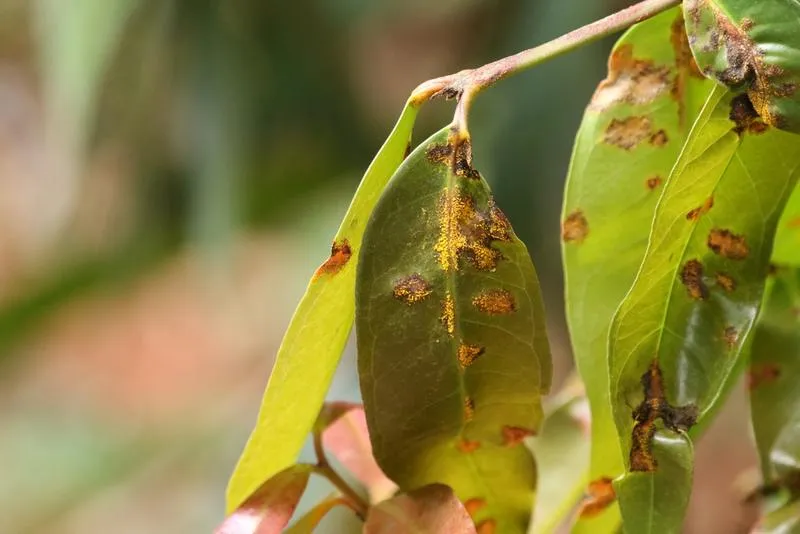
Older infections turn purple-brown and die, with spent pustules on the surface. - Shoot dieback
Repeatedly infected shoot tips die back, sometimes forming a witches’ broom. - Leaf loss and decline
Severely affected plants shed their new growth and thin out over several seasons.
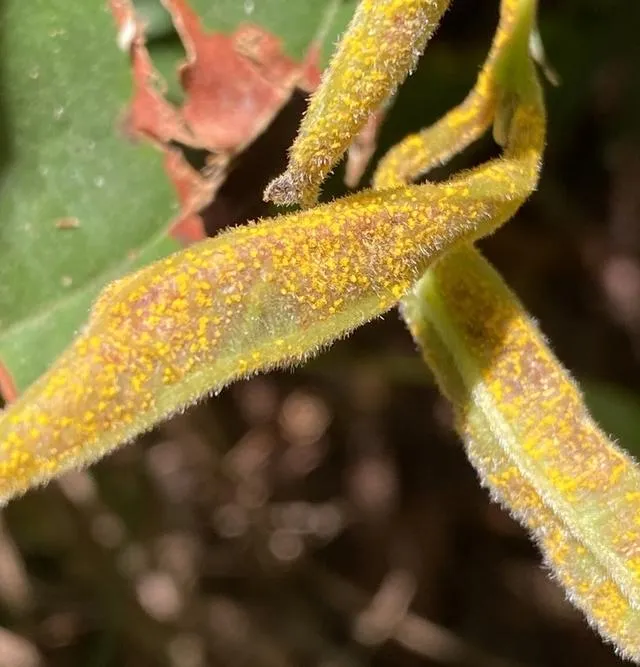
How to diagnose myrtle rust
To diagnose myrtle rust, check two things: that the plant belongs to the Myrtaceae, and that the yellow pustules are powdery and rub off as spores. A hand lens separates rust from look-alikes such as yellow lichen, scale insects and mite damage, and a plant pathology laboratory can diagnose it formally where it matters, such as in a nursery or revegetation site.
What plants does myrtle rust affect?
Myrtle rust affects only the Myrtaceae, and by 2020 it had infected 382 native Australian species, 17% of the country’s 2,253 native Myrtaceae. How badly it damages a plant varies enormously between species: some are being pushed towards extinction, while others carry the rust with little harm.
| Tree | How badly it is affected | What was recorded |
|---|---|---|
| Native guava (Rhodomyrtus psidioides) | Severe | 100% of trees dead at a Gold Coast hinterland site by 2016; now listed as Critically Endangered |
| Scrub turpentine (Rhodamnia rubescens) | Severe | About a quarter of trees dead by 2014; now listed as Critically Endangered |
| Rose myrtle (Archirhodomyrtus beckleri) | Severe | Deaths rose from 13% to 44% in a single year |
| Red lilly pilly (Syzygium hodgkinsoniae) | High | 90–100% of new shoots infected on young trees |
| Lilly pilly (Syzygium smithii) | Low | Relatively tolerant, and the main species regenerating in the same forest |
| Eucalypts and brush box (Eucalyptus, Lophostemon) | Usually low | No infection seen on the overstorey trees in the same forest |
Sources: Pegg et al. (2017), PLoS ONE 12; Makinson, Pegg and Carnegie (2020), Myrtle Rust in Australia: A National Action Plan.
Suspect myrtle rust on your plant? We can confirm it and tell you what's worth saving.
Book a checkWhen myrtle rust is most active in South East Queensland
In South East Queensland, myrtle rust is most active when plants are putting on new growth in warm, humid weather, which usually means the spring and autumn growth flushes. It is worst in wet, sheltered places: in Queensland research, the disease was more severe with high rainfall, dense canopy cover and on flood plains, and less severe where summer maximum temperatures went above about 32°C.
How myrtle rust spreads
Myrtle rust spreads on the wind. Each pustule releases huge numbers of tiny spores, which are carried on air currents and can also travel on clothing, gloves, tools, animals and infected plants. This is why it spread along the east coast so quickly after arriving in 2010, and why Western Australia, which does not have it, restricts the movement of Myrtaceae plants from other states.
How to treat myrtle rust
Myrtle rust cannot be eradicated, so treatment means reducing the damage to individual plants: choosing tolerant species, avoiding large flushes of soft growth and keeping foliage dry, within an integrated pest management (IPM) approach. Fungicides have a place on nursery stock and small plants, but rarely on established trees.
Choosing tolerant species
Most effective
What it is
A cultural control: replacing, or not planting, the species that myrtle rust repeatedly destroys, in favour of tolerant species and cultivars.
How it works
Susceptibility varies enormously between species. In the Tallebudgera Valley study, native guava died out entirely while the lilly pilly Syzygium smithii showed low dieback and made up most of the regenerating seedlings. A tolerant plant holds its new growth; a susceptible one loses every flush and never gets ahead.
Effectiveness
The most effective long-term measure, and the only one that does not need repeating. Where a plant is hammered every flush, replacing it is usually better value than treating it.
Avoiding a flush of soft growth
Effective
What it is
A cultural control: avoiding the heavy fertilising and hard pruning that push out large flushes of soft new growth.
How it works
Myrtle rust infects only young, soft, expanding tissue, and hardened leaves are largely safe. Heavy nitrogen and hard pruning both produce more of that tissue at once, often in the warm, humid weather the rust favours. Lighter, less frequent pruning of hedges and screens produces less of it.
Effectiveness
Reduces the amount of growth available to infect, particularly on hedges and screens that are pruned often. It lowers the damage rather than preventing infection.
Watering and airflow
Supporting
What it is
A cultural control: keeping foliage dry and air moving through the plant.
How it works
Rust spores need moisture on the leaf surface to infect. Watering at the base rather than overhead, avoiding evening watering, and thinning dense plantings so leaves dry quickly all shorten the time new growth stays wet.
Effectiveness
A useful support, especially for nursery stock and young plants, but it cannot control rainfall or the humidity of a South East Queensland summer.
Fungicide
Limited
What it is
A chemical control: a fungicide registered or permitted for myrtle rust, applied to protect new growth.
How it works
Fungicides protect the leaf surface they cover. Because the rust attacks each new flush, protection has to be repeated as new growth appears, and any product must be registered or permitted for that use and applied strictly to its label.
Effectiveness
Practical on nursery stock and small, valuable plants where coverage can be achieved. On an established tree it is rarely worthwhile: a large canopy cannot be covered properly, it keeps producing new growth, and spores keep arriving on the wind.
Removing badly affected plants
Last resort
What it is
Removing a plant that loses every flush and is declining.
How it works
A plant repeatedly stripped of its new growth cannot build reserves, and declines over successive seasons. Removing it, and replacing it with a tolerant species, ends the cycle. Infected material should be bagged rather than moved around the garden or to other sites.
Effectiveness
Ends the problem in that position, but does not remove myrtle rust from the area, which is established and spreads on the wind.
How to prevent myrtle rust
Preventing myrtle rust damage relies mainly on what you plant: tolerant species hold their new growth, and susceptible ones lose it every flush. Because the spores are everywhere in South East Queensland, prevention means limiting the damage rather than keeping the rust out.
- Choose tolerant species for new plantings and replacements, and avoid those known to be severely affected.
- Inspect nursery stock before buying, and reject plants with yellow pustules on their new growth.
- Prune and fertilise lightly, so plants do not push out large flushes of soft growth at once.
- Clean gloves, tools and clothing after working on infected plants, particularly before moving to bushland or a nursery.
Is myrtle rust killing your lilly pilly?
Myrtle rust is the most likely cause of yellow powdery spots on lilly pilly new growth in South East Queensland, and lilly pillies are among its most common garden hosts. How much harm it does depends on the species and how the plant is managed:
- Species – lilly pillies differ widely in tolerance; Syzygium smithii has shown relatively low damage in Queensland research.
- Hedging – hedges and screens pruned often keep producing soft growth, which gives the rust a constant supply of tissue to infect.
- Flush after flush – a plant that loses most of each flush cannot build reserves, and will decline over several seasons.
Many lilly pillies carry some rust and stay healthy. Where a hedge or tree is losing its new growth season after season, a tree health assessment can confirm the cause and whether the plant is worth keeping.
Myrtle rust: common questions
Does my tree have myrtle rust?
Only if your tree is in the Myrtaceae family, because myrtle rust infects nothing else. In South East Queensland gardens that usually means a lilly pilly, eucalypt, paperbark, bottlebrush, tea-tree, brush box or water gum. If the tree is not one of these, a yellow rust on it is a different disease, such as frangipani rust.
How do I know if my tree has myrtle rust?
Look at the newest growth while the tree is putting out a flush, usually in spring or autumn, because that is the only tissue the rust infects. Check the shoot tips and young leaves for egg-yellow powder, and wipe a spot with a tissue: myrtle rust leaves a yellow dust. Older, hardened leaves may show only brown or purple spots from earlier infections.
Can myrtle rust kill a tree?
Yes, on highly susceptible species. The rust repeatedly destroys new growth, so the plant cannot build reserves and declines over several seasons; in a south east Queensland study, native guava had died out entirely within a few years. On tolerant species, including most established eucalypts, it is usually cosmetic.
Can you get rid of myrtle rust?
Not from a garden or an area. Myrtle rust arrived in Australia in 2010, eradication proved impossible because the spores spread so easily on the wind, and it is now established along the east coast. Management aims to reduce the damage on individual plants, mainly by choosing tolerant species.
Does myrtle rust affect other plants?
Only plants in the Myrtaceae family, which includes lilly pillies, eucalypts, paperbarks, bottlebrushes, tea-trees and many rainforest species. If the plant is not in the Myrtaceae, a yellow rust on it is a different disease.
Should I remove a lilly pilly with myrtle rust?
Only if it loses most of its new growth every flush and is declining. Many lilly pillies carry some rust and stay healthy. Where a plant is badly affected season after season, replacing it with a more tolerant species is usually better than treating it.
Will a fungicide fix myrtle rust?
Not on an established tree. A fungicide only protects the growth it covers, the rust attacks every new flush, and spores keep arriving on the wind. Fungicides registered or permitted for myrtle rust are practical on nursery stock and small plants, applied strictly to the label.
Is myrtle rust the same as other rusts?
No. Myrtle rust, Austropuccinia psidii, attacks only the Myrtaceae. Other plants, such as frangipani, have their own rust fungi, which look similar but are different diseases with different hosts.
References
- Makinson, R. O., Pegg, G. S., & Carnegie, A. J. (2020). Myrtle Rust in Australia: A National Action Plan. Australian Network for Plant Conservation. Source
- Meiklejohn, N., Staples, T., & Fensham, R. (2021). Climatic preferences of myrtle rust fungal plant disease. Threatened Species Recovery Hub. Source
- NSW Department of Primary Industries. Myrtle rust. Source
- Pegg, G. S., et al. (2017). Impact of Austropuccinia psidii (myrtle rust) on Myrtaceae-rich wet sclerophyll forests in south east Queensland. PLoS ONE, 12(11), e0188058. Source
General information, not a diagnosis. Many tree problems look alike, and only an inspection, and sometimes a laboratory test, can confirm what is wrong. Any treatment product must be registered for the use and applied strictly to its label.