
Root & butt rots South East Queensland
Phytophthora Root Rot in Trees: Symptoms and Treatment
Phytophthora is a water mould that kills a tree's fine roots, and South East Queensland's wet summers and heavy clay suit it perfectly. This guide shows you what phytophthora root rot does, how to identify phytophthora and how to treat phytophthora dieback.
- What it is
- A soil-borne water mould (oomycete)
- Scientific name
- Phytophthora cinnamomi
- Trees affected
- More than 900 woody species, especially Proteaceae (macadamia, grevillea, banksia), Myrtaceae, avocado and grass trees
- Peak season
- Summer, peaking in January, and after heavy rain or flooding
- How it spreads
- Motile zoospores in saturated soil, and in infested soil, water and nursery stock
- Key sign
- Crown dieback and decaying feeder roots, with no visible fungal growth
- Think your tree has phytophthora?
- We'll diagnose it and give you a treatment plan. Book a check →
What is phytophthora root rot?
Phytophthora (fy-TOFF-thor-uh) is a genus of soil-borne, fungus-like pathogens that attack and kill a tree’s fine feeder roots, causing dieback. These organisms belong to a group called oomycetes, commonly known as water moulds. Although they resemble fungi, they are biologically distinct, which is important because many conventional fungicides are ineffective against Phytophthora.
- GroupOomycetesWater moulds: fungus-like, but not fungi
- GenusPhytophthoraOver a hundred species of plant pathogens
- SpeciesPhytophthora cinnamomiThe best known, with over 900 host plants
How phytophthora kills a tree
Phytophthora kills fine feeder roots, reducing the tree’s ability to absorb water and nutrients. In susceptible hosts, infection can also spread into larger roots and the root collar, causing lesions that disrupt the movement of water and nutrients between the roots and canopy. If the damage is severe enough, the tree can die.
Differences between Phytophthora species
Phytophthora species differ mainly in the plants they attack, the climates they favour and where they occur, and more than 100 have been described. In Queensland, three species account for almost two-thirds of all recorded Phytophthora detections: P. cinnamomi (35%), P. palmivora (17%) and P. nicotianae (12%).
| Species | Prevalence in QLD | Principal hosts | Notes |
|---|---|---|---|
| P. cinnamomi | 35% | More than 900 woody species, including Proteaceae, Myrtaceae, avocado and grass trees | The principal cause of root and collar rot in native vegetation and in many garden and amenity trees |
| P. palmivora | 17% | Palms, papaya and other tropical crops | Causes bud rot in palms, and fruit and stem rots, in warm climates |
| P. nicotianae | 12% | A wide range of crops and ornamentals, including citrus | Root and crown rot, most common in warm climates |
| P. multivora | 1% | A wide range of woody plants | Rarely recorded in Queensland, but detected at 77% of urban parkland sites in Perth, compared with 48% for P. cinnamomi |
Sources: Burgess et al. (2021), Persoonia 47; Khdiar et al. (2020), Microorganisms 8.
How to identify and diagnose Phytophthora in trees
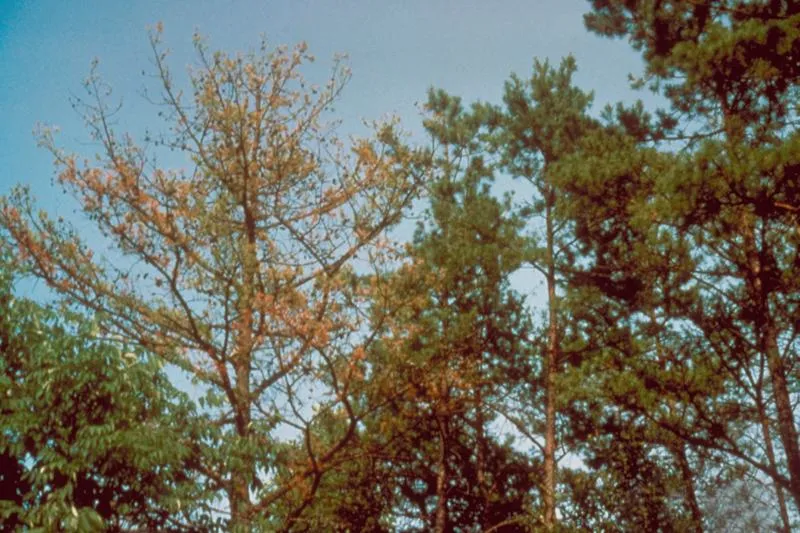
The main signs of Phytophthora infection in trees are crown dieback, yellowing or wilting foliage, premature leaf fall, decaying feeder roots and lesions at the root collar. However, these symptoms can resemble other causes of tree decline, so visual inspection alone cannot reliably confirm infection.
Signs and symptoms of Phytophthora
Above ground
- Crown dieback
Progressive branch death, often starting at the tips, resulting in a thinning canopy. - Yellowing and wilting foliage
Leaves may become pale, wilt or drop prematurely as root function declines. - Leaf scorch
Brown, scorched leaf margins may develop as water uptake becomes impaired. - Unusually small leaves or fruit
Some affected trees produce smaller leaves or an unusually heavy crop of small fruit.
Below ground
- Decaying feeder roots
Fine roots may become brown or black and decay, reducing the tree’s ability to absorb water and nutrients. - Root and root collar lesions
Infected tissue may show brown to dark discolouration beneath the bark. Lesions can extend into the lower trunk and, in severe cases, girdle it.
How to diagnose Phytophthora
To accurately diagnose Phytophthora, a laboratory test is needed to confirm infection. Samples of affected fine roots and surrounding soil are collected from the advancing edge of the decline, where viable pathogen activity is more likely, rather than exclusively from dead tissue at the centre.
What trees does Phytophthora affect?
Phytophthora affects more than 900 woody species, and in South East Queensland the most susceptible trees are the Proteaceae (macadamia, grevillea and banksia), the Myrtaceae, avocado and grass trees. Phytophthora cinnamomi has one of the broadest host ranges of any plant pathogen. Susceptibility varies between species and is strongly influenced by site drainage.
- Proteaceae – macadamia (Macadamia), grevilleas (Grevillea) and banksias (Banksia).
- Myrtaceae – eucalypts (Eucalyptus) and tea-trees (Leptospermum).
- Lauraceae – avocado (Persea americana).
- Grass trees (Xanthorrhoea) – highly susceptible, and often the first plants to die on an infested site.
Queensland government material also identifies pineapple and stone fruit among the principal commercial hosts.
When phytophthora is most active in South East Queensland
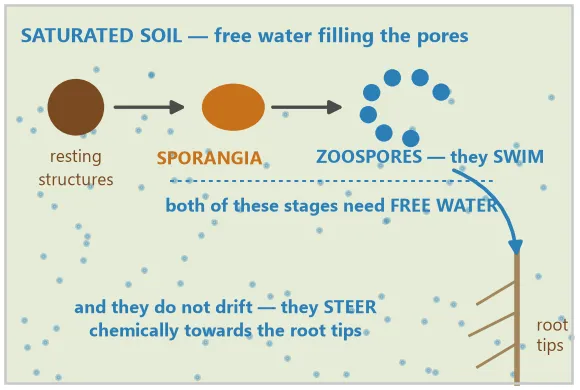
In South East Queensland, phytophthora is most active during the summer wet season, particularly in January, and following heavy rainfall or flooding. Activity depends on saturated soil, when free water fills the soil pore spaces.
Persistently wet sites can support activity year-round, including those affected by leaking pipes or stormwater lines, frequent irrigation or poorly drained clay soils. Symptoms are often delayed: a tree may appear stable while the soil remains wet, then decline weeks or months later as the soil dries and its reduced root system can no longer meet the canopy’s water demand.
Suspect phytophthora in your tree? Many trees recover if it's caught early.
Book a checkHow phytophthora spreads
Phytophthora spreads through water and soil. In saturated conditions, its resting structures produce sporangia, which release motile zoospores. These swim through the water-filled soil and are chemically attracted to exudates from root tips, where they attach and infect.
Over longer distances, the pathogen is moved in surface runoff and in soil carried on footwear, tools, vehicles and machinery, as well as in potting media and nursery stock. Infected nursery stock is a documented pathway into new plantings.
How to treat phytophthora root rot
Phytophthora root rot is treated by improving drainage, managing irrigation and, where needed, applying phosphite to the tree, combined in an integrated pest management (IPM) approach. The pathogen cannot be eradicated from an infested site, so treatment aims to suppress it and give the tree the conditions to grow new roots.
Drainage improvement
Most effective
What it is
A cultural control: changing the site so that water drains away from the root zone instead of saturating it.
How it works
Phytophthora needs free water in the soil to produce sporangia and for its zoospores to swim to the roots. Surface or subsurface drainage, mounding, regrading, and repairing leaking pipes and stormwater lines all shorten the periods the soil stays saturated.
Effectiveness
The most effective treatment, and the one the others depend on. Chemical and biological measures are unlikely to succeed on a site that remains waterlogged.
Irrigation management
Essential
What it is
A cultural control: watering to the tree’s needs so the root zone does not stay saturated.
How it works
Watering less often but more deeply lets the soil drain and take in air between waterings, which shortens the periods free water is present. Keeping sprinklers and drippers off the trunk, and mulch clear of it, protects the root collar, where collar lesions begin.
Effectiveness
Essential on any irrigated site, and often the quickest change to make: over-watering alone can keep a well-drained soil wet enough for infection.
Phosphite (phosphorous acid)
Suppresses
What it is
A chemical control: salts of phosphorous acid, sold as phosphite or phosphonate, and the principal chemical treatment for Phytophthora in trees.
How it works
Phosphite moves through the tree’s vascular system to the roots, where it acts in two ways: it strengthens the tree’s own defence responses and, at higher concentrations, inhibits the growth of the pathogen directly. It is applied by trunk injection or as a foliar spray, using products registered for the intended use and applied strictly according to the label.
Effectiveness
Well established for suppressing Phytophthora and slowing decline, but it does not eliminate the pathogen, and its effect declines over time, so treatment is repeated. It buys time while drainage is corrected rather than replacing that work.
Organic mulch and compost
Supporting
What it is
A biological control: coarse organic mulch and compost that build up the soil’s microbial life, kept clear of the trunk.
How it works
Some soils naturally suppress Phytophthora. The best-known example is an avocado grove at Tamborine Mountain in Queensland, where heavy organic mulching with a calcium source produced soil that withstood P. cinnamomi inoculum capable of causing severe root rot in other soils, and carried higher populations of bacteria and actinomycetes (Broadbent and Baker 1974). Mulch also evens out soil moisture and encourages new feeder roots near the surface.
Effectiveness
A useful supporting treatment rather than a stand-alone one. Suppression is not achieved where drainage remains inadequate.
Biocontrol products (Trichoderma)
Variable
What it is
A biological control: commercial products containing beneficial microorganisms, mainly Trichoderma fungi, applied to the soil.
How it works
Trichoderma species compete with Phytophthora for space and nutrients around the roots, and some produce enzymes and compounds that attack its hyphae.
Effectiveness
Field results vary with the product, its formulation and the site, and strong laboratory results do not reliably carry over to established trees. Worth considering only alongside drainage, irrigation and mulch.
Resistant species and rootstocks
Long term
What it is
A cultural control: replacing susceptible plants with species, or rootstocks, that tolerate the pathogen.
How it works
Susceptibility varies widely between species. Where susceptible plants have repeatedly failed on a site, replanting with species suited to wet conditions removes the hosts the pathogen depends on. For avocado, rootstocks with greater tolerance to root rot are available.
Effectiveness
The long-term solution on sites where drainage cannot be fully corrected, although tolerant plants can still decline in persistently waterlogged soil.
How to prevent phytophthora
Preventing phytophthora root rot relies on good drainage, clean planting stock and hygiene that limits the movement of infested soil and water. Because the pathogen cannot be removed once established, prevention is considerably more effective than treatment.
- Establish drainage before planting, particularly in clay soils and low-lying areas.
- Inspect nursery stock before planting, and reject plants with dark, sparse or decaying fine roots.
- Limit soil movement. Clean footwear, tools and vehicles, work in healthy areas before affected ones, and avoid moving soil from infested sites.
- Irrigate according to plant requirements, rather than on a fixed daily schedule.
Is phytophthora killing your macadamia?
Phytophthora is one of the two major diseases of macadamia in Australia, alongside husk spot, and Phytophthora cinnamomi is the most widespread species in Australian orchards. Most commercial cultivars are susceptible, and the disease attacks both the roots and the trunk. Affected trees typically show:
- Thinning canopy – yellowing or wilting leaves.
- Dieback – branches dying back from the tips.
- Heavy set of small nuts – a common sign of a stressed tree.
- Trunk cankers – dark, sunken bark on the lower trunk that may crack and weep dark sap.
Infection is most likely on heavy clay, low-lying ground and persistently wet garden beds, and decline often shows after a wet summer. Treatment follows the methods above, led by drainage, with phosphite the principal chemical control.
Drought, construction damage to roots and other diseases can look the same, so a laboratory test as part of a tree health assessment is needed to confirm the cause.
Sources: Hort Innovation, Disease management in macadamia (MC07003); Jeff-Ego et al. (2020), Plant Pathology 69.
Phytophthora root rot: common questions
What does Phytophthora do?
Phytophthora infects and kills a tree's fine feeder roots, the roots responsible for most water and nutrient uptake. In susceptible trees, infection can extend into larger roots and the root collar, where lesions disrupt the movement of water and nutrients between the roots and canopy. The tree responds with wilting, yellowing foliage and crown dieback, and severe infections can kill it.
Can a tree recover from phytophthora?
Recovery is possible where infection is detected early and drainage is corrected. New feeder roots can develop once the soil no longer remains saturated, and phosphite treatment can suppress the pathogen during this period. Trees with extensive root collar lesions or severe crown dieback rarely recover and may require removal.
Is phytophthora contagious to other plants?
Yes. Phytophthora spreads in water and soil, including surface runoff, footwear, tools, vehicles, potting media and nursery stock. Working in unaffected areas before affected ones, and avoiding the movement of soil from infested areas, reduces the risk of spread.
Does phytophthora stay in the soil?
Yes. Phytophthora persists in soil and infected root material as resistant resting structures and cannot practically be eliminated from a site. Management therefore aims to prevent the saturated soil conditions it requires.
How do I treat phytophthora naturally?
The primary management measures are non-chemical: improving drainage, adjusting irrigation, and maintaining mulch and organic matter clear of the trunk. Phosphite is the principal chemical treatment used on trees, and it suppresses rather than cures the disease.
Does phosphite cure phytophthora?
No. Phosphite suppresses Phytophthora rather than curing it. It strengthens the tree's own defence responses and, at higher concentrations, inhibits the pathogen directly, which slows the disease and gives the tree time to grow new roots. It does not remove the pathogen from the tree or the soil, its effect declines over time so treatment is repeated, and it works only alongside improved drainage.
Will a fungicide fix phytophthora?
Most will not. Phytophthora is an oomycete, not a true fungus, and many conventional fungicides, including the triazoles and other sterol-inhibiting products, have no effect on it because oomycetes do not produce their own sterols. Phosphite is the exception used on trees, and it suppresses rather than cures the disease. Correcting drainage remains the primary treatment.
Is phytophthora the same as dieback?
No. Dieback is a symptom, the progressive death of branches from the tips, and has many possible causes, including drought, root damage and other diseases. Phytophthora is a common cause on poorly drained sites, which is why the term phytophthora dieback is widely used.
References
- Broadbent, P., & Baker, K. F. (1974). Behaviour of Phytophthora cinnamomi in soils suppressive and conducive to root rot. Australian Journal of Agricultural Research, 25, 121–137. Source
- Burgess, T. I., et al. (2021). Current status of Phytophthora in Australia. Persoonia, 47, 151–177.
- Hort Innovation. Disease management in macadamia (MC07003). Source
- Jeff-Ego, O. S., et al. (2020). Prevalence of Phytophthora species in macadamia orchards in Australia and their ability to cause stem canker. Plant Pathology, 69. Source
- Khdiar, M. Y., et al. (2020). Association of Phytophthora with declining vegetation in an urban forest environment. Microorganisms, 8.
- Lourenço, D. A., Branco, I., & Choupina, A. (2022). A systematic review about biological control of phytopathogenic Phytophthora cinnamomi. Molecular Biology Reports. Source
- Phosphite inhibits Phytophthora cinnamomi by downregulating oxidoreductases and disrupting energy metabolism (2025). Frontiers in Microbiology. Source
General information, not a diagnosis. Many tree problems look alike, and only an inspection, and sometimes a laboratory test, can confirm what is wrong. Any treatment product must be registered for the use and applied strictly to its label.