
Leaf diseases South East Queensland
Powdery Mildew on Trees: Symptoms and Treatment
Powdery mildew is a fungal disease that coats the leaves, shoots and flowers of trees in a white powder, and South East Queensland's mild, humid spring and autumn suit it perfectly. This guide shows you what powdery mildew does, how to identify powdery mildew and how to treat powdery mildew on trees.
- What it is
- A group of fungi that grow on the surface of leaves and flowers
- Scientific name
- Erysiphales (many species)
- Trees affected
- Hundreds of plants, including crepe myrtle, mango, plane trees, maples, oaks and fruit trees such as apple and stone fruit
- Peak season
- Mild, humid weather in spring and autumn; mango flowering in late winter and spring
- How it spreads
- Wind-blown spores, which infect without needing rain
- Key sign
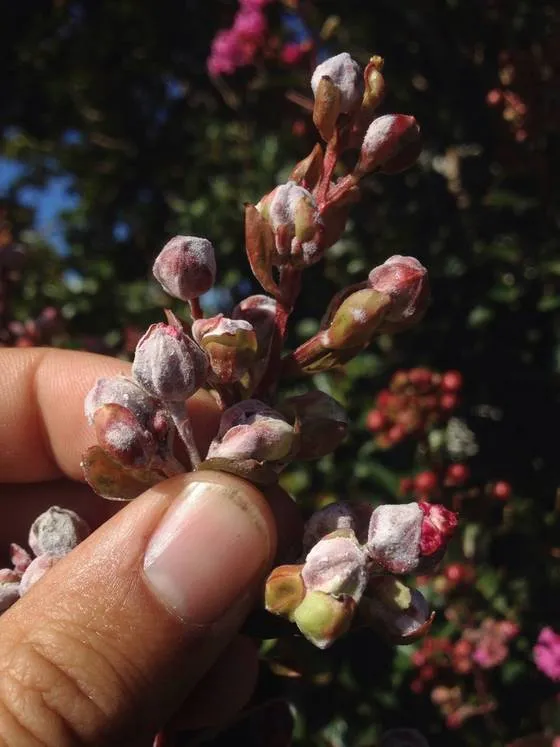
- White to grey powdery patches on leaves, shoots and flower buds
- Think your tree has powdery mildew?
- We'll check it and tell you if it needs treating. Book a check →
What is powdery mildew?
Powdery mildew is a fungal disease that grows on the surface of leaves, young shoots and flowers, covering them in a white to grey powder. It is one of the most widespread plant diseases, affecting hundreds of plants from trees to roses and vegetables, and is caused by a group of related fungi, each of which attacks particular plants: the mildew on a crepe myrtle is a different species from the one on a mango or an oak.
- KingdomFungiTrue fungi, not water moulds
- OrderErysiphalesThe powdery mildews
- SpeciesMany speciesEach attacking particular plants
How powdery mildew damages a tree
Powdery mildew lives on the outside of the leaf, sending small feeding structures only into the surface cells. The powder is the fungus itself, so the leaf underneath stays intact but works poorly: it makes less energy, and badly infected leaves curl, distort and drop early. On an established tree it is usually cosmetic; on young trees and on mango flowers it matters more.
How to identify powdery mildew
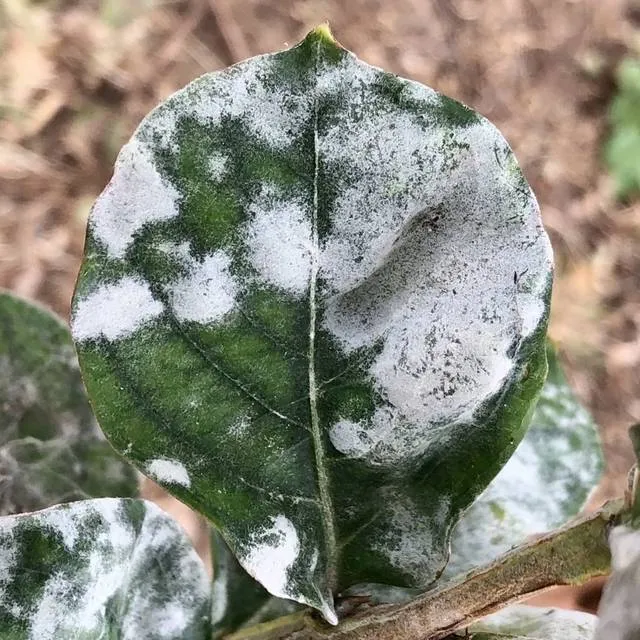
The main sign of powdery mildew is white to grey powdery patches on the leaves, shoots and flower buds, which rub off on your finger. The patches usually start on the upper surface of young leaves and spread until whole leaves look dusted with flour.
Signs and symptoms of powdery mildew
Early signs
- White spots
Small, round, white powdery patches on young leaves and shoots. - Dusted buds
Flower buds coated in white powder, often on crepe myrtle and mango. - Rubs off
The powder wipes off with a finger, leaving the leaf beneath intact.
Advanced damage
- Leaves covered
Patches join until the whole leaf is grey-white. - Curling and distortion
Young leaves twist and pucker as they grow. - Early leaf and flower drop
Badly infected leaves yellow and fall, and flowers may fail to open.
How to diagnose powdery mildew
To diagnose powdery mildew, rub the white patch with a finger: powdery mildew wipes off as a fine powder, leaving the leaf beneath green. Look-alikes include white scale insects and mealybugs, which are raised and waxy, sooty mould, which is black, and pale leaf discolouration, which does not rub off.
What trees does powdery mildew affect?
Powdery mildew affects a wide range of trees, including crepe myrtle, mango, plane trees, maples, oaks, young eucalypts and fruit trees such as apple and stone fruit. In South East Queensland gardens it is most noticeable on crepe myrtle and mango. Because each powdery mildew species attacks its own hosts, a mildewed crepe myrtle does not put a nearby mango at risk.
| Tree | How badly it is affected | What to know |
|---|---|---|
| Crepe myrtle (Lagerstroemia indica) | Often severe | The most common powdery mildew host in SEQ gardens, attacked by its own species, Erysiphe australiana; resistant varieties are available |
| Mango (Mangifera indica) | Serious at flowering | Infected flowers and young fruit drop, reducing the crop |
| Oaks (Quercus) | Usually mild | Attacked by Erysiphe alphitoides; mostly affects young, late-season leaves |
| Plane trees (Platanus) | Usually mild | Attacked by Erysiphe platani; can be unsightly on street trees |
| Maples (Acer) | Usually mild | Rarely affects the growth of established trees, but can damage seedlings |
| Apple and stone fruit (Malus, Prunus) | Moderate | Affects leaves, shoots and fruit, worst in dense, humid plantings |
| Young eucalypts | Usually mild | Affects juvenile foliage, and usually outgrown |
Sources: NC State Extension; Pacific Northwest Plant Disease Management Handbook; Fungal Network of New Zealand, Mycological Notes 24.
Suspect powdery mildew on your tree? We can check it and tell you if it needs treating.
Book a checkWhen powdery mildew is most active in South East Queensland
In South East Queensland, powdery mildew is most active in mild, humid weather without much rain, which usually means spring and autumn. On mango, the critical time is flowering in late winter and spring, when infection of the flowers reduces fruit set.
Unlike most leaf diseases, powdery mildew does not need rain or wet leaves to infect: high humidity is enough, and free water on the leaves can actually stop its spores germinating. That is why it often flares in dry, humid, still spells rather than in heavy summer rain.
How powdery mildew spreads
Powdery mildew spreads on the wind. The white powder is made of spores, which blow onto nearby leaves and infect them directly, without needing a wet surface. Shaded, crowded and sheltered positions, where the air is still and humid, are where it builds up fastest.
How to treat powdery mildew
Powdery mildew is treated by choosing resistant varieties, improving airflow and avoiding soft growth, with sprays on small trees, within an integrated pest management (IPM) approach. On an established ornamental tree it is usually cosmetic, so the aim is to keep it at a level the tree can live with.
Choosing resistant varieties
Most effective
What it is
A cultural control: planting varieties bred to resist powdery mildew, particularly for crepe myrtle.
How it works
The US National Arboretum bred a series of crepe myrtle hybrids, mostly crosses of Lagerstroemia indica and L. fauriei named after Native American tribes, that are highly tolerant of powdery mildew. Varieties such as ‘Natchez’, ‘Tuscarora’ and ‘Muskogee’ rarely need any treatment.
Effectiveness
The most effective answer where mildew is a recurring problem, and the only one that does not need repeating. Ask the nursery for a mildew-resistant variety when buying a crepe myrtle.
Improving airflow and sun
Effective
What it is
A cultural control: thinning dense growth and keeping susceptible trees out of shade.
How it works
Powdery mildew thrives in still, humid, shaded air around crowded foliage. Thinning the canopy, avoiding planting in shade and giving trees space lets air move and lowers the humidity around the leaves.
Effectiveness
Reduces how severe the mildew becomes, especially on crepe myrtles and young trees planted too close together.
Avoiding excess nitrogen
Supporting
What it is
A cultural control: not over-fertilising susceptible trees.
How it works
Powdery mildew attacks young, soft growth most readily. Heavy nitrogen fertiliser produces large flushes of exactly that growth.
Effectiveness
A simple support: lighter, balanced feeding reduces the amount of susceptible growth without affecting the tree’s health.
Bicarbonate, oil and sulphur sprays
Small plants only
What it is
A chemical control using low-toxicity products: potassium bicarbonate, horticultural oils and sulphur.
How it works
These products work on the leaf surface, where powdery mildew lives, either preventing infection or damaging the fungus. Any product must be registered for the use and applied to its label, and sulphur and oils can scorch leaves in hot weather.
Effectiveness
Useful on small plants and young trees where the whole plant can be covered. On a large tree, coverage is the same problem as with any spray.
Registered fungicides
Limited
What it is
A chemical control: a fungicide registered for powdery mildew on that plant.
How it works
Fungicides protect the leaves and flowers they cover, so they are applied before or at the first sign of mildew and repeated through the high-risk period. For mango, protecting the flowers is what matters, because infection there reduces fruit set.
Effectiveness
Practical in orchards and on small trees. On a large established ornamental tree, where the disease is usually cosmetic, it is rarely worthwhile.
How to prevent powdery mildew
Preventing powdery mildew relies mainly on what you plant and where: resistant varieties in sunny, open positions are rarely badly affected. Because the spores travel on the wind, prevention means making the tree a poor place for the fungus to grow.
- Choose mildew-resistant varieties, especially for crepe myrtle.
- Plant in full sun, with space for air to move around the canopy.
- Feed lightly, avoiding heavy nitrogen that produces soft growth.
- Water at the base, in the morning, rather than over the foliage in the evening.
Is powdery mildew killing your crepe myrtle?
Powdery mildew rarely kills a crepe myrtle, but it is the most common reason a crepe myrtle looks grey, flowers poorly and drops its leaves early in South East Queensland. Whether it is worth treating depends on the variety and the tree’s position.
- Older varieties – many older crepe myrtles are highly susceptible and will be affected most years.
- Shady or crowded trees – a crepe myrtle in shade or hemmed in by other plants is far worse affected.
- Resistant varieties – hybrids such as ‘Natchez’, ‘Tuscarora’ and ‘Muskogee’ are rarely badly affected.
If a crepe myrtle is declining beyond its leaves, with dieback or bark damage, look for another cause through a tree health assessment.
Powdery mildew: common questions
Is powdery mildew harmful to trees?
Rarely seriously on an established tree. The fungus lives on the leaf surface, so it reduces how well the leaves work and can make them distort and drop early, but it does not attack the wood. It matters more on young trees, which have less leaf to lose, and on mango, where infected flowers set less fruit.
What causes powdery mildew on trees?
Powdery mildew is caused by fungi in the Erysiphales, a group of species that each attack particular plants. It is favoured by mild temperatures, high humidity, shade and still air, and unlike most leaf diseases it does not need rain or wet leaves to infect.
How do I get rid of powdery mildew on my crepe myrtle?
Improve airflow by thinning the canopy, avoid heavy nitrogen fertiliser, and on a small tree a registered bicarbonate, oil or sulphur spray applied at the first sign helps. The lasting answer is a mildew-resistant variety, such as 'Natchez' or 'Tuscarora', when replacing or planting a crepe myrtle.
Can powdery mildew spread to other plants?
Only to plants that particular species of powdery mildew can attack. Each species has its own range of hosts, so the mildew on a crepe myrtle will not move to a rose or a mango, even though they look the same.
Does rain help or spread powdery mildew?
Neither, really. Powdery mildew is unusual in not needing rain to infect, and free water on the leaves can actually stop its spores germinating. It is worst in dry, humid, still weather, which is why it often flares in spring and autumn rather than during heavy summer rain.
Should I cut off leaves with powdery mildew?
On a small tree, removing badly infected shoots reduces the spores available to spread. On a larger tree it makes little difference, as new infection keeps arriving on the wind; improving airflow and choosing resistant varieties do more.
References
- NC State Extension. Powdery mildew on crape myrtles. Source
- Pacific Northwest Plant Disease Management Handbook. Crape myrtle (Lagerstroemia spp.): powdery mildew. Source
- Pacific Northwest Plant Disease Management Handbook. Maple (Acer spp.): powdery mildew. Source
- Fungal Network of New Zealand. Mycological Notes 24: two powdery mildews. Source
- Pooler, M. R. (2006). 'Arapaho' and 'Cheyenne' Lagerstroemia. HortScience, 41(3), 855–856. Source
- University of Maine Cooperative Extension. Powdery mildew of cucurbits. Source
General information, not a diagnosis. Many tree problems look alike, and only an inspection, and sometimes a laboratory test, can confirm what is wrong. Any treatment product must be registered for the use and applied strictly to its label.