
Insects South East Queensland
Termites in Trees: Signs, Risks and Treatment
Termites hollow out living trees from the inside, and in South East Queensland the culprit is usually the giant termite, Coptotermes acinaciformis. This guide shows you what termites do to a tree, how to identify termites in a tree and how to treat termites in trees.
- What it is
- A subterranean termite that nests inside living trees
- Scientific name
- Coptotermes acinaciformis
- Trees affected
- Mature eucalypts and other large hardwoods, especially old, wounded or stressed trees
- Peak season
- Active year-round, slowing in winter; swarms on warm, humid evenings after rain
- How it spreads
- Underground galleries up to 50 m long, and winged swarms that found new colonies
- Key sign
- A rounded nest on the trunk or in a branch fork, mud tubes on the bark, or mud packed into wounds
- Think your tree has termites?
- We'll check it and tell you if it's safe. Book a check →
What are termites in trees?
Termites in trees are subterranean termites that build their nest inside the trunk of a living tree, eating out the dead heartwood at its centre. In South East Queensland, the species usually responsible is the giant termite, Coptotermes acinaciformis. It is also Australia’s most destructive timber pest: Queensland Government research attributes more economic loss to it than to all other Australian termite species combined.
- GroupTermitesSocial insects, now classed with cockroaches
- GenusCoptotermesThe most damaging subterranean termites
- SpeciesCoptotermes acinaciformisThe giant termite, nesting in living trees
How termites damage a tree
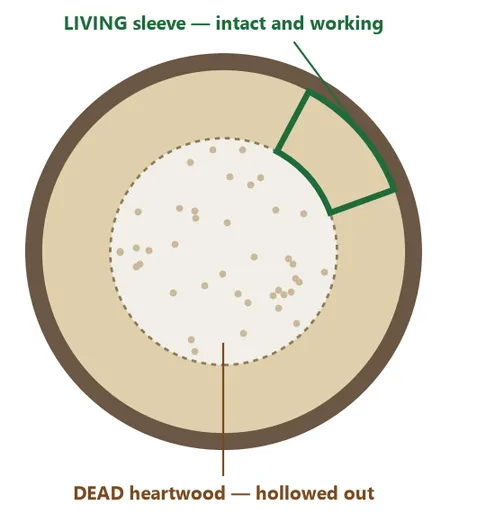
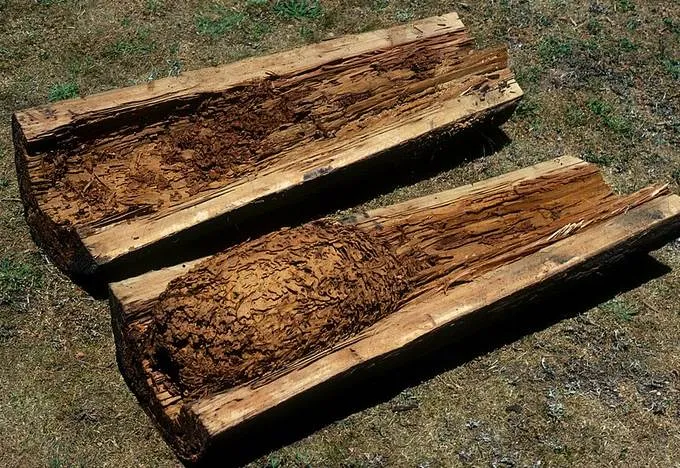
Termites eat the dead heartwood at the centre of the trunk, not the living sapwood that carries water, so the tree can keep a full, healthy canopy while it is hollowed out. They replace the eaten wood with a mixture of soil and chewed material, known as mudgut, and use the hollow as their nest. The damage is therefore structural rather than a matter of tree health: the tree loses strength from the inside while appearing normal.
Differences between termite species
Termite species differ mainly in where they nest and how much damage they do, and only a few of Australia’s 258 described species attack timber or trees. In South East Queensland, Coptotermes acinaciformis is the species most often found nesting in living trees, and in a study of north Australian woodland it made more than 90% of the termite pipes found in trees.
| Species | How common in SEQ | Nest | Risk to trees and buildings |
|---|---|---|---|
| Coptotermes acinaciformis | The most common in living trees | Inside living trees, stumps and the ground | High. Hollows living trees and causes most termite damage to buildings |
| Schedorhinotermes spp. | Common | In the ground, stumps and buried timber | Moderate. Attacks timber in service, and retreats when disturbed |
| Nasutitermes walkeri | Common, especially after bushfires | Rounded nests on the trunk or in branch forks of living trees | Moderate. Nests in stressed or decaying trees and eats their dead wood; also attacks fences and poles |
| Mastotermes darwiniensis | Not present: tropical north only | In the ground and in trees | Very high. Attacks growing trees as well as timber |
Sources: Queensland Department of Agriculture, Fisheries and Forestry (2013), Subterranean termite baiting systems; Business Queensland, Subterranean and drywood termites; Werner and Prior (2007), Journal of Tropical Ecology 23.
How to identify termites in a tree
The main signs of termites in a tree are a rounded termite nest on the trunk or in a branch fork, mud shelter tubes on the bark, mud packed into wounds and cavities, and a hollow trunk filled with mud. However, an infested tree often shows no outward sign at all, so a drilling test is the reliable way to confirm termites.
Signs and symptoms of termites
Outside the tree
- A nest on the tree
A rounded, dark nest on the trunk or in a branch fork, usually the tree termite, Nasutitermes walkeri, which nests where the wood is already stressed or decaying. - Mud packing
Soil packed into old pruning wounds, cracks and cavities, often the first sign seen. - Shelter tubes
Mud tubes running up the bark. Fresh tubes are moist and quickly repaired if broken. - Hollow broken branches
Sometimes the only external sign of a hollow trunk. - Swarmers
Winged termites on warm, humid evenings after rain, and discarded wings nearby.
Inside the tree
- Hollow trunk
A drill suddenly runs freely as it reaches the hollowed centre. - Mudgut
The hollow filled with a mixture of soil and chewed wood. - Live termites
Soldiers with dark, curved jaws that release a drop of milky fluid when disturbed.
How to diagnose termites in a tree
To diagnose termites in a tree, the trunk is drilled towards its centre about 1 m above the ground, following Queensland Government guidance. A hollow or mud-filled centre confirms the damage, and live termites on the drill bit, or on a dowel left in the hole for one to two weeks, confirm current activity. Mud tubes and galleries should not be broken open, as this can push the termites elsewhere.
Are termite-damaged trees dangerous?
A termite-damaged tree can be dangerous, and because the damage is inside the trunk it is a largely hidden risk. A widely used guideline, Mattheck’s t/R ratio, treats a trunk as high risk once the sound wood in its outer shell is thinner than about 30% of the trunk’s radius, which means the hollow has taken more than about 70% of it.
The guideline is a starting point rather than a pass mark: an open cavity, decay alongside the termite damage, lean and exposure to wind all change the risk. None of it can be judged from the outside, so it needs an AQF Level 5 arborist to measure the shell with drilling resistance or sonic tomography as part of a tree risk assessment.
Suspect termites in your tree? An arborist can measure the damage and tell you if it's safe.
Book a checkWhat trees do termites attack?
Termites attack most mature trees, but in South East Queensland the giant termite nests mainly in eucalypts, and has been recorded nesting in more than 25 eucalypt species. Older, larger trees are the most at risk, because termites feed on dead heartwood and young trees have very little of it.
Trees most susceptible to termites in SEQ
- Eucalypts – the main hosts, with more than 25 species recorded as nest trees.
- Hoop pine (Araucaria cunninghamii)
- Cypress pines (Callitris)
- She-oaks (Casuarina)
- Silky oak (Grevillea robusta)
Why young trees are less susceptible
Termites feed on the dead heartwood at the centre of the trunk, so a young tree with a thin trunk offers a colony little to eat or nest in. As a tree ages its heartwood core grows, and in a study of 541 trees, termite hollowing became more common as trees got larger. Wounds, root damage and decay make a tree of any size easier to colonise.
When termites are most active in South East Queensland
In South East Queensland, termites are most active in the warmer months, when they forage hardest for food. Activity slows over winter and can stop altogether. Mature colonies swarm on warm, humid evenings, usually around storms or rain, releasing thousands of winged termites that fly off to start new colonies.
How termites spread
Termites spread through underground galleries and by swarming. A single colony’s gallery system can cover up to a hectare, with individual galleries up to 50 m long, and in one classic study a colony nesting in a living tree had spread its galleries to fifteen other living trees.
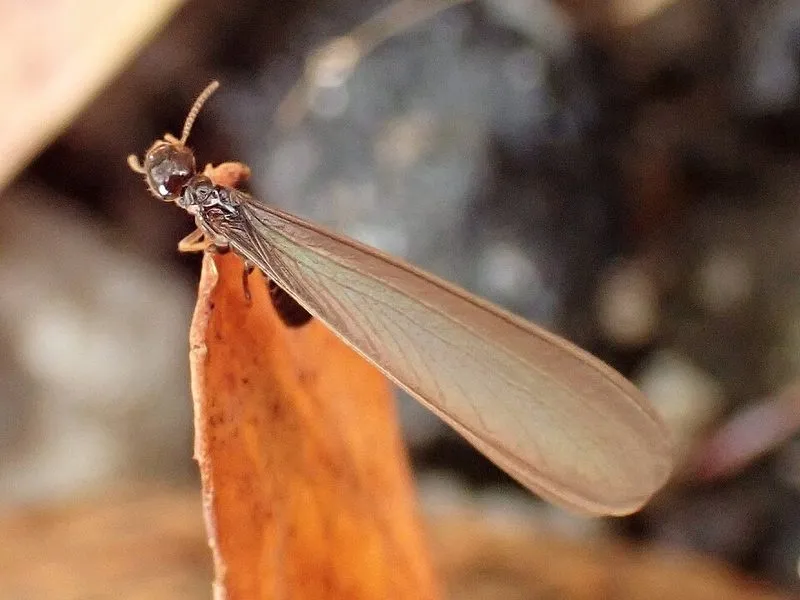
Swarming starts new colonies. The swarmers, or alates, are winged males and females, the colony’s future kings and queens; a mature colony can release up to 60,000 a year, usually at dusk in rainy or stormy weather. After a short flight they shed their wings, pair off and tunnel into suitable timber to found a new nest, which may be a stressed or wounded tree. Because of this foraging range, Queensland Government guidance recommends checking all large trees within 50 m of a building.
Sources: Queensland Department of Agriculture, Fisheries and Forestry (2013); Greaves (1962), Australian Journal of Zoology 10; Sandlant (1985), Forest Research Institute, Forest and Timber Insects in New Zealand No. 62.
How to treat termites in trees
Termites in trees are treated by eliminating the colony with baiting or a termiticide applied by a licensed pest manager, together with a tree risk assessment to decide whether the tree can stay. In Queensland, treating termites for a customer is a regulated pest management activity, carried out by a licensed pest management technician.
Colony baiting
Most effective
What it is
A chemical control: bait stations, attached to the tree or set in the ground nearby, containing a slow-acting toxicant in a cellulose bait.
How it works
Foraging termites feed on the bait and carry it back to the nest, where it is shared through the colony. Chitin-synthesis inhibitors such as chlorfluazuron, hexaflumuron and noviflumuron stop termites moulting, so the colony declines over the following weeks to months.
Effectiveness
The only method designed to eliminate the whole colony rather than the termites in one place. Queensland Government guidance notes that Coptotermes do not always find and accept baits, so placement and monitoring matter, and a new colony can move in afterwards.
Nest treatment with a termiticide
Effective
What it is
A chemical control: a registered termiticide applied directly into the nest inside the trunk, by injection through drilled holes or as a dust.
How it works
The trunk is drilled to locate the nest, and the product is either injected as a liquid or puffed in as a dust: a fine insecticide powder blown into the galleries. Termites walking through the dust pick it up on their bodies and carry it back to the nest, where it spreads through the colony as they groom and feed one another.
Effectiveness
Can kill or suppress the colony quickly, although the outcome may be suppression rather than elimination. It treats the nest the drilling finds, so a colony with more than one nest site may survive.
Tree risk assessment
Essential
What it is
An assessment of the tree’s structure by an arborist, rather than a treatment of the termites themselves.
How it works
Termites hollow the trunk from the inside, so the question is how much sound wood remains in the outer shell. Drilling resistance and sonic tomography measure the shell and the size of the cavity, and the findings decide whether the tree can be retained, needs its load reduced, or should be removed.
Effectiveness
Essential before deciding what to do with the tree. Killing the colony stops further damage but does not restore the wood already eaten.
Removing dead wood and stumps
Supporting
What it is
A cultural control: removing the dead timber, stumps and buried wood that feed and shelter termite colonies around the tree and the house.
How it works
Termites favour timber in contact with damp soil, particularly timber already softened by decay. Removing dead stumps, sleepers and stored timber, keeping mulch and garden beds clear of the house, and fixing leaks reduces the food and moisture available to colonies.
Effectiveness
Lowers the chance of a colony establishing or spreading, but does not affect a colony already nesting in a living tree.
Tree removal
Last resort
What it is
Removing an infested tree that cannot be retained safely.
How it works
Removal takes away the hazard the hollow trunk presents. It does not take away the colony, which lives on in the stump, roots and soil galleries and can forage on to other trees or a house.
Effectiveness
Removes the tree risk, not the termites. Where termites are active, have the colony treated before the tree comes down, and remember that protected trees still need council approval.
Monitoring and inspection
Ongoing
What it is
Checking the tree, and any building within foraging range, at regular intervals.
How it works
Bait stations and drilled inspection points are rechecked for activity, and trees and buildings are inspected for new mud packing, shelter tubes and damage. Queensland Government guidance recommends checking all large trees within 50 m of a building.
Effectiveness
Essential after any treatment, because baits and termiticides affect only the colony treated, and another colony can move into the same tree.
How to prevent termites in trees
Preventing termites in trees relies on keeping trees free of the wounds and stress that let termites in, and removing the dead timber that sustains colonies. Because colonies can be hidden inside a healthy-looking trunk, regular inspection is part of prevention: an AQF Level 5 arborist can drill and check your trees for termites, assess any damage and advise on keeping them healthy, while a licensed pest manager treats any colony found.
- Prune correctly, to AS 4373, so that wounds close rather than exposing the heartwood.
- Protect roots and trunks from construction damage, trenching and mower wounds.
- Remove dead stumps and timber from around trees and buildings.
- Inspect large trees near buildings, especially within 50 m, as part of a regular termite inspection.
Book a tree inspection for termites →
Are termites in a tree near your house a risk?
Termites in a tree near a house are a risk to the house, because one colony’s galleries can run up to 50 m and reach any timber in that range. A colony established in a tree has a protected nest and a large food supply, and can forage into a building for years before damage is found.
Two separate checks answer the two separate questions. A licensed pest management technician inspects the house and treats the colony. An arborist assesses whether the tree itself is safe to keep, as part of a tree risk assessment.
Termites in trees: common questions
Are termites in a tree dangerous?
They can be. Termites hollow the trunk from the inside, so a tree can look healthy while it loses strength, and a weakened trunk or limb can break in a storm. A colony in a tree can also forage into nearby buildings. Drilling or a sonic test by an arborist measures how much sound wood remains, which is what decides the risk.
How long can a tree survive with termites?
Often for decades. Termites eat the dead heartwood rather than the living sapwood, so the tree keeps growing while it is hollowed out. What usually ends an infested tree's life is the weakened trunk or limbs breaking, not the termites killing it, so its structure is what needs monitoring.
How do I remove a termite nest from a tree?
Do not cut into or break open the nest yourself: disturbing the galleries can push the termites into other trees or a house. The colony is eliminated with baiting or a termiticide applied by a licensed pest management technician, and the tree then needs assessing, because the hollow left behind weakens the trunk. An AQF Level 5 arborist confirms the nest by drilling, measures the damage and advises whether the tree is safe to keep. Book a tree risk assessment.
What are termite galleries?
Termite galleries are the enclosed tunnels termites build to travel between their nest and their food. Underground they run through the soil; above ground they are the mud shelter tubes on bark and walls, and the channels hollowed through eaten wood. Termites dry out quickly and avoid light, so they almost never travel in the open, and one colony's galleries can run up to 50 m. Continue reading: how termites spread.
Should I cut down a tree with termites?
Not necessarily. Termites eat the dead heartwood, so many infested trees remain healthy, and the decision depends on how much sound wood remains in the trunk. A tree risk assessment measures this. Removing the tree also does not remove the colony, which survives in the stump, roots and soil, so have the termites treated first.
Can a tree survive termites?
Yes. Termites feed on the dead heartwood at the centre of the trunk, not the living sapwood that carries water, so an infested tree can keep a full, healthy canopy for many years. The risk is structural: a hollow trunk is weaker, and that is what needs assessing.
Do termites in a tree mean my house has termites?
Not necessarily, but it is a reason to have the house inspected. A single colony's galleries can extend up to 50 m and cover up to a hectare, so a colony nesting in a nearby tree can forage into a house. A licensed pest management technician should inspect the building.
Will removing the tree get rid of the termites?
No. The colony lives on in the stump, the roots and the network of soil galleries, and it can forage on to other trees or a building. Have the colony treated before the tree is removed.
Can an arborist treat termites?
An arborist assesses the tree, but in Queensland treating termites for a customer is a regulated pest management activity under the Medicines and Poisons (Pest Management Activities) Regulation 2021, so baiting and termiticide treatments are carried out by a licensed pest management technician.
Do I need council approval to remove a tree with termites?
Termite damage does not by itself exempt a protected tree from council approval. Check the council's rules for the property, and where an application is needed, an arborist report on the tree's condition and structure supports it.
References
- Australian Museum. Termites as pests. Source
- Business Queensland. Subterranean and drywood termites. Queensland Government. Source
- Department of Agriculture, Fisheries and Forestry (2013). Subterranean termite baiting systems. State of Queensland. Source
- Greaves, T. (1962). Studies of foraging galleries and the invasion of living trees by Coptotermes acinaciformis and C. brunneus (Isoptera). Australian Journal of Zoology, 10, 630–651. Source
- Mattheck, C., & Breloer, H. (1994). The Body Language of Trees: A Handbook for Failure Analysis. HMSO, London.
- Medicines and Poisons (Pest Management Activities) Regulation 2021 (Qld). Source
- Sandlant, G. R. (1985). Australian subterranean termites in New Zealand. Forest and Timber Insects in New Zealand No. 62. Forest Research Institute. Source
- Werner, P. A., & Prior, L. D. (2007). Tree-piping termites and growth and survival of host trees in savanna woodland of north Australia. Journal of Tropical Ecology, 23, 611–622. Source
General information, not a diagnosis. Many tree problems look alike, and only an inspection, and sometimes a laboratory test, can confirm what is wrong. Any treatment product must be registered for the use and applied strictly to its label.