
Insects South East Queensland
Caterpillars on Trees: Identification and Treatment
Caterpillars are the larvae of moths that feed on the leaves of trees, and in South East Queensland the ones most often seen are cup moths, gumleaf skeletonisers and processionary caterpillars on gums and wattles, white cedar moths on white cedars and poinciana loopers on poincianas. This guide shows you what caterpillars do to trees, how to identify caterpillars on trees and how to treat caterpillars.
- What it is
- The leaf-eating larvae of moths
- Scientific name
- Many moths, including Doratifera, Uraba, Ochrogaster and Leptocneria
- Trees affected
- Eucalypts, brush box, wattles, white cedar and poinciana
- Peak season
- Varies by species; gumleaf skeletoniser outbreaks peak in late winter and early spring
- How it spreads
- Moths lay eggs on the trees; caterpillars walk to new branches and trees
- Key sign
- Chewed or skeletonised leaves, often with clusters of caterpillars, silk or droppings
- Caterpillars stripping your tree?
- We'll tell you what they are and if the tree needs help. Book a check →
What are tree caterpillars?
Tree caterpillars are the larvae of moths, and they feed on the leaves of trees until they are ready to pupate. In South East Queensland the ones people notice most are cup moths, gumleaf skeletonisers and processionary caterpillars on gums and wattles, and white cedar moths, and several of them have stinging spines or irritating hairs.
- KingdomAnimaliaAnimals
- OrderLepidopteraThe moths and butterflies
- StageLarvaThe caterpillar, which does the feeding
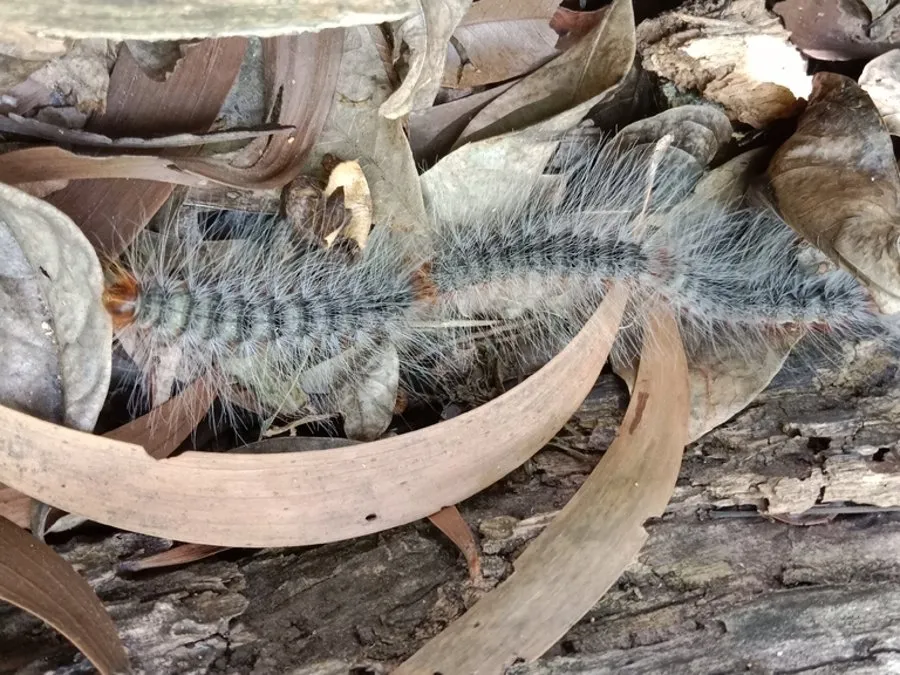
How caterpillars damage a tree
Caterpillars damage a tree by eating its leaves. Young caterpillars usually graze the leaf surface, leaving a skeleton of veins, while older ones eat whole leaves, and outbreaks can strip a tree completely. An established tree normally regrows its leaves, but repeated defoliation weakens young and stressed trees, and can occasionally kill them.
Types of caterpillars on trees
The caterpillars on South East Queensland trees fall into a few common groups, from spiny cup moths and hairy skeletonisers to communal caterpillars that shelter in silk nests or at the base of the trunk. Each keeps mostly to its own trees, and several are hazardous to touch.
| Caterpillar | What it looks like | Main trees | Hazard |
|---|---|---|---|
| Cup moths (Doratifera) | Fleshy, slug-like, 20 to 35 mm, with clusters of stinging spines at each end | Spotted gum, rose gum, blackbutt, Gympie messmate, Sydney blue gum, brush box | Painful stings |
| Gumleaf skeletoniser (Uraba lugens) | Hairy, 5 to 20 mm, yellow and brown, wearing a “hat” of old head cases | Forest red gum, spotted gum, narrow-leaved ironbark | Severe skin irritation |
| Processionary caterpillar (Ochrogaster lunifer) | Hairy, walking in lines; lives in a brown silk bag | Gums and wattles | Skin and eye irritation; danger to pregnant horses |
| White cedar moth (Leptocneria reducta) | Hairy, brown, in large groups at the base of the trunk by day | White cedar (Melia azedarach) | Skin reactions in some people |
| Poinciana looper (Pericyma cruegeri) | Long, thin and green, up to 7 cm, with white lines along the sides and back; moves by looping | Poinciana; also yellow poinciana, cassia and leucaena | None |
| Leafrollers (Strepsicrates) | Small, 10 to 20 mm, inside leaves rolled or webbed with silk | Eucalypts and tea-trees, especially young trees | None |
Sources: Business Queensland, Cup moths, Gumleaf skeletoniser and Leafroller caterpillars; University of Queensland; Pacific Pests, Pathogens and Weeds, Poinciana looper moth; Herbison-Evans and Crossley, Leptocneria reducta.
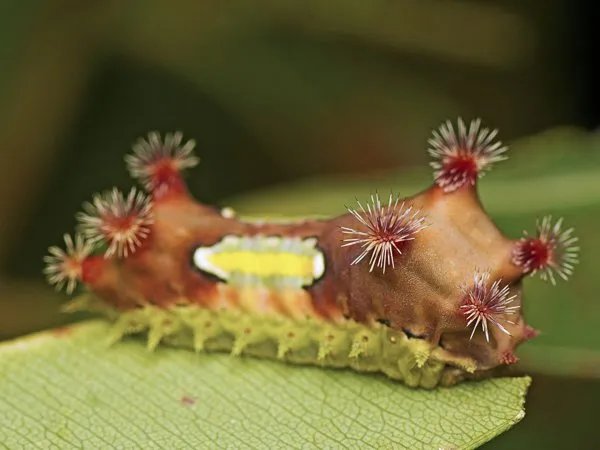
Cup moth
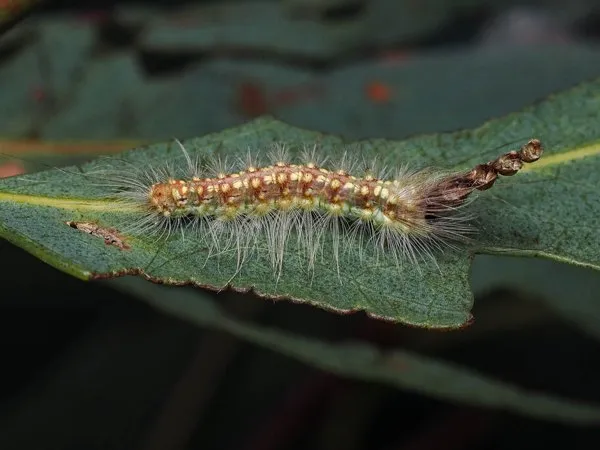
Gumleaf skeletoniser
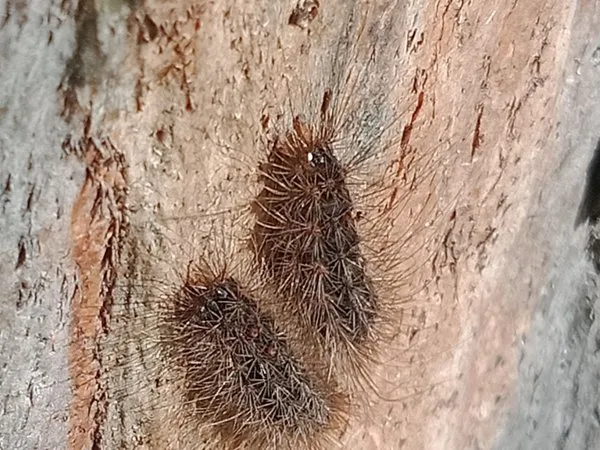
White cedar moth
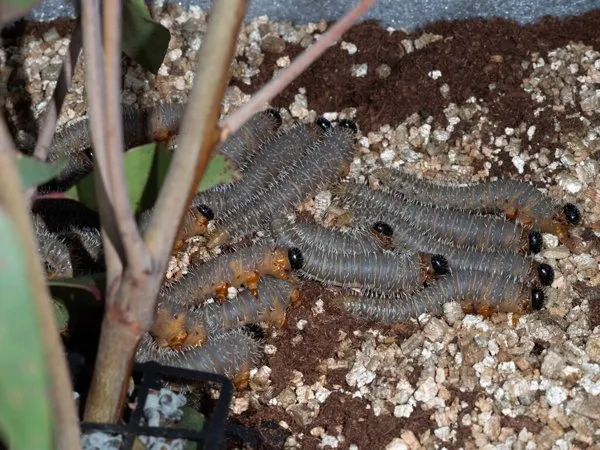
Spitfires (look-alike)
How to identify caterpillars on trees
The main sign of tree caterpillars is chewed or skeletonised leaves, usually with the caterpillars, their silk or their droppings nearby. Many feed at night and hide by day, so the damage is often seen before the caterpillars are.
Signs and symptoms of tree caterpillars
Early signs
- Skeletonised leaves
Leaf surfaces grazed away to a lacework of veins. - Clusters of caterpillars
Groups feeding together on a leaf or stem. - Droppings below
Small dark pellets falling under the tree.
Heavy outbreak
- Bronzed crown
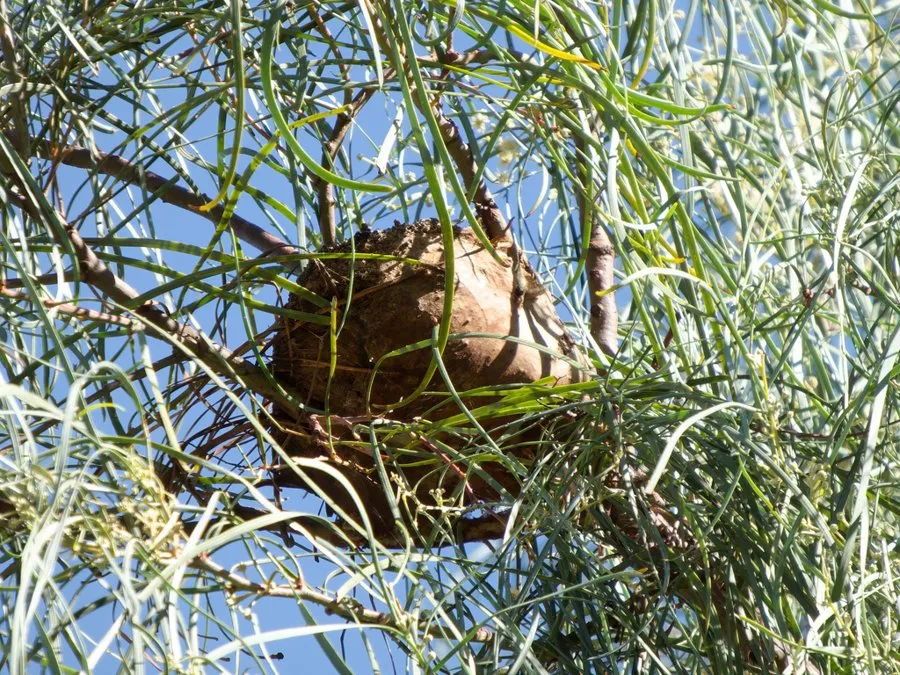
A gum that looks scorched from a distance. - Silk nests and processions
Brown silk bags in branches, and caterpillars walking in lines. - Bare branches
Whole trees stripped of leaves.
How to diagnose tree caterpillars
To diagnose caterpillars, look at the damage and then for the larvae: skeletonised leaves point to young caterpillars or gumleaf skeletonisers, a scorched-looking gum to a skeletoniser outbreak, and silk bags to processionary caterpillars. Check the base of a white cedar by day for clustered caterpillars. The main look-alike is sawfly larvae, or spitfires, which cluster on stems and rear up when disturbed. Never handle hairy or spiny larvae with bare hands.
What trees do caterpillars attack?
Caterpillars attack many trees, but in South East Queensland they are most often found on eucalypts, brush box, wattles and white cedar. Each caterpillar keeps mostly to its own group of trees, so the tree is a strong clue to what is eating it.
- Eucalypts – cup moths, gumleaf skeletonisers, processionary caterpillars, leafrollers, and spitfires.
- Brush box – cup moths.
- Wattles – processionary caterpillars.
- White cedar – white cedar moth.
- Poinciana – poinciana looper.
- Tea-trees – leafrollers.
Suspect caterpillars on your tree? We can tell you what they are and if the tree needs help.
Book a checkWhen caterpillars are most active in South East Queensland
In South East Queensland, caterpillar activity depends on the species, but the gumleaf skeletoniser is a winter pest, with outbreaks often during winter and most damage in late winter and early spring. Cup moths usually have two generations a year, and their outbreaks come and go in cycles.
White cedar moth caterpillars feed while the deciduous white cedar is in leaf. Many leafrollers have several generations a year in the subtropics.
Sources: Business Queensland, Gumleaf skeletoniser, Cup moths and Leafroller caterpillars.
How caterpillars spread
Caterpillars spread as moths, which fly to new trees and lay their eggs, often in large groups. The caterpillars themselves walk between branches and, for processionary and white cedar caterpillars, up and down the trunk.
- Egg-laying moths – gumleaf skeletonisers lay rows of up to 200 eggs under a leaf.
- Walking caterpillars – white cedar caterpillars climb the trunk each night and come back down before dawn.
- Processions – processionary caterpillars leave their nest in lines to feed or to find a place to pupate.
How to treat caterpillars on trees
Caterpillars on trees are treated by letting natural enemies work, removing clusters and nests by hand where they are within reach, and keeping young trees healthy, within an integrated pest management (IPM) approach. Business Queensland notes that control is not usually necessary for cup moths, leafrollers or sawflies.
Natural enemies
Most effective
What it is
A biological control: the birds, parasitic wasps, flies and diseases that attack caterpillars.
How it works
Birds eat caterpillars and their eggs, and parasitic wasps and tachinid flies lay their eggs in them. Cup moths are also prone to viral infections, which is likely why their outbreaks are episodic rather than constant.
Effectiveness
Why most outbreaks collapse on their own. Avoiding broad-spectrum sprays keeps these enemies working.
Removing nests and clusters
Effective
What it is
A physical control: cutting out silk nests, egg masses and clusters of caterpillars within reach.
How it works
The University of Queensland advises removing bag-shelter moth egg masses and nests from trunks and branches and disposing of them safely. Clusters of leafrollers can be squashed or dropped into boiling water. Wear gloves, long sleeves and eye protection with any hairy or spiny caterpillar.
Effectiveness
Very effective on small trees, hedges and the lower branches of larger ones, and essential near horse paddocks.
Collecting white cedar caterpillars at the base
White cedar only
What it is
A physical control: collecting white cedar moth caterpillars from where they shelter by day.
How it works
White cedar caterpillars hide in crevices on or near the ground by day and climb the trunk at dusk to feed. That habit puts the whole group within reach at the base of the tree in daylight. Use gloves, as the hairs cause skin reactions in some people.
Effectiveness
Reduces the damage on a single garden tree. Often not needed at all, since white cedars usually recover from being stripped.
Helping the tree recover
Supporting
What it is
A cultural control: watering and mulching a defoliated tree so it can regrow its leaves.
How it works
A stripped tree has to regrow its leaves from stored reserves. Watering through dry spells and mulching the root zone helps it do so, especially young trees, which have less in reserve.
Effectiveness
The best support after an outbreak, and the main protection against repeated defoliation weakening a young tree.
Insecticides
Last resort
What it is
A chemical control: an insecticide registered for caterpillars on that tree.
How it works
Business Queensland notes that controlling gumleaf skeletonisers on trees in the landscape is not feasible, though caterpillars near houses may be sprayed to stop them coming inside. Any product must be registered for the use and applied to its label.
Effectiveness
Rarely worthwhile on a tree, where coverage is poor and natural enemies are killed. Kept for small trees and for keeping hairy caterpillars out of homes.
How to prevent caterpillar damage
Preventing caterpillar damage relies on keeping natural enemies working, checking young trees, and catching nests and clusters early. Caterpillars cannot be kept off trees altogether, but early action stops a small group becoming a stripped tree.
- Check young trees for egg masses, clusters and skeletonised leaves.
- Remove silk nests early, wearing gloves and eye protection, especially near horses.
- Avoid broad-spectrum sprays, which kill the birds’ food and the wasps and flies that control caterpillars.
- Water and mulch young trees so they can regrow after feeding.
Poinciana looper on poinciana trees
The poinciana looper is the caterpillar that strips poinciana trees in South East Queensland, eating the small leaflets of the compound leaves until only the midribs remain. Its numbers rise in wet seasons and fall in dry ones, so heavy defoliation tends to follow wet spells.
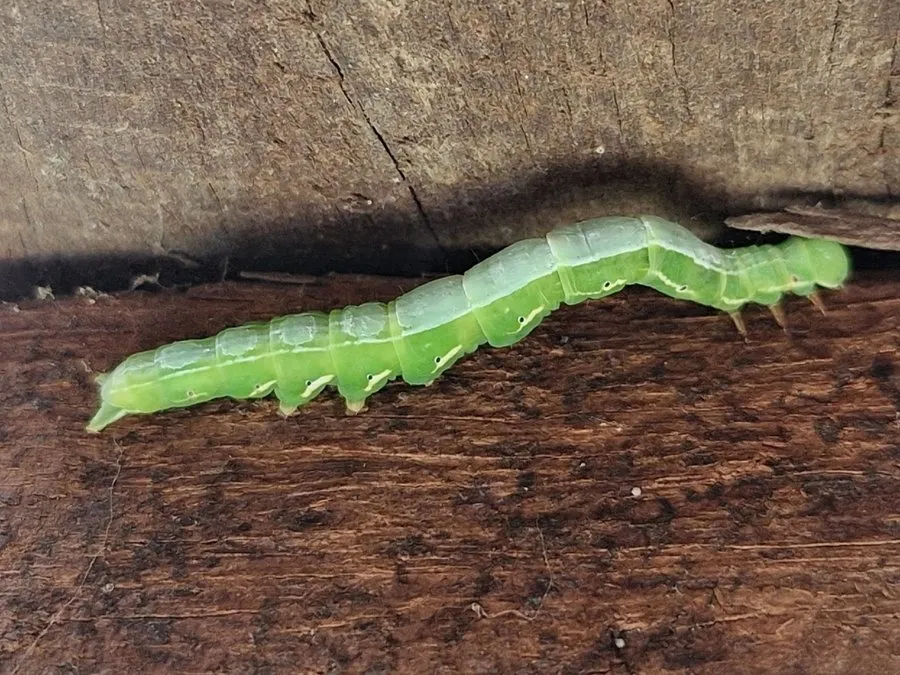
- Strips the leaflets – severe attacks can defoliate a whole tree.
- Healthy trees recover – a single stripping is usually followed by quick regrowth.
- Repeated attacks weaken trees – continued defoliation can bring smaller leaves, dieback, poor or erratic flowering, borer attack and a general loss of vigour.
- Hard to control – there is no practical control on a large tree. A registered Bacillus thuringiensis (Bt) spray works on the caterpillars but is usually too costly to apply to a whole tree.
Source: Pacific Pests, Pathogens and Weeds, Poinciana looper moth.
If a poinciana is losing vigour after repeated stripping, a tree health assessment can check whether stress, borers or root problems are holding it back.
Are tree caterpillars dangerous?
Some tree caterpillars are dangerous to touch, and the processionary caterpillar is a serious risk to horses. Cup moths have clusters of stinging spines, while gumleaf skeletonisers, processionary caterpillars and white cedar moths have hairs that cause skin irritation.
- Stinging spines – cup moth spines rise when the caterpillar is disturbed and give a painful, sharp sting.
- Irritating hairs – processionary caterpillars carry up to 2.5 million tiny hairs, which break off in the skin, are hard to remove and can get into the eyes.
- Horses – horses that eat processionary caterpillars or nest remains can lose their foals; University of Queensland researchers say the caterpillars are believed to cause up to a third of thoroughbred abortions.
For skin reactions, the Northern Territory Government suggests soothing lotions such as calamine, antihistamines for severe reactions, and medical advice if a reaction is severe or involves the eyes.
Caterpillars: common questions
What are the hairy caterpillars on my gum tree?
Hairy caterpillars on a gum tree are most often gumleaf skeletonisers, which carry a stack of old head cases like a little hat, or processionary caterpillars, which walk in lines and shelter in silk bags. Both have irritating hairs, so do not handle them with bare hands.
What is the silk bag hanging in my wattle tree?
A brown silk bag in a wattle or gum, often full of droppings and shed skins, is usually the nest of the bag-shelter moth, whose caterpillars are the processionary caterpillars. The nest is full of irritating hairs even when empty, so remove it only with gloves, long sleeves and eye protection.
Why are caterpillars walking in a line?
Caterpillars walking nose to tail in a long line are processionary caterpillars, the young of the bag-shelter moth. They leave their nest in a gum or wattle together to feed or to find a place to pupate. Their hairs cause skin and eye irritation and are a serious risk to pregnant horses.
What is eating the leaves of my gum tree?
Leaves eaten back from the edges, or skeletonised down to the veins, are usually caterpillars such as cup moths and gumleaf skeletonisers, or sawfly larvae (spitfires). Christmas beetles and other leaf beetles chew gum leaves too. Look for clusters of larvae, silk or droppings on the leaves and branches.
Why has my white cedar lost all its leaves?
A white cedar stripped bare while in leaf is usually the work of white cedar moth caterpillars, which hide at the base of the tree by day and climb up to feed at night. Trees are often stripped year after year and still recover, because white cedar is deciduous and regrows its leaves.
What is eating my poinciana tree?
A poinciana stripped of its leaflets, with long, thin green caterpillars that move by looping, is almost certainly being eaten by the poinciana looper. Healthy trees recover quickly from a single stripping, but repeated attacks can bring smaller leaves, dieback and poor flowering, so a poinciana hit year after year is worth having checked.
Are spitfires caterpillars?
No. Spitfires are the larvae of sawflies, relatives of wasps, though they look like caterpillars. They cluster in clumps on gum stems by day, and when disturbed raise their tails and bring up a yellowish fluid, which gives them their name. Like caterpillars, they eat leaves and can strip individual young trees.
Will my tree recover from caterpillars?
Usually, yes. An established tree stripped by caterpillars normally regrows its leaves, and most outbreaks collapse on their own as birds, wasps and diseases catch up with them. Repeated defoliation of young or stressed trees is the main risk, and can weaken or occasionally kill them.
References
- Business Queensland. Cup moths. Source
- Business Queensland. Gumleaf skeletoniser (Uraba lugens). Source
- Business Queensland. Leafroller caterpillars. Source
- Business Queensland. Eucalypt sawflies. Source
- University of Queensland. Saving horses from scary hairy caterpillars, 2 February 2018. Source
- Northern Territory Government. Itchy caterpillars: bag-shelter moth. Source
- Pacific Pests, Pathogens and Weeds. Poinciana looper moth (Pericyma cruegeri), fact sheet 251. Source
- Herbison-Evans, D., & Crossley, S. Leptocneria reducta (white cedar moth), Australian Caterpillars and their Butterflies and Moths. Source
General information, not a diagnosis. Many tree problems look alike, and only an inspection, and sometimes a laboratory test, can confirm what is wrong. Any treatment product must be registered for the use and applied strictly to its label.