
Root & butt rots South East Queensland
Armillaria Root Rot: Identification and Treatment
Armillaria root rot is a native fungal disease that decays the roots and base of trees and can kill them suddenly, and in Queensland it is found mainly in rainforest and wet forest country, where land cleared for gardens and orchards can carry it into new trees. This guide shows you what Armillaria root rot does, how to identify Armillaria root rot and how to treat Armillaria.
- What it is
- A native fungus that decays the roots and base of trees
- Scientific name
- Armillaria luteobubalina
- Trees affected
- More than 200 species, including eucalypts such as Gympie messmate, and fruit trees such as macadamia, citrus, custard apple and stone fruit
- Peak season
- Year-round; mushrooms appear in cool, wet weather
- How it spreads
- Root contact, and black bootlace-like strands growing through the soil from old stumps and roots
- Key sign
- Creamy, fan-shaped fungus under the bark at the base, with a strong mushroom smell
- Think your tree has Armillaria?
- We'll check the base and roots and tell you what's needed. Book a check →
What is Armillaria root rot?
Armillaria root rot is a native fungal disease that decays the roots and base of trees and can kill them suddenly. It is caused by Armillaria luteobubalina, which infects more than 200 plant species, and in Queensland it is found mainly in rainforest and wet sclerophyll forest, making it uncommon in South East Queensland gardens.
- KingdomFungiTrue fungi
- GenusArmillariaThe honey fungi
- SpeciesArmillaria luteobubalinaThe native Australian species
Sources: Business Queensland, Armillaria root rot; Queensland Mycological Society, Armillaria luteobubalina.
How Armillaria kills a tree
Armillaria kills a tree by decaying its roots and the base of the trunk. The tree slowly declines with yellowing leaves, smaller leaves and twig dieback, as with other root rots, and then often dies very suddenly: the leaves wilt and turn brown but stay on the tree. Cracks in the bark at the base are common on trees it has killed.
Armillaria vs brown root rot
Armillaria and brown root rot both decay tree roots and both can kill trees, but in South East Queensland gardens brown root rot is the one more often found. The signs at the base of the tree tell them apart.
| Armillaria root rot | Brown root rot | |
|---|---|---|
| Fungus | Armillaria luteobubalina | Pyrrhoderma noxium |
| Sign at the base | Creamy, fan-shaped fungus under the bark; strong mushroom smell | A gritty brown crust, or stocking, with a white margin |
| Mushrooms | Honey-coloured mushrooms in cool, wet weather | Brown, bracket-like fruiting bodies after prolonged rain |
| In the soil | Black, bootlace-like strands | Spreads by root contact |
| How common in SEQ | Uncommon; mainly rainforest and wet forest | A serious problem in Brisbane gardens and streets |
Sources: Business Queensland, Armillaria root rot; our brown root rot guide.
How to identify Armillaria root rot
The main sign of Armillaria root rot is creamy-white, sometimes fan-shaped fungus just beneath the bark at the base of the tree and on its large roots, with a strong mushroom smell. Black, cord-like strands on the roots and honey-coloured mushrooms at the base in cool, wet weather confirm it.
Signs and symptoms of Armillaria root rot
Early signs
- Slow decline
Yellowing leaves, smaller leaves and twig dieback. - Honey mushrooms
Clusters at the base in cool, wet weather. - Mushroom smell
A strong smell at the base of the trunk.
Advanced disease
- Creamy fans under the bark
Felt-like fungus beneath the bark at the base and roots. - Bootlace strands
Black, cord-like threads on the roots and in the soil. - Sudden death
Leaves wilting and turning brown but staying on the tree.
How to diagnose Armillaria root rot
To diagnose Armillaria, lift a small piece of bark at the base of the trunk or on a large root: creamy, felt-like or fan-shaped fungus beneath it, with a strong mushroom smell, is the diagnostic sign. Look for black, bootlace-like strands on the roots. Honey-coloured mushrooms alone are not enough, as many fungi fruit at tree bases. A laboratory test confirms it.
What trees does Armillaria affect?
Armillaria affects more than 200 plant species across more than 50 families, most of them native to Australia, and Business Queensland lists eucalypts such as Gympie messmate and fruit trees including macadamia, citrus, custard apple and stone fruit among its hosts. Trees planted on land recently cleared of native forest are most at risk.
- Eucalypts – including Gympie messmate and shining gum.
- Fruit and nut trees – macadamia, citrus, custard apple, stone fruit, apple, pear, banana and grapevines.
- Native forest trees – in rainforest and wet sclerophyll forest.
Suspect Armillaria in your tree? We can check the base and roots and tell you what's needed.
Book a checkWhen Armillaria is most active in Queensland
Armillaria is active year-round, as the decay continues inside the roots in every season, but its honey-coloured mushrooms appear during wet, cold weather in early winter. A tree can decline slowly for some time before dying suddenly.
Source: Business Queensland, Armillaria root rot.
How Armillaria spreads
Armillaria spreads through the soil, by root contact with infected trees and, more commonly, by black, root-like strands called rhizomorphs that grow out from infected roots and stumps. The fungus can survive in the soil for many years on old stumps and roots.
- Rhizomorphs – bootlace-like strands grow through the soil and infect young roots.
- Root contact – roots touching infected roots pass the fungus on.
- Moved soil and roots – small infected root pieces travel in flowing water and on machinery.
- Not the mushrooms – Business Queensland notes the mushrooms play no role in infection.
How to treat Armillaria root rot
Armillaria root rot is treated mainly by removing infected roots and stumps and keeping new plantings away from them, within an integrated approach. There is no cure for an infected tree, so the aim is to stop the fungus reaching healthy ones.
Removing infected roots and stumps
Most effective
What it is
A physical control: digging out as many roots and stumps as possible from infected and recently cleared ground.
How it works
The fungus lives on in old roots and stumps for years and grows out from them to infect new trees. Business Queensland advises removing as many roots and stumps as possible before planting. Infected material should not be moved to other sites.
Effectiveness
The only proven way to reduce the risk to new and neighbouring trees.
Careful replanting
Effective
What it is
A cultural control: choosing where and how to plant after Armillaria.
How it works
Business Queensland advises planting between old rows rather than in the same spots, building mounds free of root residue where planting is dense, and using resistant rootstocks in high-risk areas.
Effectiveness
Keeps new trees' roots away from the fungus while it remains in old roots.
Risk assessment of infected trees
Safety
What it is
Checking whether an infected tree is still safe.
How it works
Armillaria decays the roots and the base of the trunk, which can make a tree unstable before it looks dead. A tree risk assessment checks the extent of decay and whether the tree is a danger to people or property.
Effectiveness
Essential for any infected tree near a house, path, road or play area.
Soil fumigation
Orchards only
What it is
A chemical control: fumigating infested soil with a registered fumigant before replanting.
How it works
Business Queensland lists fumigating infested soil with a recommended fumigant for orchards and vineyards. Any product must be registered for the use and applied to its label.
Effectiveness
A commercial orchard measure, not practical in a garden.
How to prevent Armillaria root rot
Preventing Armillaria relies on not planting into old infected roots and stumps, and on not moving infected soil and wood. In South East Queensland it matters most on blocks recently cleared of rainforest or wet forest.
- Remove old roots and stumps before planting on recently cleared land.
- Do not move soil or wood from an infected site.
- Replant away from old stump positions.
- Have declining trees checked early on rainforest and wet forest blocks.
Armillaria root rot: common questions
What are the honey-coloured mushrooms at the base of my tree?
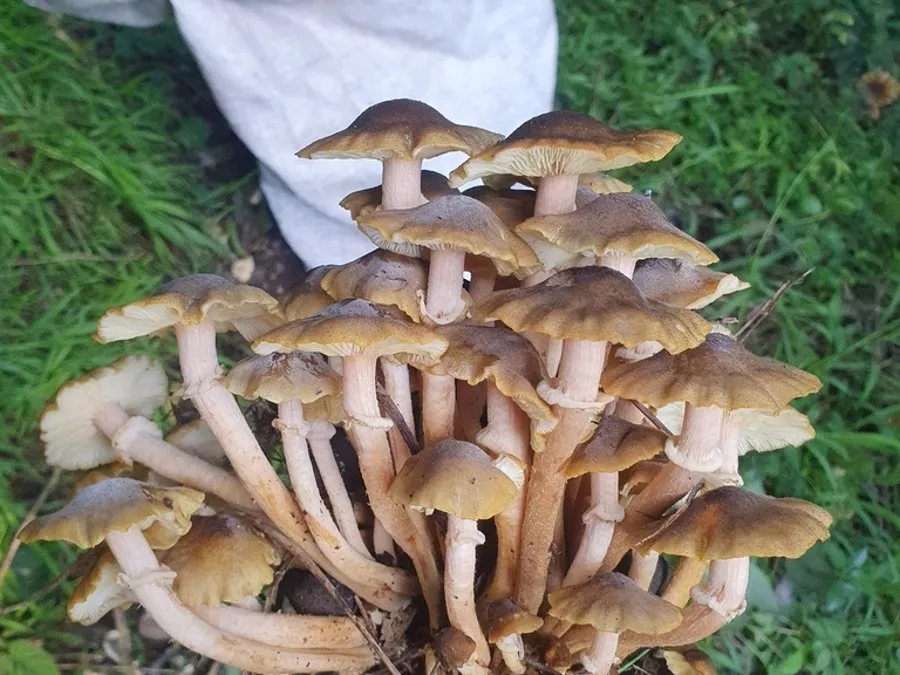
Clusters of honey-coloured mushrooms with widely spaced gills at the base of a tree, appearing in cool, wet weather, can be Armillaria, the honey fungus. Many other mushrooms grow at tree bases too, so look under the bark at the base for creamy, fan-shaped fungus and a strong mushroom smell to confirm it.
What is the white fungus under the bark of my tree?
Creamy-white, felt-like or fan-shaped fungus just beneath the bark at the base of a tree or on its large roots is a sign of Armillaria root rot. Business Queensland lists it, with a strong mushroom smell, as the diagnostic sign of the disease.
Is Armillaria common in South East Queensland?
No, it is uncommon in South East Queensland gardens. In Queensland it is found mainly in rainforest and wet sclerophyll forest, and Business Queensland notes losses are most likely where trees are planted on land recently cleared of native vegetation, where old roots and stumps carry the fungus.
Can a tree with Armillaria be saved?
Usually not once the base and major roots are badly decayed, and Armillaria can kill a tree suddenly. Because it decays the roots, an infected tree can also become unstable, so a tree with Armillaria near a house or path should have a risk assessment.
Can I plant a new tree where one died of Armillaria?
Not straight away. The fungus survives for many years on old roots and stumps. Business Queensland advises removing as many roots and stumps as possible before replanting, and planting between the old rows rather than in the same spots.
References
General information, not a diagnosis. Many tree problems look alike, and only an inspection, and sometimes a laboratory test, can confirm what is wrong. Any treatment product must be registered for the use and applied strictly to its label.