
Insects South East Queensland
Psyllids and Lerps on Trees: Identification and Treatment
Psyllids are tiny sap-sucking insects that feed on the leaves of trees, and on eucalypts their young shelter under small covers called lerps. In South East Queensland they are common on gum trees and lilly pilly hedges. This guide shows you what psyllids do, how to identify psyllids and lerps and how to treat psyllids.
- What it is
- Tiny sap-sucking insects; on gums, the young live under a sugary or waxy cover called a lerp
- Scientific name
- Psylloidea (many species)
- Trees affected
- Eucalypts, especially rose gum, forest red gum, blackbutt and spotted gum, lilly pilly and Moreton Bay fig
- Peak season
- Builds with each flush of new growth
- How it spreads
- Winged adults fly to new leaves and trees, and arrive on infested plants
- Key sign
- White or lacy lerps on gum leaves; pimples or pits on new lilly pilly leaves
- Think your tree has psyllids?
- We'll check it and tell you if it needs treating. Book a check →
What are psyllids and lerps?
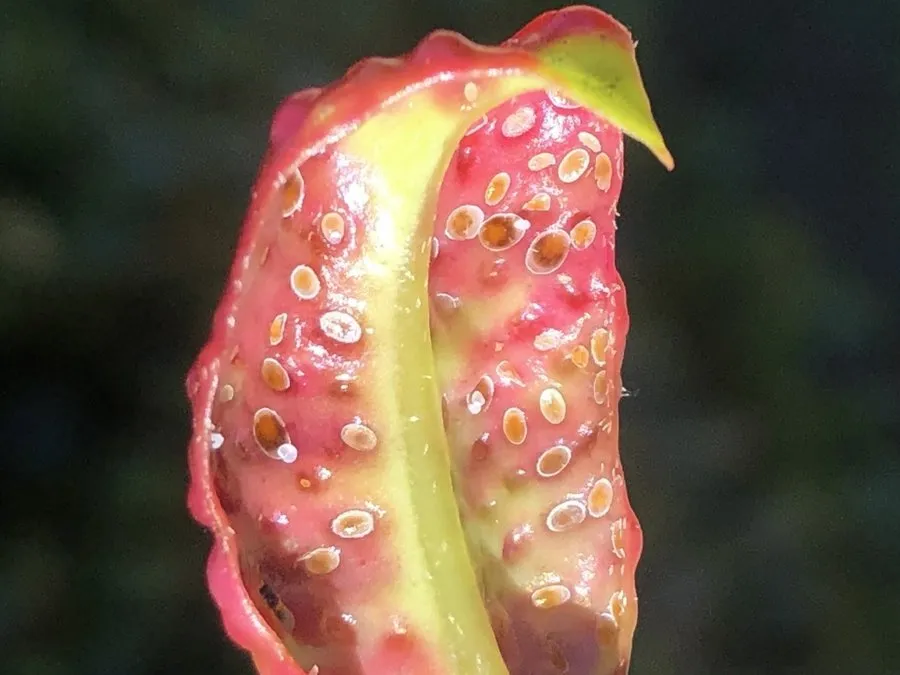
Psyllids are tiny sap-sucking insects, a few millimetres long, related to aphids and scale insects, and lerps are the covers their young build to shelter under while they feed. On gum trees the lerps show up as small white, cream or lacy spots on the leaves. On lilly pillies, a psyllid that builds no lerp instead leaves pimples and pits in the new leaves.
- KingdomAnimaliaAnimals
- OrderHemipteraThe true bugs, with sucking mouthparts
- SuperfamilyPsylloideaThe psyllids
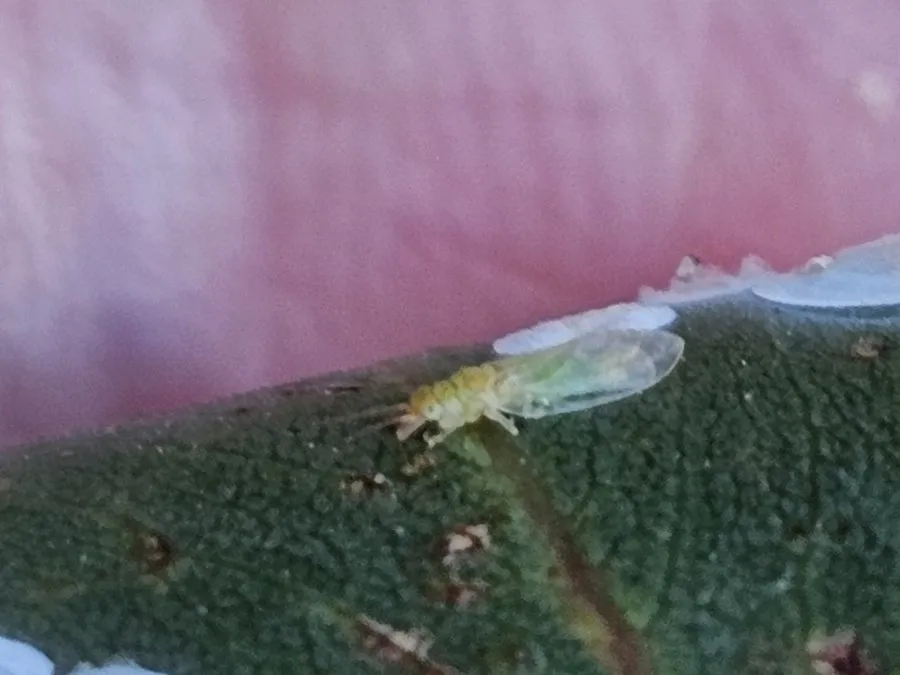
How psyllids damage a tree
Psyllids damage a tree by sucking sap from its leaves. Most lerp psyllids do little direct harm, but their sugary waste grows sooty mould, and some species kill the leaf around where they feed, turning it red-purple and then brown. In high numbers they can strip a tree, causing defoliation, tip dieback and, rarely, death.
Types of psyllids on trees
The psyllids on South East Queensland trees fall into lerp-building species on eucalypts and the free-living lilly pilly psyllid, and the damage each does differs. Business Queensland lists four groups on Queensland eucalypts, and the lilly pilly psyllid adds a fifth on lilly pillies.
| Psyllid | What it looks like | Damage | Main trees |
|---|---|---|---|
| Sugar lerps (Glycaspis) | Squarish to conical white lerps, up to 5 mm, on the upper leaf along the midrib | Little direct damage; honeydew and sooty mould; defoliation in high numbers | Rose gum, forest red gum, blackbutt, swamp mahogany, red ironbark |
| Basket lerps (Cardiaspina) | Lacy, basket or shell-like lerps, 1 to 4 mm, yellow-brown | Kill leaf tissue, which turns red-purple then brown; leaves drop | Rose gum, forest red gum, swamp mahogany, Sydney blue gum |
| Creiis psyllid | Round, smooth, shell-like lerps, 1 to 5 mm, mostly under older leaves | Reddish-purple, then brown, dying leaf tissue; crown discolouration | Dunn’s white gum, grey gum |
| Spotted gum psyllid (Eucalyptolyma maideni) | White, flat, fern-shaped lerps about 10 mm long | Rarely defoliates; sooty mould in high numbers | Spotted gum, red bloodwood |
| Lilly pilly psyllid (Trioza adventicia) | No lerp; pimples on the upper leaf with pits underneath | Pimpled, distorted, discoloured new growth | Lilly pilly (Syzygium) |
| Moreton Bay fig psyllid (Mycopsylla fici) | A sticky white lerp covering on the leaves | Occasional outbreaks can strip the tree bare | Moreton Bay fig only |
Sources: Business Queensland, Psyllids and lerps; Taylor and Martoni (2019); Australian Faunal Directory, Mycopsylla fici.
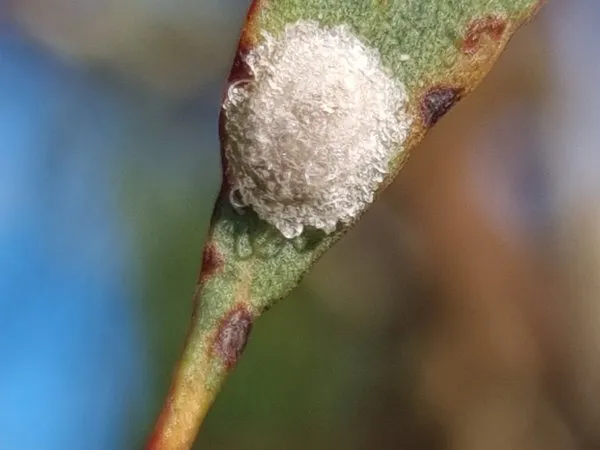
Sugar lerp
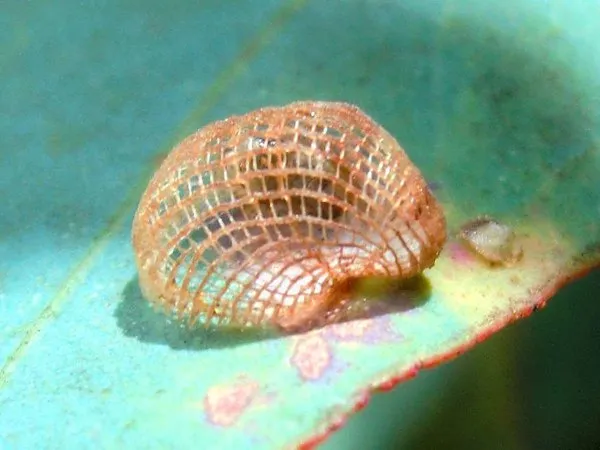
Basket lerp
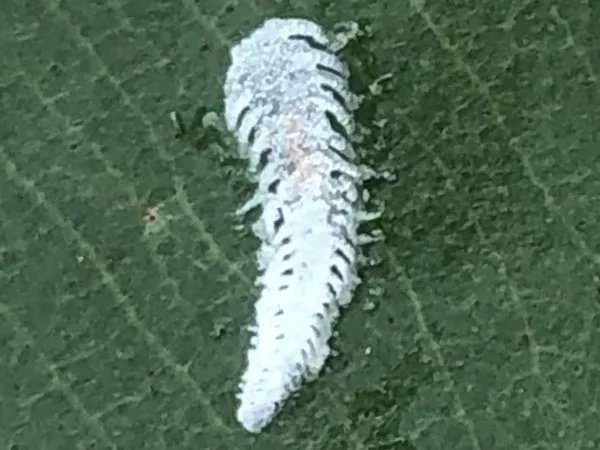
Spotted gum psyllid
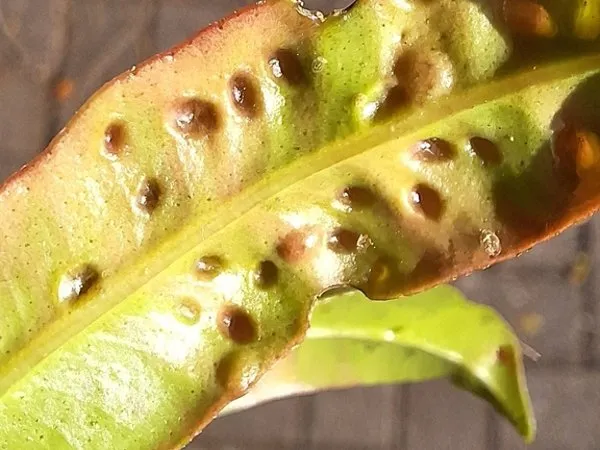
Lilly pilly psyllid
How to identify psyllids and lerps
The main sign of psyllids is small white or lacy covers stuck to gum leaves, or pimples and pits in the new leaves of a lilly pilly. On gums, lift a lerp with a fingernail: a tiny yellow or green insect underneath confirms it is live.
Signs and symptoms of psyllids
Early signs
- White spots on gum leaves
Small white, cream or lacy lerps on the leaf surface. - Pimply new leaves
Raised bumps on new lilly pilly growth, with pits underneath. - Sticky leaves
Honeydew on the leaves, and on cars and paving below.
Advanced damage
- Browning leaves
Red-purple, then brown patches around the lerps. - Black leaves
Sooty mould growing on the honeydew. - Leaf drop and dieback
Thinning crowns and dying tips on heavily infested gums.
How to diagnose psyllids
To diagnose psyllids on a gum, lift a lerp: an empty lerp is old, while a small yellow, orange or green nymph underneath means the colony is active. On a lilly pilly, pimples on the upper surface of new leaves that match pits underneath are the lilly pilly psyllid. Look-alikes include scale insects, which are fixed to stems and midribs and do not lift off as a cover, and sooty mould, which is black and rubs off.
What trees do psyllids affect?
Psyllids mostly affect eucalypts and lilly pillies in South East Queensland, and each psyllid species keeps to its own group of trees. Rose gum, forest red gum, blackbutt, swamp mahogany and spotted gum carry lerp psyllids, while the lilly pilly psyllid attacks lilly pillies.
| Tree | Psyllid | What to know |
|---|---|---|
| Rose gum (Eucalyptus grandis) | Sugar lerps, basket lerps | Hosts both sugar and basket lerps |
| Forest red gum (E. tereticornis) | Sugar lerps, basket lerps | Commonly carries lerps in SEQ |
| Blackbutt, red ironbark, Gympie messmate | Sugar lerps | Honeydew and sooty mould more than leaf damage |
| Swamp mahogany, Sydney blue gum | Sugar lerps, basket lerps | Leaf browning in heavy years |
| Spotted gum, red bloodwood | Spotted gum psyllid | Usually cosmetic |
| Dunn’s white gum, grey gum | Creiis psyllid | Can brown the whole crown |
| Lilly pilly (Syzygium) | Lilly pilly psyllid | Pimpled new growth; some varieties far more susceptible |
| Moreton Bay fig (Ficus macrophylla) | Moreton Bay fig psyllid | Its only host; outbreaks can defoliate the whole tree |
Source: Business Queensland, Psyllids and lerps.
Suspect psyllids on your tree? We can check it and tell you if it needs treating.
Book a checkWhen psyllids are most active in South East Queensland
In South East Queensland, psyllids are most active when trees push out new growth, so numbers build with each flush of soft leaves, in spring especially. Psyllid numbers generally rise with the tree’s new growth and fall away in cool weather, and for sugar lerps, Business Queensland notes low temperatures and high humidity go with low psyllid numbers.
Psyllids breed through several generations a year, and each takes weeks in warm weather but months in cool weather.
Sources: Business Queensland, Psyllids and lerps; University of California IPM, Pest Notes 7460.
How psyllids spread
Psyllids spread as winged adults, which fly to new leaves and nearby trees and lay their eggs on soft new growth. The young then settle and feed in one place, building a lerp on gums or forming a pit on lilly pilly leaves.
- Flying adults – adults move freely between trees and gardens.
- New growth – eggs are laid on young leaves, so every growth flush is a new target.
- Infested plants – psyllids arrive on new lilly pillies and other plants brought into the garden.
How to treat psyllids
Psyllids are treated by letting their natural enemies work, keeping the tree free of stress, and on lilly pillies, choosing resistant varieties, within an integrated pest management (IPM) approach. On an established gum, lerps rarely need any treatment at all.
Natural enemies
Most effective
What it is
A biological control: the birds, insects and parasitic wasps that feed on psyllids.
How it works
Small birds eat psyllids and their lerps, and a range of tiny wasps lay their eggs in psyllid eggs and nymphs. Broad-spectrum sprays kill these natural enemies along with the pest.
Effectiveness
On most gums, enough on its own. It is the main reason lerp numbers rise and fall from year to year without anyone doing anything.
Choosing resistant lilly pillies
Most effective
What it is
A cultural control: planting lilly pilly varieties the psyllid rarely attacks.
How it works
Susceptibility varies widely. Syzygium luehmannii and its dwarf form 'Royal Flame', and Acmena smithii var. minor, are reported not to be attacked, while many Syzygium australe and S. paniculatum cultivars are very susceptible.
Effectiveness
The only lasting answer for a lilly pilly hedge that is pimpled every year. When replacing or planting, ask the nursery about psyllid resistance.
Reducing drought stress
Effective
What it is
A cultural control: keeping the tree watered and mulched through dry spells.
How it works
Drought-stressed trees carry far more psyllids. University of California research on the redgum lerp psyllid found that reducing drought stress can substantially reduce psyllid numbers.
Effectiveness
A simple, lasting help for young gums and lilly pilly hedges, and it makes every other control work better.
Trimming lilly pilly hedges
Supporting
What it is
A physical control: trimming off pimpled new growth on lilly pilly hedges.
How it works
The psyllid breeds in soft new growth. Trimming removes the infested tips, and leaving the clippings on the ground for a few weeks lets the parasitic wasps inside them emerge and return to the hedge. Each trim also triggers a new flush, so the timing matters.
Effectiveness
Keeps a hedge looking tidy, but the psyllids return to the next flush. Best combined with good watering, and with resistant varieties when replanting.
Avoiding excess nitrogen
Supporting
What it is
A cultural control: not over-fertilising trees and hedges.
How it works
Psyllids prefer the soft, succulent growth that heavy nitrogen fertiliser produces. Lighter, balanced feeding means less of it.
Effectiveness
A small but easy help, especially on lilly pilly hedges that are fed to push growth.
Systemic insecticides
Last resort
What it is
A chemical control: a systemic insecticide taken up by the tree, which reaches psyllids feeding on its sap.
How it works
Sprays rarely work on psyllids, because the lerp or the leaf pit shields the young. A systemic product reaches them through the sap instead, and is timed for before the new growth flush. Any product must be registered for the use and applied to its label.
Effectiveness
Results vary, and it also kills the parasitic wasps that control psyllids naturally. Kept for valuable hedges or young trees badly affected year after year.
How to prevent psyllids
Preventing psyllid damage relies on healthy, unstressed trees and plants the psyllids rarely attack. Psyllids cannot be kept out of a garden, but they can be kept at numbers that do no harm.
- Choose resistant lilly pilly varieties when planting a hedge.
- Water through dry spells, as drought-stressed trees carry far more psyllids.
- Feed lightly, avoiding heavy nitrogen that pushes soft growth.
- Avoid broad-spectrum insecticides, which kill the birds’ food and the wasps that control psyllids.
Bumps on lilly pilly leaves: the lilly pilly psyllid
Pimples and pits on new lilly pilly leaves are caused by the lilly pilly psyllid, Trioza adventicia, a common pest of lilly pilly hedges. Each pimple is where a young psyllid settled into the soft leaf to feed, leaving a pit underneath.
- Mostly cosmetic – the hedge survives, but new growth is pimpled, curled and blotchy red or purple.
- Worst on soft growth – each flush of new leaves, and each trim, brings a new round of damage.
- Variety matters most – some lilly pillies are badly attacked every year while others are barely touched.
The lilly pilly psyllid was long called Trioza eugeniae, a name that a 2019 study showed belongs to a different psyllid found only in a small area of south-eastern Australia. If a lilly pilly is declining beyond its new leaves, with dieback or bark damage, look for another cause through a tree health assessment.
Moreton Bay figs stripped by psyllids
The Moreton Bay fig psyllid, Mycopsylla fici, can strip a Moreton Bay fig completely bare in an outbreak. It was first described in 1895 from Brisbane, and the Moreton Bay fig is its only host.
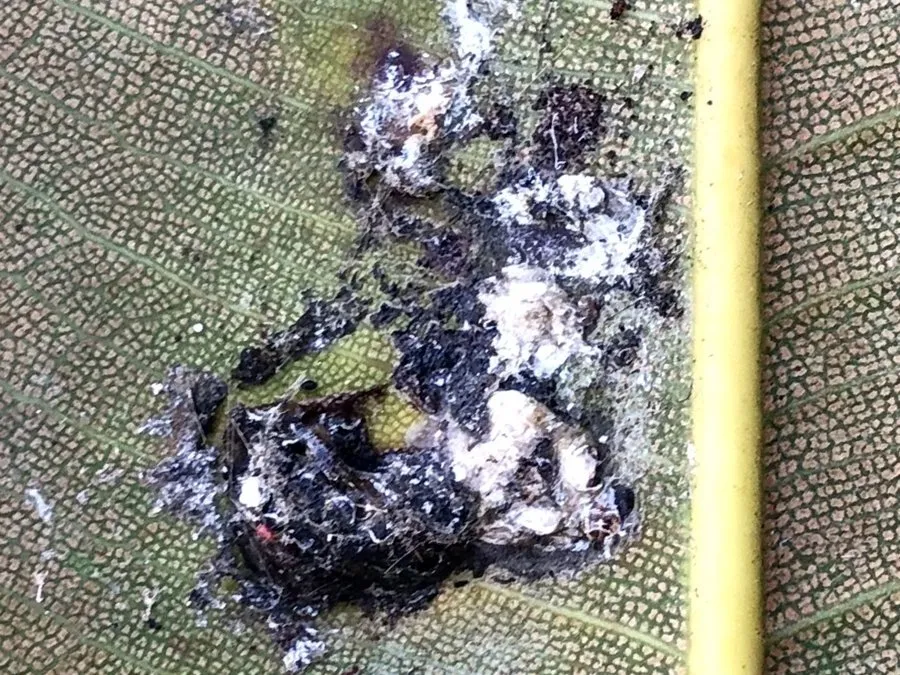
- Sticky lerps – the young psyllids cover themselves in a sticky lerp, which coats leaves and drips onto whatever is below.
- Defoliation – occasional outbreaks strip the whole tree, cutting the leaves and fruit that many insects and animals rely on.
- Stress plays a part – a Macquarie University study found the psyllid affected tree health but was not the only, or even the main, cause of defoliation, with water and nutrient supply also major factors.
Moreton Bay figs usually regrow after an outbreak. A fig that defoliates repeatedly is worth a tree health assessment, which looks at the root zone, water and soil as well as the psyllids.
Psyllids and lerps: common questions
What are the white spots on my gum tree leaves?
Small white, cream or lacy spots that sit on the leaf surface and can be flicked off are usually lerps: the protective covers that young psyllids build over themselves while they feed. Lift one and you may find a tiny yellow or green insect underneath. On an established gum they rarely need treating.
Why are my lilly pilly leaves covered in bumps?
Pimples or bumps on new lilly pilly leaves, often red or purple, with a pit on the other side, are caused by the lilly pilly psyllid. Each pimple is where a young psyllid settled and fed. The damage is mostly cosmetic, but it can make a hedge look distorted and blotchy.
Why are the new leaves on my lilly pilly curled and blistered?
The most common cause is the lilly pilly psyllid, which attacks soft new growth and leaves it puckered, curled and pitted as it hardens. Look for pimples on the upper surface and pits underneath. Fresh, distorted growth in spring is the usual time it shows.
Can lerps kill a gum tree?
Rarely. Most gums carry lerps every year without harm. Very high numbers can brown the leaves, cause leaf drop and tip dieback, and occasionally kill a tree, according to Business Queensland. In parts of New South Wales, over-abundant psyllids together with bell miner birds are linked to a forest dieback that is listed as a key threatening process.
Should I spray my gum tree for lerps?
Usually not. Sprays rarely reach the psyllids under their lerps, and they kill the birds' food and the small wasps that keep psyllids in check. On a large gum, a well-watered, unstressed tree and its natural enemies do more than any spray.
Which lilly pillies are resistant to psyllids?
Burke's Backyard reports that Syzygium luehmannii (riberry) and its dwarf form 'Royal Flame', and the small-leaved lilly pilly Acmena smithii var. minor, do not appear to be attacked, while Syzygium australe cultivars such as 'Blaze' and 'Lillyput' and S. paniculatum cultivars are very susceptible. Nursery claims vary, so ask about psyllid resistance when buying.
Why has the Moreton Bay fig lost its leaves?
A Moreton Bay fig stripped bare, with sticky white lerps on the remaining leaves and honeydew dripping below, is usually having an outbreak of the Moreton Bay fig psyllid. Research suggests water and nutrient stress matter as much as the psyllid itself, so a fig that defoliates repeatedly is worth having its root zone and water supply checked.
Why is my gum tree dropping brown leaves?
One common cause is psyllids: some species, such as the basket lerps, kill the leaf tissue around where they feed, turning patches red-purple and then brown until the leaf falls. Check the browned leaves for lerps. Drought, root damage and other stresses cause leaf drop too, so a tree dropping leaves heavily is worth having checked.
References
- Business Queensland. Psyllids and lerps. Source
- Taylor, G. S., & Martoni, F. (2019). Case of mistaken identity: resolving the taxonomy between Trioza eugeniae Froggatt and T. adventicia Tuthill (Psylloidea: Triozidae). Bulletin of Entomological Research, 110(3), 340–351. Source
- University of California IPM. Eucalyptus redgum lerp psyllid, Pest Notes 7460. Source
- University of California IPM. Psyllids, Floriculture and Ornamental Nurseries Pest Management Guidelines. Source
- NSW Threatened Species Scientific Committee. Forest eucalypt dieback associated with over-abundant psyllids and bell miners, key threatening process listing. Source
- Australian Faunal Directory. Mycopsylla fici (Tryon, 1895). Source
- Newman, A. K. L. The biology of Mycopsylla fici Tryon on its sole host Ficus macrophylla. Thesis, Macquarie University. Source
- Burke's Backyard. Lilly pilly psyllids. Source
General information, not a diagnosis. Many tree problems look alike, and only an inspection, and sometimes a laboratory test, can confirm what is wrong. Any treatment product must be registered for the use and applied strictly to its label.