
Leaf diseases South East Queensland
Sooty Mould on Trees: What Causes It and How to Get Rid of It
Sooty mould is a black fungus that coats the leaves and stems of trees, growing on the sticky honeydew left by sap-sucking insects, and South East Queensland's warm, humid weather lets it build up fast on lilly pillies, gums and fruit trees. This guide shows you what sooty mould is, what causes sooty mould on trees and how to get rid of sooty mould.
- What it is
- Fungi that grow on the honeydew sap-sucking insects leave on leaves
- Scientific name
- Capnodium, Scorias, Leptoxyphium and many others
- Trees affected
- Any tree with honeydew insects, especially lilly pilly, umbrella tree, eucalypts, citrus, mango and avocado
- Peak season
- Warm, humid weather, peaking when scale and psyllid numbers build in spring and late summer
- How it spreads
- Airborne spores, which can only grow where honeydew coats the leaves
- Key sign
- A black, sooty coating on leaves and stems that rubs or peels off
- Black leaves on your tree?
- We'll find the insects causing it and tell you if it needs treating. Book a check →
What is sooty mould?
Sooty mould is a black fungus that grows on the leaves, stems and fruit of trees, feeding on the sticky honeydew left by sap-sucking insects. It is not a single species but a group of fungi with the same habit, and it coats the leaves like soot. Sooty mould does not infect the tree; it grows on the leaf surface, feeding on the honeydew.
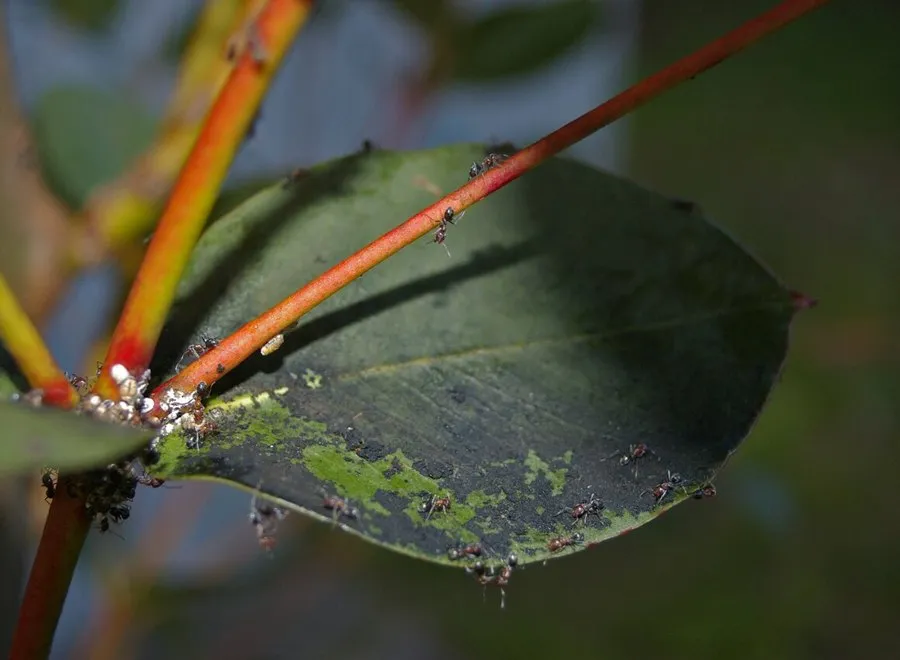
How sooty mould affects a tree
Sooty mould affects a tree by shading its leaves, which reduces the light they can use to make energy. How much that matters depends on how thick the mould is. In a study of orange trees, sooty mould blocked between 44% and 74% of the light reaching the leaves, yet the leaves still made as much energy at their peak as clean leaves, and had more chlorophyll.
On most trees, sooty mould spoils the look of the tree, and fruit, long before it seriously harms it. The insects producing the honeydew are usually the bigger problem.
Source: Insausti et al. (2015), European Journal of Plant Pathology.
What causes sooty mould on trees?
Sooty mould is caused by sap-sucking insects that excrete honeydew, most often scale insects, psyllids and mealybugs on South East Queensland trees. The insects take the protein they need from the sap and pass out the excess sugar, which drips onto the leaves below and feeds the mould.
| Insect | Where to look | What to know |
|---|---|---|
| Scale insects | Waxy domes or shells on stems and leaf midribs | The most common cause; pink wax scale on lilly pilly and umbrella tree, gumtree scale on eucalypts |
| Psyllids and lerps | Small white or yellow lerp covers on gum leaves | Sugar lerps (Glycaspis) on eucalypts produce honeydew that grows sooty mould |
| Mealybugs | White, mealy-coated insects in leaf joints and on fruit | Heavy sooty mould on citrus and fruit trees |
| Whitefly | Tiny white winged insects under the leaves | Adults and young both excrete honeydew |
| Aphids | Clusters of small soft insects on new shoots | Usually only causes sooty mould when numbers build up to high levels |
Sources: Business Queensland fact sheets for each insect.
How to identify sooty mould
The main sign of sooty mould is a black, sooty coating on the upper surface of leaves, which rubs or peels off. It usually sits below the insects producing the honeydew, so the blackest leaves are often the lower ones, and the leaves may feel sticky before the mould appears.
Signs and symptoms of sooty mould
Early signs
- Sticky leaves
Clear, sticky honeydew on leaves, and on cars and paving under the tree. - Grey film
A thin, dark film starting on the upper surface of the leaves. - Ants
Lines of ants climbing the trunk to feed on the honeydew.
Heavy mould
- Black leaves
Leaves, twigs and fruit coated in a thick, black crust. - Flaking
Dry mould cracking and peeling off in sheets. - Dull canopy
A whole tree or hedge looking grey and dirty.
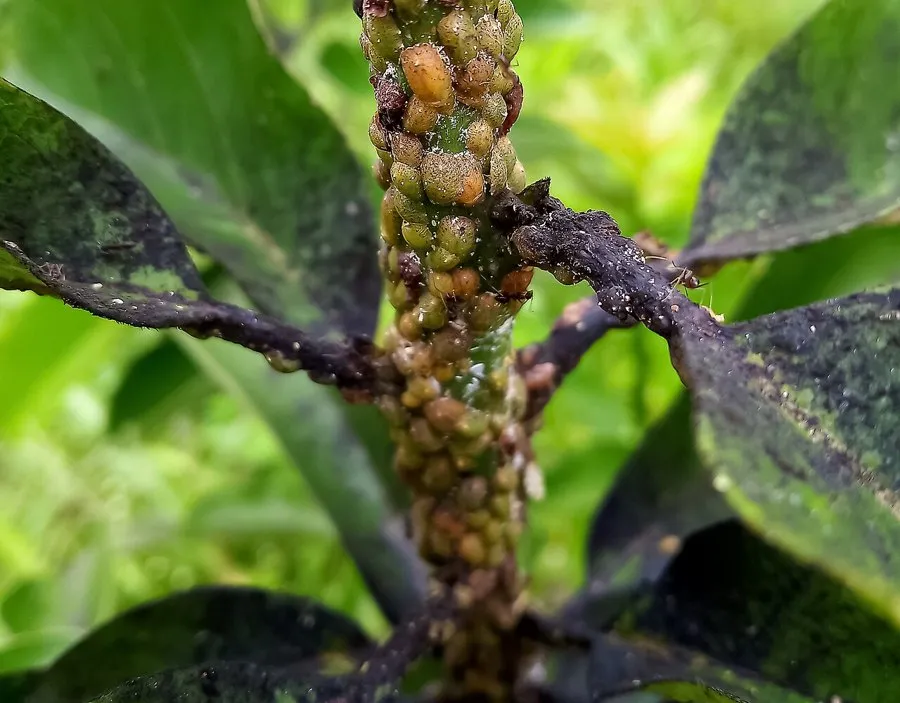
How to diagnose sooty mould
To diagnose sooty mould, rub or peel the black coating: sooty mould comes away like soot or a thin skin, leaving the leaf beneath green and healthy. Leaf spot diseases look similar but are part of the leaf and do not rub off. Once you have confirmed sooty mould, look on the stems and leaves above it for the insects producing the honeydew.
How sooty mould spreads
Sooty mould spreads as airborne spores, but it can only grow where there is honeydew to feed on. That is why it appears on one tree and not its neighbour: the spores land everywhere, and the mould grows only on the tree carrying sap-sucking insects, or on whatever sits beneath it.
How to get rid of sooty mould
Sooty mould is removed by controlling the insects that produce the honeydew, within an integrated pest management (IPM) approach. Once there is no fresh honeydew, the mould stops growing and weathers away, so cleaning the leaves without controlling the insects only works until the mould grows back.
Controlling the honeydew insects
Most effective
What it is
Treating the cause: the scale, psyllids, mealybugs or other sap-suckers producing the honeydew.
How it works
Without fresh honeydew, sooty mould has nothing to feed on. How the insects are controlled depends on which they are; for the most common cause, see how to treat scale insects.
Effectiveness
The only treatment that stops sooty mould coming back. Everything else on this list either supports it or only cleans the leaves.
Ant control
Effective
What it is
A physical or chemical control: stopping ants from climbing the tree, with a sticky band around the trunk or a registered treatment at its base.
How it works
Ants feed on honeydew and protect the insects producing it from their predators and parasites, and they move scale insects to new feeding spots. Keeping ants off lets ladybirds and parasitic wasps bring the insects down.
Effectiveness
One of the most useful steps on any tree with sooty mould and a line of ants up the trunk.
Washing the leaves
Small trees only
What it is
A physical control: hosing or wiping the mould off the leaves.
How it works
Water softens the honeydew and lifts the dry mould from the leaf surface, restoring the leaves' appearance and the light reaching them.
Effectiveness
Useful on hedges, small trees and fruit, once the insects are under control. On a large tree, or while the insects are still feeding, it makes little lasting difference.
Letting it weather away
Supporting
What it is
Leaving rain and sun to break down the mould once the insects are controlled.
How it works
Without fresh honeydew, the mould dries, cracks and flakes off, and rain gradually washes it away. New leaves grow in clean.
Effectiveness
How most large trees recover. It is slow, but it costs nothing and does no harm.
Fungicides
Not needed
What it is
A chemical control aimed at the fungus itself.
How it works
Sooty mould is not infecting the tree; it lives on the honeydew on the leaf surface. A fungicide does nothing about the honeydew, so the mould keeps returning while the insects are there.
Effectiveness
Not a treatment for sooty mould. Money spent on controlling the insects does far more.
How to prevent sooty mould
Preventing sooty mould means preventing the honeydew insects from building up, by keeping their natural enemies working and the tree healthy. A tree without heavy scale, psyllid or mealybug numbers does not get sooty mould.
- Keep ants off the tree, because they protect honeydew insects from their predators.
- Avoid broad-spectrum insecticides, which kill ladybirds and parasitic wasps along with the pest.
- Check stems and leaves in spring, when scale crawlers first hatch, and deal with small colonies early.
- Check new plants for scale and mealybugs before planting them.
- Keep trees well watered and mulched through dry spells, as stressed trees are more heavily infested.
Suspect sooty mould on your tree? We can find the insects causing it and tell you if it needs treating.
Book a checkSooty mould vs powdery mildew
Sooty mould is black and grows on insect honeydew on the leaf surface, while powdery mildew is white to grey and is a fungus feeding on the leaf itself. Both rub off with a finger, which is why they are confused, but they have different causes and need different treatment.
| Sooty mould | Powdery mildew | |
|---|---|---|
| Colour | Black, like soot | White to grey, like flour |
| What it is | Fungi growing on insect honeydew | Fungi feeding on the leaf |
| Needs insects? | Yes: scale, psyllids, mealybugs and others | No |
| Sticky leaves? | Often, from the honeydew | No |
| Common SEQ trees | Lilly pilly, umbrella tree, eucalypts, citrus, mango | Crepe myrtle, mango, plane trees |
| Treatment | Control the insects; the mould weathers away | Resistant varieties, airflow, and sprays on small trees |
For the white powder, see our powdery mildew guide.
What trees get sooty mould?
Sooty mould grows on any tree with honeydew-producing insects, and in South East Queensland it is most often seen on lilly pilly, umbrella tree, pittosporum, callistemon, eucalypts and fruit trees such as citrus, mango and avocado. The tree itself matters less than whether it is carrying scale, psyllids or mealybugs.
Mould also builds up on plants and surfaces under an infested tree, because the honeydew drips onto whatever is below. A blackened shrub may be catching honeydew from the tree above it rather than carrying insects of its own.
When sooty mould is worst in South East Queensland
In South East Queensland, sooty mould is worst in warm, humid weather, when honeydew stays sticky on the leaves and the insects producing it are breeding. Business Queensland advises checking for sooty mould especially when conditions are humid.
Its timing follows the insects. Pink wax scale, a common cause, hatches its crawlers mostly from mid-October to mid-November and again from February to late April, so mould often builds through late spring and again through late summer and autumn.
Source: Business Queensland, Pink wax scale and Soft brown scale.
Sooty mould: common questions
What is the black mould on my tree's leaves?
A black, sooty coating on tree leaves that rubs or peels off is almost always sooty mould. It is a fungus growing on honeydew, the sticky waste of sap-sucking insects such as scale and psyllids feeding on the tree, so the insects are what to look for and treat.
Why are the leaves on my tree turning black?
The most common reason is sooty mould: if the black rubs off and the leaf underneath is green, it is mould growing on insect honeydew. If the black is part of the leaf and does not rub off, the cause is something else, such as a leaf spot disease or scorch, and the tree is worth having checked.
What is honeydew, and why does it matter for sooty mould?
Honeydew is the sticky, sugary liquid that sap-sucking insects excrete. Sap holds far more sugar than the insects need, so they take the protein and pass out the excess sugar, which drips onto the leaves below. Sooty mould feeds on that sugar: without honeydew it cannot grow, which is why controlling the insects is what gets rid of the mould.
Is sooty mould harmful to trees?
Not directly. Sooty mould does not infect the tree: it grows on the honeydew coating the leaves and shades them. Heavy mould reduces the light reaching the leaf, but the real damage comes from the sap-sucking insects producing the honeydew, so the mould is best read as a sign of an insect problem.
Can sooty mould kill a tree?
No. Sooty mould only shades the leaves and does not attack the tree. A tree covered in it can still decline, but that is the work of the insects underneath, such as a heavy scale or psyllid infestation, or of the stress that let them build up.
Will rain wash off sooty mould?
Rain helps, but slowly. While insects keep producing honeydew, the mould keeps growing back. Once the insects are controlled, rain and sun gradually break the dry mould down and wash it away.
What is the black stuff on my lilly pilly leaves?
Black, sooty patches that peel or rub off a lilly pilly leaf are almost always sooty mould growing on honeydew. Look on the stems and leaves above for scale insects, such as the pink, waxy domes of pink wax scale, which Business Queensland lists on lilly pilly.
Why is my car sticky under a tree?
The sticky film is honeydew, the sugary waste of sap-sucking insects feeding in the tree above, such as scale, psyllids or aphids. The same honeydew on the leaves is what sooty mould grows on, so a sticky car is often the first sign of a problem that will turn the leaves black.
Do I need a fungicide for sooty mould?
No. Sooty mould is not infecting the tree, so a fungicide does not address the cause. Controlling the insects producing the honeydew stops the mould growing, and it then weathers away.
References
- Chomnunti, P., Hongsanan, S., Aguirre-Hudson, B., et al. (2014). The sooty moulds. Fungal Diversity, 66, 1–36. Source
- Insausti, P., Ploschuk, E. L., Izaguirre, M. M., & Podworny, M. (2015). The effect of sunlight interception by sooty mold on chlorophyll content and photosynthesis in orange leaves (Citrus sinensis L.). European Journal of Plant Pathology, 143(3), 559–565. Source
- Business Queensland. Pink wax scale (Ceroplastes rubens). Source
- Business Queensland. Soft brown scale. Source
- Business Queensland. Gumtree scale (Eriococcus species). Source
- Business Queensland. Psyllids and lerps. Source
- Business Queensland. Citrus mealybug (Planococcus citri). Source
- Business Queensland. Silverleaf whitefly. Source
- Business Queensland. Banana aphid. Source
General information, not a diagnosis. Many tree problems look alike, and only an inspection, and sometimes a laboratory test, can confirm what is wrong. Any treatment product must be registered for the use and applied strictly to its label.