
Cankers & dieback South East Queensland
Tree Cankers: Symptoms, Causes and Treatment
A tree canker is a patch of dead bark that can girdle and kill branches, and in South East Queensland most are caused by fungi that only become harmful once drought or other stress weakens the tree. This guide shows you what a canker does to a tree, how to identify a tree canker and how to treat tree cankers.
- What it is
- Dead patches of bark, usually caused by fungi
- Scientific name
- Botryosphaeriaceae (the most common cause)
- Trees affected
- Most trees, especially eucalypts, macadamia, mango, figs, citrus and avocado
- Peak season
- After hot, dry spells, especially following a wet season
- How it spreads
- Spores from dead wood entering wounds; many causes already live inside the tree
- Key sign
- A sunken or cracked patch of dead bark, with dieback of the branch beyond it
- Found a canker on your tree?
- We'll find what's stressing it and what needs cutting out. Book a check →
What is a tree canker?
A tree canker is a patch of dead bark on a trunk or branch, usually sunken or cracked, with a defined edge where the tree is trying to wall off the infection. Most cankers are caused by fungi, and the damage runs deeper than the bark: as a canker spreads around a branch, it cuts off the flow of sugars along it, so everything beyond it dies back.
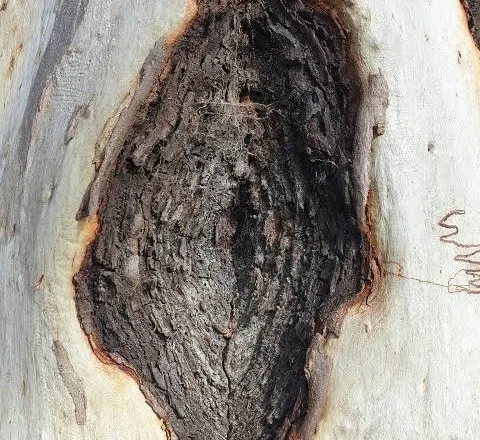
How cankers damage a tree
A canker kills the inner bark and the cambium, the thin growing layer just beneath it. The inner bark carries sugars from the leaves to the rest of the tree, and the cambium produces new wood and bark, so where a canker has killed them the tree can neither move sugars past that point nor grow over the damage. Once a canker circles a branch, the branch beyond it dies; once it circles the trunk, the whole tree above it dies. Large cankers on the trunk also weaken the wood, and dead branches above them can fall.
Types of tree cankers
There are three types of tree canker, annual, target and diffuse, and the shape shows whether the tree or the fungus is winning. Reading the shape is often enough to judge how serious a canker is, without knowing the exact fungus.
Annual canker
One dead patch, with callus rolling in from the edge. The tree has walled it off.
Target canker
Rings of callus, built up as the fungus breaks through each year and the tree walls it off again.
Diffuse canker
A spreading strip of dead bark with no defined edge. This is the type that girdles and kills branches.
How to identify a tree canker
The main sign of a canker is a sunken, cracked or discoloured patch of dead bark on a branch or trunk, often with dieback of the branch beyond it. Many cankers are hard to see from outside, so dieback on scattered branches is often the first thing noticed.
Signs and symptoms of tree cankers
On the bark
- Sunken dead patch
Bark that is darker, sunken or cracked, with a defined edge. - Callus ridges
Rolls of new bark around the edge, or concentric target rings. - Small black dots
Fruiting bodies erupting through the dead bark, sometimes in rows. - Gum or sap
Gum, kino or sap weeping from the edge of the lesion.
In the crown and wood
- Dieback beyond the canker
Branches dying from the canker outwards, often on scattered branches. - Dead leaves hanging on
Leaves that die and stay attached on affected branches. - Internal staining
A brown wedge or streak in the wood, running further than the dead bark outside.
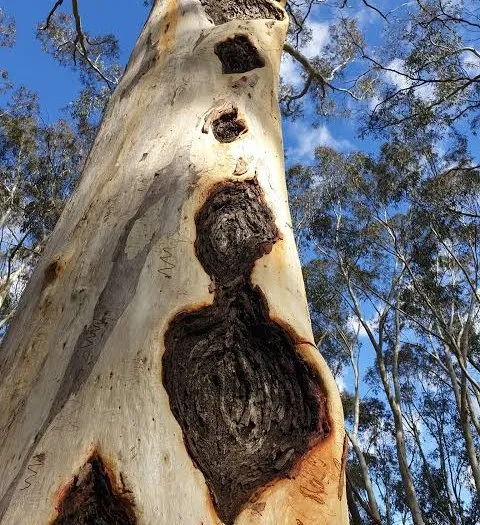
How to diagnose a tree canker
To diagnose a canker, the bark at the edge of the lesion is cut back to show the boundary between dead, discoloured tissue and healthy green wood, and the branch is often cut lengthwise to see how far the internal staining runs. This also separates a canker from look-alikes such as burls, galls and old wounds, which are living tissue, and a laboratory can identify the fungus from a sample of the margin.
What causes cankers on trees in South East Queensland?
Most cankers in South East Queensland trees are caused by fungi in the Botryosphaeriaceae family, which become harmful when a tree is stressed. Other causes include Phytophthora at the base of the trunk, sunscald and wounds that become infected, and, less often, bacteria.
| Cause | Trees most affected | What to know |
|---|---|---|
| Botryosphaeriaceae fungi | Eucalypts, macadamia, mango, figs, citrus, avocado and many others | The most common cause; triggered by drought and stress |
| Phytophthora collar canker | Macadamia, avocado and other susceptible trees on wet soil | Dark, weeping lesions at the base of the trunk |
| Sunscald and wounds | Thin-barked trees, suddenly exposed when a neighbour is removed | The bark dies from heat or damage, and fungi then enter |
| Bacterial cankers | Mainly fruit trees | Wet, sometimes foul-smelling lesions with ooze; uncommon on garden trees |
Why cankers appear after drought
Cankers often appear after a drought because the fungi behind them were already living harmlessly inside the tree, and stress is what switches them on. Fungi in the Botryosphaeriaceae live inside healthy bark and wood for years, and become aggressive when the tree is stressed, by drought, heat, root damage or compaction.
This explains why cankers and dieback seem to appear suddenly across a whole suburb after a hot, dry summer: nothing new has arrived; a fungus that was already there has become active in trees stressed at the same time. It also explains why the stress, not the fungus, is the real diagnosis, and why fixing it is the main treatment.
Suspect a canker on your tree? We can find the cause and tell you what needs cutting out.
Book a checkWhen cankers are most active in South East Queensland
In South East Queensland, cankers are most active after hot, dry spells, particularly when a dry summer follows a wet season that grew more canopy than the roots can now support. Dieback usually becomes visible during or soon after the stress, and the cankers themselves can keep extending until the tree’s condition improves.
How tree cankers spread
Tree cankers spread mainly by spores released from small fruiting bodies on dead cankered wood, which are carried by rain splash and wind into wounds on the same or nearby trees. Pruning tools and infected prunings left under a tree can carry them too.
But because the fungi behind most cankers already live inside healthy trees, a canker usually reflects the tree’s condition rather than infection from a neighbour. Fresh wounds, such as pruning cuts made in hot, dry weather, are where new cankers most often start.
How to treat tree cankers
Tree cankers are treated by correcting the stress that triggered them and pruning out cankered branches, within an integrated pest management (IPM) approach. Because the fungi are already inside the wood, sprays do not work; restoring the tree’s condition is what makes the fungus go quiet again.
Correcting the stress
Most effective
What it is
A cultural control: finding and fixing what has stressed the tree, most often drought, root damage or soil compaction.
How it works
The fungi behind most cankers live harmlessly inside healthy trees and only start causing damage when the tree is stressed. Deep watering in dry spells, mulching the root zone, and repairing or protecting damaged roots return the tree to a condition where the fungus goes quiet again.
Effectiveness
The most effective treatment, because it removes the trigger rather than the symptom. Without it, new cankers keep appearing however much is pruned out.
Pruning out cankered branches
Effective
What it is
Removing dead and cankered branches, cutting well back into healthy wood, to AS 4373.
How it works
The damage inside a branch usually runs further than the dead bark outside, so cuts are made beyond any internal staining: if the cut face is stained, the cut goes further back. Tools are cleaned between cuts and between trees, and pruning is best timed for when the tree is not water-stressed.
Effectiveness
Removes infected wood and the fruiting bodies on it. Heavy pruning of a drought-stressed tree in hot weather can make things worse, as it creates fresh wounds when the tree is least able to respond.
Removing infected prunings
Supporting
What it is
Taking cankered branches and prunings off site rather than leaving them under the tree.
How it works
Dead cankered wood carries the small black fruiting bodies that release spores. Leaving it beside the tree keeps a source of infection close to the wounds and stressed branches most likely to be infected.
Effectiveness
A simple support to pruning, most worthwhile in orchards and where several trees are affected.
Removing a girdled tree
Last resort
What it is
Removing a tree where a canker has girdled the main trunk, or where cankers have killed much of the crown.
How it works
A canker that circles the trunk cuts off the flow of water and sugars, and everything above it dies. Large cankers on the trunk can also weaken it structurally.
Effectiveness
Necessary where the trunk is girdled or the tree is no longer viable, and where dead wood creates a risk of falling branches.
Fungicides
Not effective
What it is
Spraying or injecting a fungicide to treat a cankered tree.
How it works
The fungi are already inside the wood, where most of them have lived for years before causing any damage, so a spray cannot reach them.
Effectiveness
Not effective on established trees. Fungicide protection of pruning wounds has been researched in horticulture, but on a garden tree it addresses neither the fungus already inside nor the stress that triggered it.
How to prevent tree cankers
Preventing cankers relies on keeping trees free of stress and wounds, so the fungi already inside them never get the chance to cause damage. Most of what prevents cankers is good basic tree care.
- Water deeply in long dry spells, particularly trees that put on heavy growth after a wet season.
- Mulch the root zone and protect it from compaction, trenching and construction damage.
- Prune correctly, to AS 4373, and avoid heavy pruning in hot, dry weather.
- Protect thin-barked trees from sudden sun exposure when neighbouring trees are removed.
Tree cankers: common questions
What is canker girdling in a tree?
Girdling is when a canker spreads all the way around a branch or trunk. The inner bark it kills carries sugars from the leaves to the roots, so once the ring is complete nothing can pass it: the roots below are starved and everything above the canker dies. A girdled branch is pruned off; a girdled trunk usually means the tree cannot be saved. Continue reading: how cankers damage a tree.
Are cankers caused by fungi?
Most are. In South East Queensland the usual cause is fungi in the Botryosphaeriaceae family, and other fungi, including Phytophthora at the base of the trunk, cause some too. Cankers can also start from sunscald, frost or physical wounds, and a few are caused by bacteria, though fungi often move into those wounds afterwards.
Can a tree recover from a canker?
Often, yes. Many trees wall off a canker and grow callus around it, especially once the stress that triggered it is fixed. A canker that circles the trunk is different: it cuts off the flow of water and sugars, and the tree above it will die.
Is a tree canker contagious?
Somewhat. Spores from fruiting bodies on dead cankered wood can infect wounds on the same or nearby trees, which is why prunings are removed and tools are cleaned. But the fungi behind most cankers already live inside healthy trees, so the main driver is stress, not spread from tree to tree.
Should I cut off a branch with a canker?
Yes, if the branch is dying or dead, cutting well back into healthy wood beyond any internal staining. Avoid heavy pruning of a drought-stressed tree in hot weather, as fresh wounds then make it worse, and fix the watering or root problem at the same time.
What causes cankers on trees?
Most cankers in South East Queensland are caused by fungi in the Botryosphaeriaceae family, which live harmlessly inside trees until stress, usually drought, heat, root damage or compaction, sets them off. Others come from Phytophthora at the base of the trunk, sunscald, wounds and, less often, bacteria.
Is a canker the same as a burl?
No. A canker is dead bark and wood, usually sunken, with a defined edge. A burl is a rounded swelling of living wood with wild grain, and it is not a disease. Cutting into it settles the question: living wood is a burl, dead and discoloured tissue is a canker.
Can you treat a tree canker with fungicide?
Not effectively on an established tree. The fungus is inside the wood, often for years before the canker appears, so sprays and injections do not reach it. Fixing the stress and pruning out dead wood are what work.
References
- Slippers, B., & Wingfield, M. J. (2007). Botryosphaeriaceae as endophytes and latent pathogens of woody plants: diversity, ecology and impact. Fungal Biology Reviews, 21, 90–106. Source
General information, not a diagnosis. Many tree problems look alike, and only an inspection, and sometimes a laboratory test, can confirm what is wrong. Any treatment product must be registered for the use and applied strictly to its label.