
Insects South East Queensland
Tree Galls: Identification and Treatment
Tree galls are abnormal growths the tree forms around insects, mites or other organisms living in its leaves, stems and buds, and in South East Queensland they are most common on eucalypts, citrus and figs. This guide shows you what tree galls are, how to identify galls on trees and how to treat tree galls.
- What it is
- Abnormal growths a tree forms around insects, mites or other organisms living inside it
- Scientific name
- Many insects and mites, including gall wasps, gall midges, scale insects and thrips
- Trees affected
- Eucalypts, citrus, figs, lilly pilly, melaleuca and lychee
- Peak season
- Most form on new growth in spring and summer
- How it spreads
- Adult insects and mites move to new growth; infested branches and plants carry them further
- Key sign
- Lumps, swellings, blisters or rolled leaves on leaves, buds or stems
- Found galls on your tree?
- We'll tell you what they are and if they need treating. Book a check →
What are tree galls?
Tree galls are abnormal growths, such as lumps, swellings, blisters or rolled leaves, that a tree forms in reaction to an insect, mite or other organism living in its tissue. They are caused by a wide range of agents, including tiny wasps, midges, scale insects, thrips, mites, bacteria and fungi, and on eucalypts they are most often caused by tiny wasps.
- InsectsGall wasps, midges, scale, thrips, psyllidsThe most common gall makers
- MitesErinose and gall mitesMicroscopic, causing blisters and felting
- OthersBacteria, fungi, nematodesLess common on garden trees
Source: Business Queensland, Gall-forming insects.
How galls affect a tree
Galls affect a tree by diverting its growth into the swelling that shelters and feeds the gall maker. Most leaf galls are cosmetic, but in high numbers galls reduce photosynthesis, kill buds, distort new shoots and cause leaves to drop, and woody stem galls such as citrus gall wasp weaken branches and reduce fruit.
Types of galls on trees
The galls on South East Queensland trees fall into a few main types by what causes them: gall wasps, gall midges, gall-forming scale insects, thrips and mites. Each type tends to form on particular trees, which makes the host the quickest clue.
| Gall maker | What the gall looks like | Main trees | How serious |
|---|---|---|---|
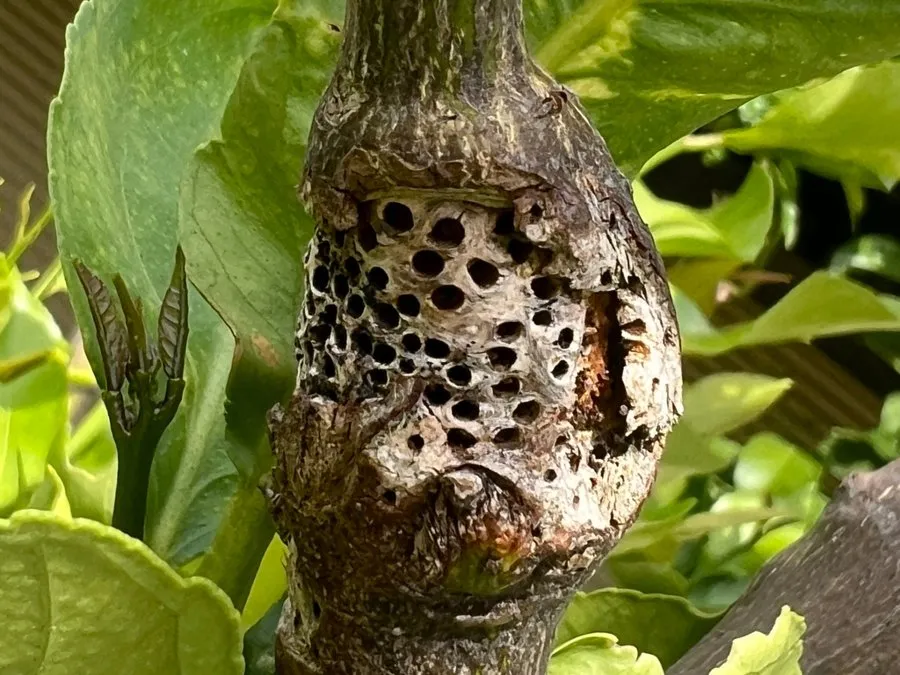
| Citrus gall wasp (Bruchophagus fellis) | Lumpy, woody swellings on stems, later full of small holes | Lemon, grapefruit and other citrus; native finger lime | Weakens trees, reduces fruit size and yield, can cause dieback |
| Eucalypt gall wasps (Ophelimus, over 50 species) | Round, fleshy galls up to 20 mm, or raised plate-like galls on leaves | Eucalypts | Usually minor; severe on some young trees |
| Gall midges | Thickened, shortened leaflets on buds | Rose gum (Blair’s gall midge); melaleuca (Lophodiplosis) | Infested buds die; trees usually grow through it |
| Gall-forming scale (Apiomorpha) | Large, often spectacular galls made by the females; small tubular galls made by the males | Eucalypts only | Usually minor |
| Leaf-galling thrips (Gynaikothrips ficorum) | New leaves folded or rolled tightly along the midrib | Hills fig and Indian laurel fig (Ficus microcarpa) | Mostly cosmetic |
| Erinose mites | Raised yellow to red blisters, or velvety brown felt under the leaf | Spotted gum (Rhombacus, Acalox); lychee (Aceria litchii) | Heavy blisters cause leaf drop on young spotted gums; serious on lychee flowers and fruit |
| Lilly pilly psyllid | Pimples on new leaves, with pits underneath | Lilly pilly | Mostly cosmetic |
Sources: Business Queensland, Gall-forming insects, Erinose mites and Lychee erinose mite; Agriculture Victoria, Citrus gall wasp; Tree and Walter (2009); Invertebrate Systematics, 30(3).
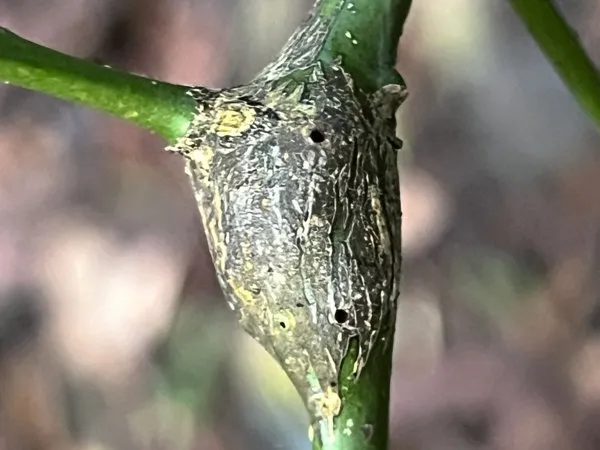
Citrus gall wasp
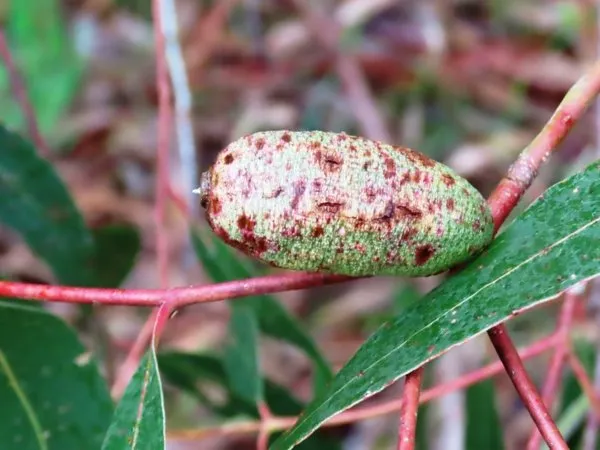
Gum gall scale
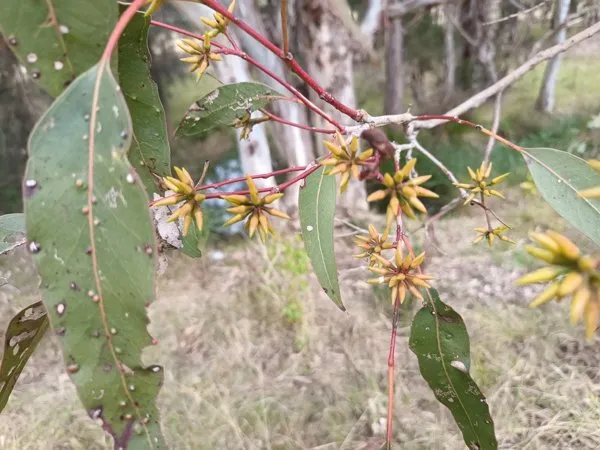
Eucalypt gall wasp
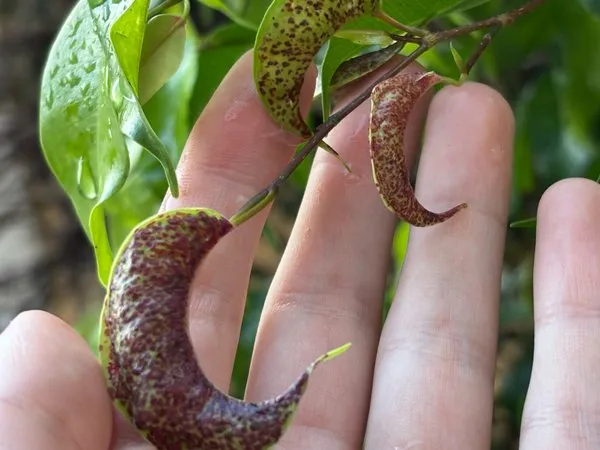
Fig leaf thrips
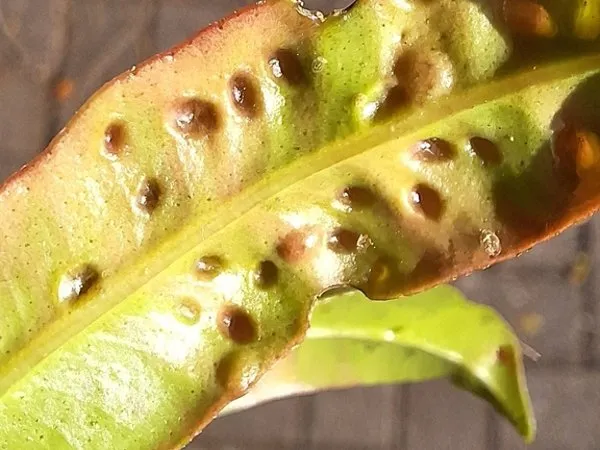
Lilly pilly psyllid
How to identify tree galls
The main sign of tree galls is lumps, swellings, blisters or rolled leaves that are part of the plant itself, usually on new leaves, buds or young stems. Unlike scale insects or lerps, a gall cannot be flicked off, because it is the tree’s own tissue.
Signs and symptoms of tree galls
Early signs
- Lumps on leaves
Round, fleshy or blister-like bumps on young leaves. - Swollen stems
Woody swellings forming on green citrus stems. - Rolled new leaves
Fig leaves folding tightly along the midrib.
Advanced damage
- Galls with exit holes
Small holes where the adults have emerged. - Dead buds and tips
Galled buds turning brown and dying. - Leaf drop and weak branches
Heavily galled leaves shed early; galled citrus stems weaken and die back.
How to diagnose tree galls
To diagnose a gall, check that the lump is part of the leaf or stem rather than sitting on it: a gall cannot be scraped or flicked off, while scale insects and lerps can. Cut one open: a larva or a cavity inside confirms an insect gall, and exit holes mean the insects have already left. Felty or blistered patches with nothing visible inside are usually microscopic mites.
What trees get galls?
Galls are found on many trees, but in South East Queensland they are most common on eucalypts, citrus and figs, with lilly pilly, melaleuca and lychee also often affected. Most gall makers attack only one tree or a small group of related trees, so the host often identifies the gall.
- Eucalypts – gall wasps, gall midges, gall-forming scale and erinose mites.
- Citrus – citrus gall wasp, especially on lemons and grapefruit.
- Figs – leaf-galling thrips on Hills fig and Indian laurel fig hedges.
- Lilly pilly – the lilly pilly psyllid’s pimples.
- Melaleuca – gall midges.
- Lychee – lychee erinose mite.
Suspect galls on your tree? We can tell you what they are and if they need treating.
Book a checkWhen galls form in South East Queensland
In South East Queensland, most galls form on new growth in spring and summer, when gall makers lay their eggs in soft leaves, buds and young stems. A Brisbane study found leaf-galling thrips forming galls on figs almost continuously through spring and summer.
Citrus gall wasp follows a yearly cycle: the adults emerge from old galls in spring and lay their eggs under the green bark of new growth, and the larvae feed in the stem for about 9 to 10 months while the gall swells around them.
Sources: Tree and Walter (2009); Agriculture Victoria, Citrus gall wasp.
How galls spread
Galls spread as the adult insects and mites move to new growth on the same tree or nearby trees, and further on infested plants and prunings. Each gall maker needs its own host, so galls spread between trees of the same kind rather than across a whole garden.
- Flying adults – gall wasps, midges and thrips fly to nearby new growth.
- Infested prunings – citrus gall wasps can still emerge from cut branches left lying around.
- Nursery plants – mites and gall insects travel on infested plants; lychee erinose mite also spreads on wind and bees.
How to treat tree galls
Tree galls are treated by cutting off galled growth before the insects emerge and keeping the tree healthy, within an integrated pest management (IPM) approach. Most leaf galls on established trees need no treatment at all, and sprays rarely work because the gall protects the insects inside.
Pruning out galls before emergence
Most effective
What it is
A physical control: cutting off galled shoots, stems or leaves while the insects are still inside, and destroying them.
How it works
Removing galls before the adults emerge removes the next generation. For citrus gall wasp, Agriculture Victoria advises pruning galls out from April to June, before the spring emergence. Once exit holes appear, the insects have gone and removal is too late to help.
Effectiveness
The main control for citrus gall wasp and for galls on small trees and hedges. Bag or burn the prunings, as wasps can still emerge from cut branches.
Keeping the tree healthy
Effective
What it is
A cultural control: watering in dry periods, mulching and feeding appropriately.
How it works
Business Queensland notes that ensuring the general health of trees reduces the effect of galls, and that fertiliser, mulch and watering in dry periods can help. A vigorous tree grows through gall damage to buds and leaves.
Effectiveness
The simplest way to make most galls a cosmetic problem rather than a growth problem.
Timing pruning and feeding on citrus
Supporting
What it is
A cultural control: avoiding late-winter pruning and heavy feeding that push out soft spring growth when citrus gall wasps are laying.
How it works
The wasps lay their eggs in new green growth in spring. Agriculture Victoria warns that pruning in winter beyond June makes the tree grow vigorously in spring, giving the wasps more to lay in.
Effectiveness
Reduces how many new galls form each year, alongside pruning out the old ones.
Natural enemies
Supporting
What it is
A biological control: the parasitic wasps and predators that attack gall makers.
How it works
Gall insect numbers are likely kept down by parasitic wasps. In its native range around the Queensland–NSW border, citrus gall wasp is held in check by parasitic wasps that have not followed it south in large numbers, and predators such as lacewing larvae attack leaf-galling thrips. Broad-spectrum sprays kill these natural enemies.
Effectiveness
Part of why galls are usually a minor problem in South East Queensland. Avoiding unnecessary sprays keeps it working.
Insecticides and miticides
Last resort
What it is
A chemical control: a product registered for the gall maker on that tree.
How it works
Business Queensland notes that chemical control of gall-forming insects is usually ineffective, because the insects are protected inside the gall. The exception is lychee erinose mite on fruiting lychees, where a registered miticide program on each new flush is used. Any product must be registered for the use and applied to its label.
Effectiveness
Rarely worthwhile on garden and street trees, and it kills the natural enemies that keep galls in check.
How to prevent tree galls
Preventing tree galls relies on clean planting material, healthy trees and removing galls before the insects emerge. Galls cannot be kept out of a garden entirely, but they can be kept to a level that does no harm.
- Check new plants for galls, blisters and felting before planting, especially citrus and lychee.
- Prune out citrus galls in autumn, before the spring emergence, and bag or burn them.
- Avoid late-winter pruning and heavy feeding of citrus.
- Water and mulch trees through dry spells.
- Avoid broad-spectrum sprays, which kill the parasitic wasps and predators that control gall makers.
Tree galls: common questions
What are the lumps on my gum tree leaves?
Round or blister-like lumps on gum leaves are usually galls, formed by the tree around tiny wasps, midges, psyllids or mites living in the leaf. Business Queensland notes that leaf galls on eucalypts generally do no significant damage to the tree unless they are in very high numbers.
What are the woody lumps on my lemon tree branches?
Lumpy, woody swellings on lemon, grapefruit or other citrus stems are almost always citrus gall wasp. The native wasp lays its eggs under the green bark, and the tree forms the gall around the larvae. Small holes in the gall mean the wasps have already flown; galls without holes still hold larvae.
Are galls harmful to trees?
Most are not. Galls on the leaves of established trees are usually cosmetic. The ones worth acting on are citrus gall wasp, which weakens trees and cuts fruit yield, and galls in high numbers on young trees, which can stunt growth, kill buds or strip leaves.
Why are the leaves on my fig hedge rolled and curled?
Tightly rolled or folded new leaves on a Hills fig or Indian laurel fig (Ficus microcarpa) hedge are usually leaf galls made by thrips. A Brisbane study found the thrips Gynaikothrips ficorum galls these figs almost continuously through spring and summer, with each gall lasting about four weeks. The damage is mostly cosmetic.
How do I get rid of galls on my tree?
For most galls, cut off and destroy galled leaves or shoots when they first appear, before the insects emerge, and keep the tree healthy. Sprays rarely work, because the insects are protected inside the gall. Citrus gall wasp needs the galls pruned out before the wasps emerge in spring.
When should I prune citrus gall wasp?
Prune out galls before the adult wasps emerge in spring. Agriculture Victoria recommends April to June, and warns that pruning later in winter makes the tree flush vigorously in spring, giving the wasps fresh growth to lay in. Bag or burn the prunings so the wasps cannot emerge from them.
References
- Business Queensland. Gall-forming insects. Source
- Business Queensland. Erinose mites. Source
- Business Queensland. Lychee erinose mite (Aceria litchii). Source
- Agriculture Victoria. Citrus gall wasp. Source
- Primary Industries and Regions SA. Citrus gall wasp. Source
- Tree, D. J., & Walter, G. H. (2009). Gynaikothrips leaf-galling thrips on Ficus in south-east Queensland. Australian Journal of Entomology. Source
- University of California IPM. Cuban laurel thrips. Source
- Two recently discovered species of Apiomorpha (Hemiptera: Eriococcidae). Invertebrate Systematics, 30(3). Source
General information, not a diagnosis. Many tree problems look alike, and only an inspection, and sometimes a laboratory test, can confirm what is wrong. Any treatment product must be registered for the use and applied strictly to its label.