
Decay fungi South East Queensland
Tree Fungus: Wood Decay Fungi, Rot and What to Do
Fungus on a tree is the visible sign of wood decay fungi rotting the wood inside, and in South East Queensland's warm, wet climate it is common on large, old and wounded trees. This guide shows you what tree fungus does, how to identify dangerous fungus on a tree and what to do about tree rot.
- What it is
- Fungi that rot the wood inside a tree
- Scientific name
- Various, including Ganoderma and Laetiporus
- Trees affected
- Any tree, especially large, old or wounded trees, including eucalypts and figs
- Peak season
- Fruiting bodies appear after rain, mostly in summer and autumn
- How it spreads
- Airborne spores entering wounds, and root contact for some root rots
- Key sign
- Brackets, crusts or mushrooms growing from the trunk, base or roots
- Found fungus on your tree?
- We'll tell you if it's serious, and if the tree is safe. Book a check →
What are wood decay fungi?
Wood decay fungi, also called wood-rotting fungi, are the fungi that grow inside a tree and rot its wood, breaking down the material that gives the trunk, roots and branches their strength. The tree fungus you see on the outside, a bracket, crust or mushroom, is only their fruiting body: by the time it appears, the fungus has usually been decaying the wood inside for years.
How decay fungi damage a tree
Most decay fungi feed on the dead heartwood at the centre of the trunk and roots, so the tree can stay green and healthy while it is weakened from within. The damage is structural, and it starts early: in laboratory studies, wood lost almost all its toughness, its ability to withstand a sudden load such as a gust of wind, before it had lost even 10% of its weight to decay. Decay that can be seen is therefore well advanced.
Brown rot, white rot and soft rot in wood
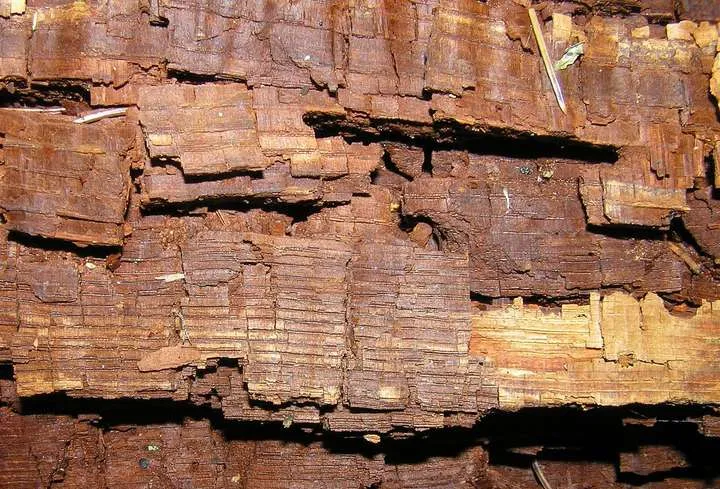
Wood decay comes in three types, brown rot, white rot and soft rot, which differ in what they eat and in how the decayed wood breaks. The type matters, because brown rot makes wood brittle far sooner than white rot. Brown rot is a type of decay, not the same thing as brown root rot, which is a specific root disease.
| Rot type | What it eats | What the wood looks like | What it does to strength |
|---|---|---|---|
| Brown rot | Cellulose, leaving the lignin | Brown, cracking across the grain into cubes, crumbling dry | Drops fast and early; failure is brittle |
| White rot | Cellulose and lignin | Pale and bleached, often with dark lines, spongy or stringy | Drops more gradually, though toughness goes sooner |
| Soft rot | Cellulose, in constantly wet wood | Soft and cheesy when wet, usually shallow | Mainly a surface problem, at wet bases and in cavities |
Sources: Australian National Botanic Gardens, Fungi: wood rots; Wilcox (1978), Wood and Fiber 9.
How to identify decay fungi on a tree
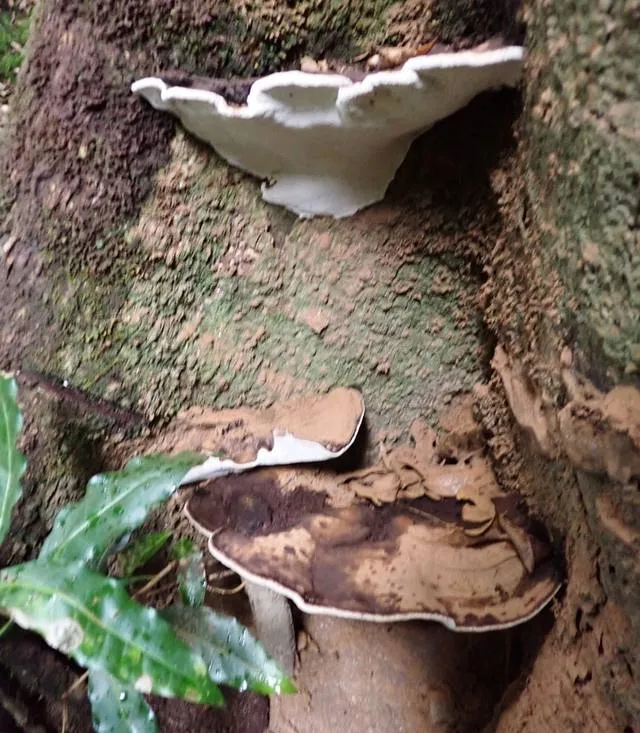
The main sign of decay fungi is a bracket, crust or mushroom growing out of the trunk, the base or the roots of a living tree. Fungus growing from the soil, mulch or dead wood nearby is usually harmless, so the first question is always what the fungus is growing from.
Signs and symptoms of decay fungi
Worth getting checked
- Brackets on the trunk or base
Shelf-like fruiting bodies growing from living wood, most seriously at the base or on buttress roots. - Crusts at the base
Flat, hard or charcoal-like crusts on the trunk base or roots, easily mistaken for fire damage. - Rusty-brown dust
Spores settling on the bark, ground or cars beneath, often visible before the bracket itself. - Cavities and soft wood
Hollows, open wounds or wood that crumbles, alongside any fungus.
Usually harmless
- Mushrooms in mulch or lawn
Living on the mulch or buried wood, or partnering with the tree’s roots. - Fungus on rotting wood
Brackets on stumps, fallen branches or dead stubs are recycling dead material, not attacking the tree. - Stinkhorns and slime moulds
Alarming to look at, but living in the mulch, not the tree. - Lichens on bark
Grey, green or orange patches on the bark surface, which do not harm the tree.
How to diagnose decay in a tree
To diagnose decay in a tree, an arborist identifies the fungus where possible, then measures the decay rather than judging it by eye, using drilling resistance or sonic tomography to map how much sound wood remains. The location matters as much as the fungus: decay in the base and roots is the most serious, because that is what holds the tree up.
Which decay fungi are found in South East Queensland trees?
The decay fungi that matter most in South East Queensland trees are Ganoderma and brown root rot at the base and roots, and white punk and other brown-rot brackets on eucalypt trunks. Many other fungi found on trees are recycling dead wood and pose little risk.
| Fungus | Rot type | Where on the tree | Risk |
|---|---|---|---|
| Ganoderma (Ganoderma australe and relatives) | White rot | Base, buttress and roots of living trees | High: decays the wood that holds the tree up |
| Brown root rot (Pyrrhoderma noxium) | White rot | Roots and base, with a brown crust or stocking | High: kills the tree and spreads to neighbouring trees |
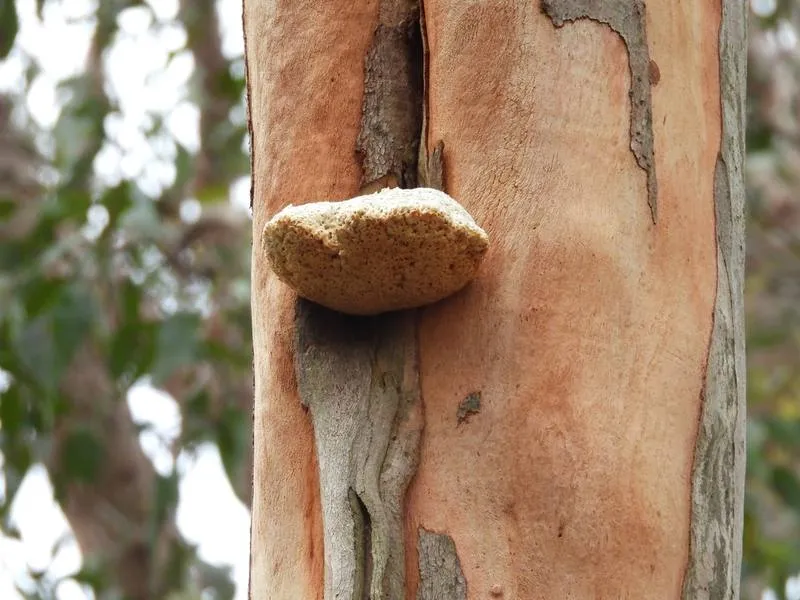
| White punk (Laetiporus portentosus) | Brown rot | Trunks of living eucalypts | High: brown rot makes wood brittle early |
| Fomitopsis brackets | Brown rot | Living and dead wood | Moderate to high on living trunks and limbs |
| Orange bracket (Trametes coccinea) | White rot | Dead wood and stubs | Low: recycling dead wood |
| Split gill (Schizophyllum commune) | White rot | Dead and damaged wood | Low: usually a sign the wood is already dead |
Sources: Business Queensland, Brown root rot; Australian National Botanic Gardens, Fungi: wood rots.
Suspect fungus or rot in your tree? We can identify it and tell you if the tree is safe.
Book a checkAre trees with fungus dangerous?
A tree with fungus can be dangerous, because the decay weakens it from the inside while it still looks healthy. How dangerous depends on where the decay is and how much sound wood remains, and neither can be judged from the outside.
Decay at the base or in the roots, brown rot anywhere in the trunk, and a large tree over a house, road or play area are the findings that raise the risk most. A widely used guideline treats a trunk as high risk once the sound shell of wood around the decay is thinner than about 30% of the trunk’s radius. Measuring that needs an AQF Level 5 arborist with decay detection equipment, as part of a tree risk assessment.
When decay fungi appear in South East Queensland
In South East Queensland, the fruiting bodies of decay fungi mostly appear after rain, particularly through the warm, wet summer and autumn. The decay itself works year-round inside the tree, so a bracket that appears after rain usually marks decay that has been developing for years.
Some brackets are perennial and stay on the tree for years, adding a new layer each season; others are soft and short-lived, lasting only days or weeks. A short-lived fungus that has disappeared has not taken the decay with it.
How decay fungi spread
Decay fungi spread mainly by airborne spores, which infect a tree through wounds that expose the wood. Pruning cuts, storm damage, root damage from trenching or construction, and mower wounds at the base are the usual entry points.
Some root rots also spread underground, from tree to tree through root contact. The most serious in South East Queensland is brown root rot, which has its own guide.
How to treat fungus on a tree
Fungus on a tree is treated by managing the risk the decay creates, not by curing the decay, which no treatment can reach. Within an integrated pest management (IPM) approach, that means an assessment of how much sound wood remains, followed by crown reduction, monitoring or removal.
Tree risk assessment
Essential
What it is
An assessment by an arborist of how much sound wood remains, where the decay is, and what the tree could hit if it failed.
How it works
Decay is measured rather than judged by eye: drilling resistance and sonic tomography map the extent of the decay and the thickness of sound wood around it. The findings are weighed against the decay’s location, the type of rot and the targets beneath the tree.
Effectiveness
The essential first step. Every other decision, from leaving the tree alone to removing it, depends on what the assessment finds.
Crown reduction
Effective
What it is
A cultural control: reducing the height and spread of the crown, or of a single decayed limb, to AS 4373.
How it works
Wind load on a tree rises with the size of its crown and the length of its branches. Reducing the crown lowers the force acting on the decayed section, so a weakened trunk or limb carries less load in a storm.
Effectiveness
Can allow a tree with moderate decay to be retained safely, where the assessment shows enough sound wood remains. It does not stop the decay, so the tree still needs monitoring.
Monitoring
Ongoing
What it is
Re-inspecting a decayed tree at set intervals.
How it works
Decay continues after it is found, so a tree retained with decay is reassessed regularly, and after major storms, to check whether the decay has advanced or new fruiting bodies have appeared.
Effectiveness
Turns a one-off decision into managed risk. The interval depends on how advanced the decay is and what lies beneath the tree.
Protecting the root zone
Supporting
What it is
A cultural control: keeping the root zone free of compaction, trenching, soil level changes and mower damage.
How it works
Healthy trees wall off decay more effectively than stressed ones. Root and trunk wounds are also the main entry points for root and butt rot fungi, the most dangerous group.
Effectiveness
Slows the spread of decay already present and lowers the chance of new infection. It cannot reverse decay.
Tree removal
Last resort
What it is
Removing a tree whose decay makes it unsafe to retain.
How it works
Where too little sound wood remains, or the decay is in the roots or base under a valuable target, removal is the only way to remove the risk.
Effectiveness
Removes the risk entirely. For root rots such as brown root rot, the stump and roots also need removing, as they can infect nearby trees.
Removing the fungus or spraying
Not effective
What it is
Knocking off the brackets or mushrooms, or treating the tree with a fungicide.
How it works
The bracket is only the fruiting body. The fungus itself lives inside the wood, where neither cutting nor spraying can reach it.
Effectiveness
Does nothing to the decay. Removing brackets also removes the evidence an arborist uses to identify the fungus, so leave them in place until the tree has been assessed.
How to prevent decay fungi in trees
Preventing decay relies mainly on avoiding the wounds that let decay fungi in, and keeping trees healthy enough to wall off any infection. Most serious decay starts at a wound that could have been avoided.
- Prune correctly, to AS 4373, cutting at the branch collar rather than flush with the trunk or leaving stubs.
- Protect the roots from trenching, soil level changes, compaction and construction damage.
- Keep mowers and trimmers away from the trunk base, using a mulched ring.
- Have storm damage cleaned up promptly, so torn limbs are cut back to sound wood.
Is fungus at the base of your tree a problem?
Fungus at the base of a tree is the most serious place to find it, because decay there weakens the roots and lower trunk that hold the whole tree up. It is also where decay is hardest to judge, since much of it can be below ground.
- Growing from the trunk or roots – a bracket, crust or cluster of mushrooms growing out of the wood needs assessing.
- Growing from the soil nearby – mushrooms a metre or more from the trunk may be on buried roots, or harmless in the soil.
- In mulch or lawn – fungi in mulch or lawn are usually living on the mulch, and are not a sign of decay in the tree.
Where fungus is growing from the base or roots of a large tree near a house, road or play area, have it assessed rather than waiting for it to grow.
Tree fungus: common questions
Is fungus on a tree bad?
It depends on what it is growing from. A bracket or crust growing out of living wood, especially at the base or on the roots, means the wood inside is decaying and the tree needs assessing. Mushrooms in the mulch or lawn beneath a tree are usually living on the mulch or partnering with the roots, and are harmless.
Mushrooms growing on my tree: what should I do?
First, work out what the mushrooms are growing from. If they are coming out of the trunk, the base or the roots, photograph them, note where they are and leave them in place, because an arborist uses them to identify the fungus. Then have the tree assessed, sooner if it is large, near a house, road or play area, or if it is leaning, cracking or lifting at the base. If they are growing from mulch, lawn or a dead stump nearby, they are usually harmless.
What causes tree rot?
Tree rot is caused by wood decay fungi, which enter through wounds such as pruning cuts, storm damage, root damage and mower wounds, then slowly rot the wood inside. Some rots start in the roots instead, such as brown root rot and phytophthora root rot. Avoiding wounds and protecting the roots are the best defences.
Should I remove fungus growing on my tree?
No. The bracket is only the fruiting body; the fungus lives inside the wood, so knocking it off does nothing to the decay. Leave it in place, because an arborist uses it to identify the fungus and judge how serious the decay is.
Will a tree with fungus die?
Not necessarily. Most decay fungi rot the dead heartwood rather than the living tissue, so the tree can keep growing for many years. The real risk is structural: decay weakens the trunk, roots or limbs, so the tree can break or fall while it still looks healthy. Root rots such as brown root rot are the exception, and can kill the tree.
Can fungus on a tree be treated?
The decay itself cannot be cured, because no treatment reaches the fungus inside the wood. What can be managed is the risk: an assessment measures how much sound wood remains, and crown reduction, monitoring or removal follow from what it finds.
Are mushrooms at the base of a tree dangerous?
Mushrooms or brackets growing from the base of the trunk or the roots are the most serious place to find fungus, because decay there weakens the part of the tree that holds it up. Mushrooms growing from the soil or mulch nearby may be harmless. An arborist can tell which, often by tracing what the fungus is growing from.
Does fungus mean a tree has to be removed?
No. Many trees with decay are retained safely for years, with crown reduction and regular monitoring. Removal depends on how much sound wood remains, where the decay is, and what the tree could hit, which is what a tree risk assessment establishes.
References
- Australian National Botanic Gardens. Fungi: wood rots. Source
- Business Queensland. Brown root rot. Queensland Government. Source
- Mattheck, C., & Breloer, H. (1994). The Body Language of Trees: A Handbook for Failure Analysis. HMSO, London.
- Wilcox, W. W. (1978). Review of literature on the effects of early stages of decay on wood strength. Wood and Fiber, 9(4). Source
General information, not a diagnosis. Many tree problems look alike, and only an inspection, and sometimes a laboratory test, can confirm what is wrong. Any treatment product must be registered for the use and applied strictly to its label.